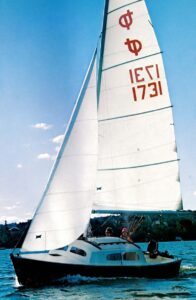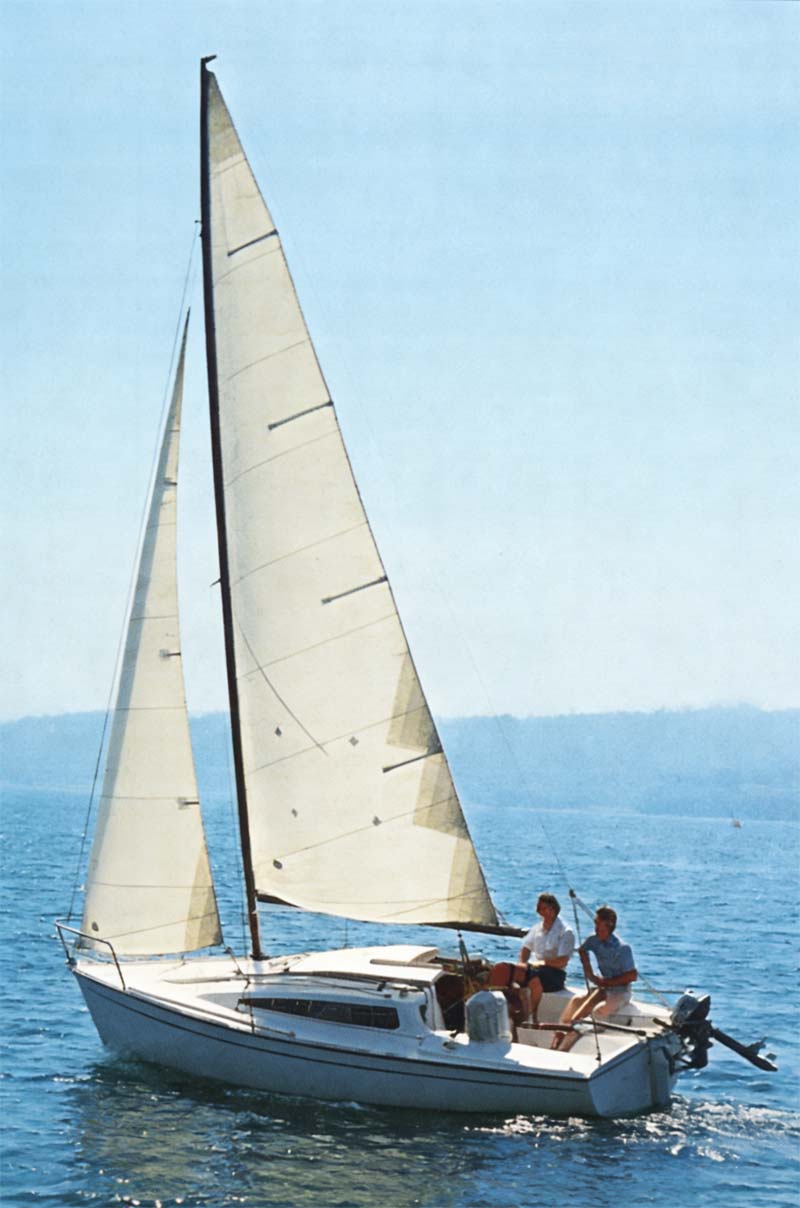
The South Coast 22 was developed by South Coast Yachts as a fresh 6.7-metre trailer yacht that combined strong sailing performance with practical accommodation. Builder Rudy Waalkins believed he had a winning formula by engaging five-time world champion skiff sailor Iain Murray to design the hull and rig, while South Coast Yachts focused on the interior layout and collaborated on the deck design. The result was intended to appeal not only to experienced sailors, but also to buyers more interested in comfort and cruising.
The yacht carried its maximum beam of 2.49 metres slightly aft of amidships, narrowing again toward a straight transom rather than following a wedge-shaped hull form. Its cockpit was spacious and included two generous storage lockers, one designed for the fuel tank and another large enough to hold sails.
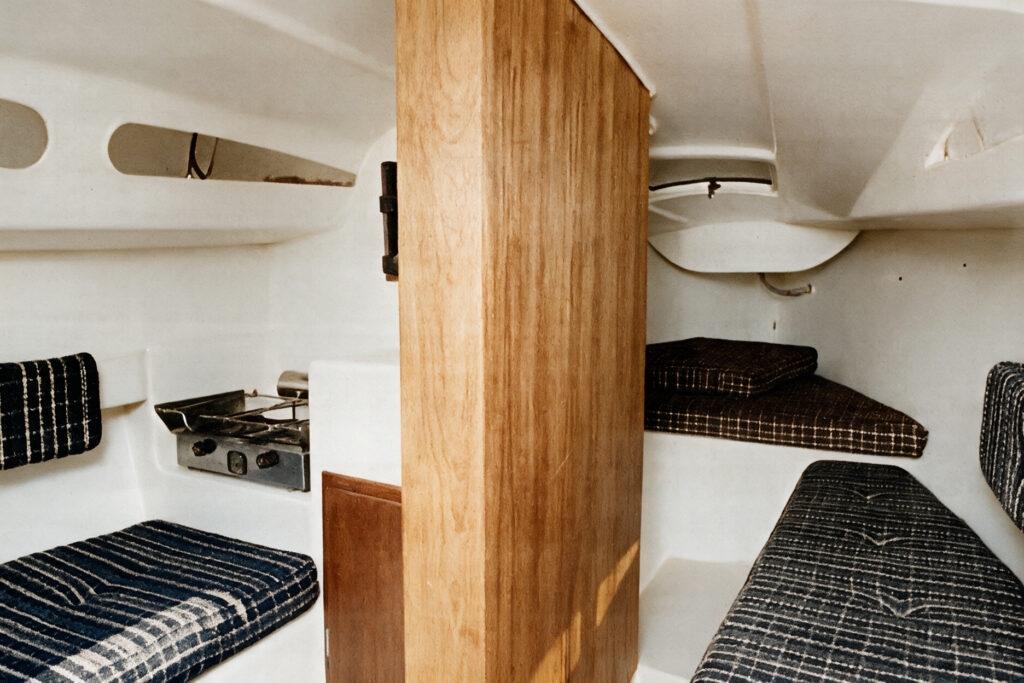
A pop-top cabin hatch provided standing headroom of about 1.83 metres when raised, while still allowing around 1.5 metres of clearance when closed. Inside, the layout was arranged with three permanent berths and additional space in the bow suitable for children, giving a theoretical sleeping capacity of five. To port was a settee berth alongside a combined sink and stove module positioned athwartships against the centreboard case, creating a recessed galley area. The test vessel featured a two-burner methylated-spirit stove and sink. Although there was insufficient standing room in this section, cooking while seated on the berth was considered comfortable enough.
A chemical toilet was tucked behind the galley in a separate area, with a vee-berth located further forward. On the starboard side were two full-length berths, one extending beneath the cockpit. Cushioned seating and raised backrests allowed occupants to sit comfortably inside the cabin without hitting the deckhead. Because the centreboard case extended the full cabin height, it effectively divided the accommodation into two distinct living areas while also discreetly separating the toilet from the main saloon.
The centreboard itself was a hollow fibreglass daggerboard containing internal lead ballast. It operated through a concealed pulley-and-tackle arrangement led aft to a jam cleat. Raising the board required more effort than many sailors might comfortably manage manually, though the system could be assisted using the Barlow 16 genoa winch if needed. Access to the lifting mechanism was available through two removable screws in the cabin roof. Draft measured 1.47 metres with the board lowered and only 0.25 metres when raised. The rudder attached through conventional pintles and featured a trip-release mechanism using a ball-and-socket arrangement with internal pulleys so it could disengage safely if the yacht struck an object or grounded (Davidson, 1980, pp. 27-29).
On the test sail Davidson (1980) said: “The day we sailed the South Coast 22 was very light – barely 5 knots – so this section can only be regarded as an impression. Sailing in these conditions was effortless. The boat was very responsive to the helm; sailing to windward it was easy to keep the boat pointing as high as the wind would allow, and under spinnaker she was easy to manage and forgiving of the odd lapse of concentration on the tiller. We would like very much to sail the South Coast 22 in more telling conditions, as the wind was so light and everything so effortless there was no chance to discover if she had any foibles. I suspect she would be tender in a stiffer breeze, as the hull sections are soft. The layout of the cockpit and the ease of spilling wind by hauling back the masthead suggest the South Coast is designed to sail flat in a blow” (Davidson, 1980, p. 29).
Power came from a long-shaft 3.5 kW (5 hp) Suzuki outboard motor, which appeared more than capable of driving the yacht effectively. The boat itself weighed 1081 kg, and with the 470 kg trailer included, total towing weight came to approximately 1550 kg depending on onboard equipment. In 1980, a reasonably complete package was priced at about $12,000.
Specifications
| LOA | 6.7m | Draft Keel Up | 0.25m |
| LWL | 6.24m | Draft Keel Down | 1.47m |
| Beam | 2.48m | Sail Area | 12.88 sq.m. |
| Displacement | 1081kg |
Source: Davidson, ‘South Coast 22: AUSTRALIAN BOATING TEST NO. 158’, Australian Boating, November, 1980, pp. 27-30. Historical photograph reproduced for identification and historical research purposes. Copyright remains with the original rights holder.
“This wide angle shot of the SC22’s interior [below] makes it look more spacious than it is, however it is spacious. Centreboard case provides a bulkhead effectively separating the galley” (Davidson, 1980, p. 30).
See also, John Crawford Marine, South Coast 22: https://www.johncrawfordmarine.com.au/advice/trailer-sailer/south-coast-22
Historical photograph reproduced for identification and historical research purposes. Copyright remains with the original rights holder.
Quick tip: Keep in mind that trailer sailers can vary quite a bit, even within the same class. Take the RL28, for example: they might not all have outboard wells as designed. Some originally may have had inboard engines, and when those were removed, the owners swapped them for a standard outboard mounted on the stern.