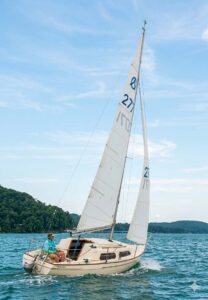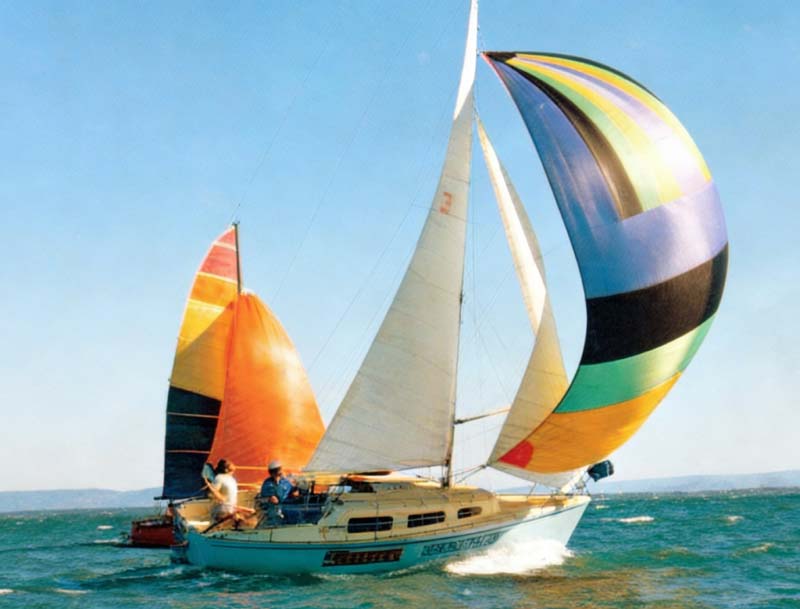
The Sabre 22 was a trailer sailer originally designed/built by Allan Scott in New Zealand. In Australia, it was built initially by Sabre Yachts Australia Pty. Ltd. in Clontarf, Queensland. Later on, the moulds were acquired by Maurie Perry of Noelex Yachts in South Australia.
The evolution of the Sabre 22 trailer sailer spanned three distinct iterations: the MKI, MKII, and MKIII. While they share the same 2.45-metre beam and hull shape, the variations introduced major improvements to the keel mechanism, pop-top cabin design, and windward performance. More detail on the changes can be found on (Trailer Sailer Place forum, 2009). If you are looking at a specific boat and trying to identify its mark, knowing the number of keel turns or checking the pop-top struts is the fastest way to confirm. MKI is 200 turns, MKII is 100 turns and the MKIII is 50 turns. The displacement of the MKI is 952kg and the MKII is heavier at 1050kg. The weight on trailer of the MKI is listed as 1338kg while the MKII is 1550kg based on the publications at John Crawford Marine Library.
The MKI features a 36% ballast ratio, achieved by moulding 341 kg of lead directly into the leading edge of its swing keel. When the keel is raised, the boat draws just 0.36 metres, increasing to 1.37 metres when fully lowered. For its sail plan, the Sabre 22 utilizes a three-quarter sloop rig with a 13.8 sq. m. mainsail and a 7.9 sq. m. jib, supported by a mast that stands 9.5 metres above the waterline.
The design of the Sabre 22 offers excellent initial stability. Its distinctively wide stern, solid displacement, and firm bilges work together to keep the boat remarkably level, even at slight angles of heel.
Below deck, the interior is well-suited for a small family. While it can accommodate five people for a single night or four over a long weekend, it is realistically at its best as a comfortable four-berth cruiser for two adults and two children. The main cabin features facing port and starboard settee berths alongside a forward-port galley. This kitchen space is equipped with a deep sink connected to a 90-litre water tank hidden under the V-berth, space for a gas stove, and a clever drop-leaf table attached to the centerboard case for meal prep. For cold storage, an esky can be tucked under the cockpit, though access is tight when the table is set up. Finally, the toilet is tucked away on the port side, just forward of the galley under the V-berth (Australian Boating, pp. 150-151).
The Sabre 22 has a large, well-protected cockpit with a transom cut-out that allows for efficient self-draining and makes boarding from a dinghy or the beach much easier. However, because the hull is so wide, shorter crew members might struggle to brace their feet against the opposite seat when the boat is leaning over-a minor downside for a family cruiser.
Storage is good on the port side with a cockpit locker large enough for sails, fenders, and rigging lines. While the side decks are somewhat tight near the back of the cabin, they open up as you move forward. Up front, the foredeck is compact but kept clear of clutter, featuring a well-proportioned, self-draining anchor locker built right into the bow (Australian Boating, pp. 152).
One of the options for the Sabre 22 was the Volvo Penta 50S, a diesel sail-drive unit that sparks a debate. On the positive side, an inboard diesel offers long-term reliability compared to an outboard and effortlessly handles the power demands of electronics and navigation lights. The propeller sits deeply enough in the water to prevent cavitation, even with multiple crew members sitting on the bow. On the downside, this depth becomes a liability in shallow water; with the keel and rudder raised, the exposed propeller becomes the lowest point of the hull. Additionally, while diesel is a much safer fuel to carry than petrol, the unit added significant cost to the boat.
When it comes to handling on land, the Sabre 22 proves surprisingly easy to launch and retrieve despite its heavy build and stub-keel draft. It can be powered directly onto its custom Tinka trailer while keeping the trailer axles completely out of the water. Stepping the rig is equally straightforward thanks to a proven, single-handed mast-raising system. The mast simply pivots aft into a transom-mounted A-frame, slides forward, and secures neatly to the pulpit (Australian Boating, pp. 152).
Sailing: “The Sabre 22 is not a racing yacht, but it is an able and steady sailer with few bad habits. Whenever a gust drove the leeward gunwhale close to the water, the rudder cavitated, causing the boat to round up gently, spilling the wind from the sails and leaving the Sabre 22 standing upright. The helm was well balanced upwind with just a touch of weather helm to keep the skipper awake and on the job. Downwind the boat tracked straight and true, but the test boat’s fixed propeller caused a surprising amount of turbulence that took an edge off the performance. The Sabre 22 performed well under main alone — a very important configuration in a family yacht. In the 16 to 18 knot breeze on the test day, it was almost as fast and easier to tack under the mainsail alone as it was under full sail. The easily bent mast flattened and depowered the mainsail in the gusts, keeping the boat upright and moving well. An efficient jiffy reefing system reduces the mainsail area quickly and efficiently in strong winds. The standard Sabre 22 is supplied without winches to keep costs down, and in most situations, they are scarcely missed. The small jib is easy to work thanks to the two-part tackle on the sheets, but the lack of a halyard winch means it is difficult to get sufficient halyard tension drawn on for optimum performance in strong conditions. Although we respect the builder’s wish to keep the price competitive, the addition of one small winch would not present a significant increase in the total cost of the Sabre, and would be one we’d recommend. It’s nice to sail, has very good manners, and apart from one or two shortcomings, is most competitive with other craft on the market” (Australian Boating, pp. 152).
| Specifications | Imperial | Metric |
| Length overall | 21’9″ | 6.63 |
| Length waterline | 19’1″ | 5.8 |
| Beam overall | 8’2″ | 2.45 |
| Beam at waterline | 7’1″ | 2.16 |
| Displacement | 2094 lbs | 952 kg |
| Ballast | 750 lbs | 341 kg |
| Weight on trailer | 2944 lbs | 1338 kg |
| Draught keel up | 1’2″ | .36 |
| Draught keel down | 4’6″ | 1.37 |
| Height on trailer | 7’6″ | 2.28 |
| Mail sail | 148 sq. ft. | 13.8 sq. m. |
| Jib | 85 sq. ft. | 7.9 sq. m. |
| Spinnaker | 377 sq. ft. | 35 m |
John Crawford Marine 2012, Sabre 22, viewed 26 May 2026, https://www.johncrawfordmarine.com.au/advice/trailer-sailer/sabre-22.
‘Sabre 22‘, Australian Boating, October, 1982, pp. 150-152.
2009, ‘Sabre 22 Questions’, Trailer Sailer Place, discussion thread, https://trailersailerplace.com.au/phpBB3/viewtopic.php?t=12701, viewed 26 May 2026.
Historical photograph reproduced for identification and historical research purposes. Copyright remains with the original rights holder.
Quick tip: Keep in mind that trailer sailers can vary quite a bit, even within the same class. Take the RL28, for example: they might not all have outboard wells as designed. Some originally may have had inboard engines, and when those were removed, the owners swapped them for a standard outboard mounted on the stern.