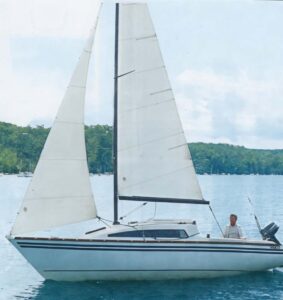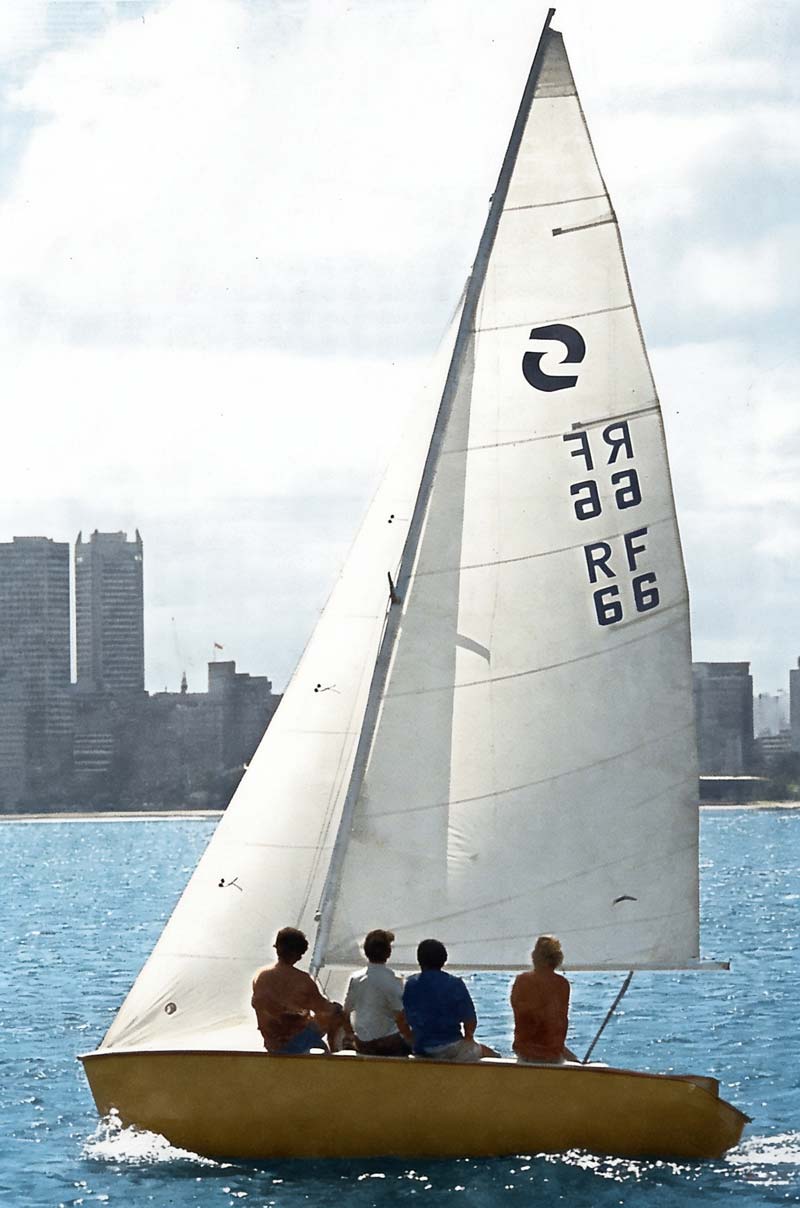
Around the time Australian Boating editor Peter Webster was writing about the decline of the trailer yacht market in September 1984, Western Australian yacht designer Kim Swarbrick had independently reached similar conclusions. His research into what sailors actually needed from a trailable family cruiser led him to a revealing insight.
Most trailer yachts in the five-to-eight metre range shared the same flaw: they tried to cram in bunks, a galley, a head, and freshwater tanks, essentially a miniature keelboat with comfort below decks as the goal. Yet Swarbrick, who had been successfully building yachts from 5.5 to 12 metres, recognised that crews on any boat under seven metres spent virtually all their time in the cockpit, the smallest part of the vessel.
Unveiled at the 1984 Perth Boat Show, his new 6.2-metre fibreglass trailer yacht, the S-20, turned heads precisely because of what it lacked. The cabin forward is deliberately minimal, a cushioned forepeak and two quarter berths, with no windows and barely enough room to shelter overnight in bad weather. What it offers instead is a vast three-metre cockpit, uncluttered and welcoming, with room enough for a family or several adults to sit comfortably and learn to sail without feeling in the way.
The S-20 does away with winches, mainsheet travellers, and the tangle of control lines and jamming blocks typical of more ambitious designs. There are no cockpit lockers or protruding hardware to trip over. The simplicity is intentional.
Construction is hand-laid fibreglass, with moulded frames fore and aft reinforcing the trailer contact points, and five buoyancy chambers in the hull plus two in the deck. Topsides and deck use 4mm Coremat, doubled to 8mm in high-stress areas. An anodised aluminium extrusion seals the hull-to-deck join, with matching bow and quarter castings. The spars are anodised aluminium, rigged with stainless steel shrouds and forestay but no backstay. The mast fits into a tabernacle for easy two-person rigging on the trailer.
A thoughtful ergonomic touch is the outward-cambered seat moulding, which supports the crew comfortably behind the knees – important for novice sailors. Racers can add toe straps, though the absence of anything else to hold onto when the mainsheet is not in hand is noted as a minor shortcoming. On the racing side, fittings such as the centreboard and rudder hardware are on the robust side – appropriate for a family boat, though a competitive racer might prefer lighter gear.
The centreboard itself is fibreglass with lead ballast moulded inside, and a counterbalancing lead weight at the head allows one crew member to raise or lower it effortlessly with a single line. The primary ballast is a 250kg die-cast lead keel bolted to the hull with nine stainless steel bolts.
On the water, the S-20 proved easy and well-balanced to sail. In 15–18 knots, the boat tracked steadily upwind at around eight degrees of heel, and when caught in a gust with the sheet cleated, it rounded up gradually rather than sharply. The sail plan comprises a 12.5m² mainsail with a deep reef, a choice of two jibs (7m² and 4.9m²), and a 36.5m² spinnaker that can be launched from the cockpit. The boom is set high enough to allow an unhurried tack with a full crew aboard.
The transom scuppers draining the long cockpit may need assistance clearing a solid sea, something that was expected to be tested in competition over the coming season. Early race results on the Swan River and Cockburn Sound were encouraging, with the S-20 consistently placing in the top four, and often taking line honours.
Swarbrick’s conclusion mirrors Webster’s diagnosis of the trailer yacht market’s troubles: buyers had imagined that living aboard a small boat would be enjoyable, discovered it wasn’t, and sold up. By being honest about the S-20’s purpose, a capable, safe, and easy-to-sail day boat for families, he sidestepped that trap entirely. Ten orders were placed at the Perth Boat Show, and production was running at two boats per week (Lloyd 1985: 40-43).
| Parameter | Details / Value |
| LOA | 6.2 m |
| DWL | 5.5 m |
| Beam | 2.1 m |
| Ballast | 250 kg die cast lead |
| Draft |
0.35 m up 1.3 m down |
| Displacement | 750 kg |
| Centreboard | GRP lead moulded weight to sink |
| Rudder |
GRP moulding. Cheeks 6 mm anodised aluminium Endless tackle 2:1 purchase for raise/lower. |
| Aux. Power | 4-6 hp outboard on reinforced mounting. |
| Sails |
Main 12.5 m², Jib 4.9 m² Tasker Sails |
| Opt. extra | 7 m² spinnaker |
| Cost | $7,400 — Sail away. |
| Custom Trailer | $1,075 |
| Supplier |
Swarbrick Yachts, 22 King Edward Rd, Osborne Park, W.A. 6017 |
Source: Blake, Lloyd (1985) ‘Swarbrick 20’, Australian Boating, January, pp. 40-43. Historical photograph reproduced for identification and historical research purposes. Copyright remains with the original rights holder.
Quick tip: Keep in mind that trailer sailers can vary quite a bit, even within the same class. Take the RL28, for example: they might not all have outboard wells as designed. Some originally may have had inboard engines, and when those were removed, the owners swapped them for a standard outboard mounted on the stern.