Driven by the need for future survival, several New Zealand boat builders expanded into Australia. Bonito Craft Ltd. was among the first to cross the Tasman Sea, spearheading a wave of Kiwi imports.
While the Bonito 22 had been available in Australia for a while, a shift toward more aggressive promotion highlighted its strengths. Though slightly expensive, it is a highly impressive trailer yacht featuring an exceptionally well-designed layout, superior craftsmanship, and commendable performance.
Specifications and Design
The Bonito 22 measures 6.65 meters (21ft 10in) in length, with a maximum beam of 2.43 meters (8ft), and a draft ranging from 0.45 meters (1ft 6in) to 1.52 meters (5ft) when the swing keel is lowered.
Weighing 1,000kg (2,200lb), which includes 331kg (730lb) of ballast molded into a small external keel, the boat is relatively heavy. This external ballast is a signature New Zealand design choice that optimizes weight distribution and provides the directional stability often missing in other trailer yachts.
Sail Configuration
The boat utilizes a traditional fractional rig with the following sail options:
Main: 12.96 sq.m. (140 sq.ft.)
Genoa: 12.5 sq.m. (135 sq.ft.)
Working Jib: 8.33 sq.m. (90 sq.ft.)
Storm Jib: 41.6 sq.m. (45 sq.ft.)
Spinnaker (Optional): 37.0 sq.m. (400 sq.ft.)
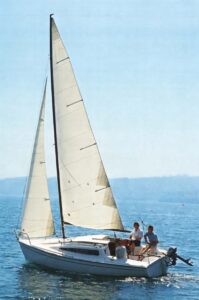
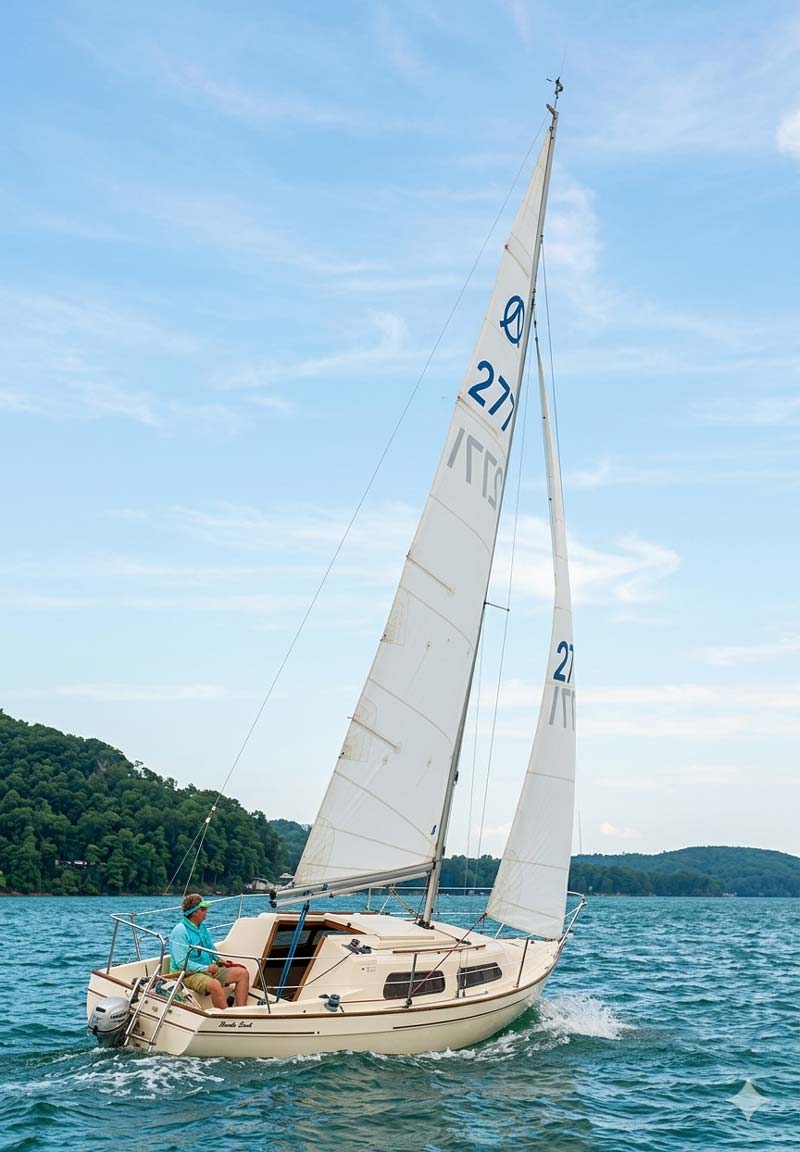
Stylistically, the Bonito 22 is modern without being overly avant-garde, sporting conventional lines reminiscent of the Kiwi-designed Sunbird 20. The deck layout is traditional, featuring a sliding companionway hatch (rather than a pop-top) and a mainsheet traveler positioned on the bridge deck just ahead of the companionway.
The cockpit is standard for a boat of this size, though the placement of the outboard well within the cockpit is a mixed blessing. While it allows the skipper to operate the motor easily, it sacrifices about two feet of seating space. This setup is perfectly adequate for a couple, but it can make the cockpit feel cramped when hosting a larger group of family or friends.
Below deck, designer Clive Jeffries delivered an exceptional layout that maximizes a compact space, making it arguably the best configuration available for a trailer yacht of this length.
By running the kitchen across the cabin rather than lengthwise, Jeffries created a space where the cook enjoys full standing headroom when the companionway hatch is open and a boom tent is rigged. The galley uniquely offers a two-burner stove, a full-sized sink, and highly coveted counter space.
Forward of the galley is a dinette featuring full-length port and starboard berths with a hinged table mounted over the centerboard case, comfortably seating four adults for meals. An insert panel can bridge the gap between the port settee and the centerboard case to create a 6ft by 4ft double bed.
In total, the boat sleeps five comfortably: a double berth for parents and three full-sized single berths for crew.
Proving the efficiency of the design, a small but fully functional private toilet room is located directly in the bow.
This highly practical layout allows a family of three or four to embark on extended cruises without sacrificing comfort regarding meals, sleeping arrangements, or bathroom facilities.
The value of the Bonito 22 depends on the chosen package, but its standard factory configuration from New Zealand is notably more generous than many local Australian competitors.
The basic Model ($11,590 – 1980 prices): Included a two-tone hull, bunk cushions/backrests, interior lighting, a cutlery drawer, a table, and a two-burner stove. This base price excludes sails, pushpit, pulpit, lifelines, and stanchions.
Turn-Key Package ($15,350): Comes fully equipped for cruising, including a Tracer tandem trailer, a 6-hp Chrysler outboard motor, a chemical toilet, a mainsail, No. 1 and No. 2 genoas, and all safety rails.
While not cheap, the complete package delivers a highly capable and well-appointed cruising vessel. The finish quality matches Australian standards, though the hardware and fittings are often superior due to the rugged, heavy-duty manufacturing style typical of New Zealand builders.
Sailing the Bonito 22 is a highly pleasant and manageable experience, as the tiller, sheets, and winches are all ergonomically positioned. During a brief test sail in light-to-moderate 10-knot breezes, the boat responded beautifully to both gusts and lulls.
The vessel can be easily single-handed or managed by a husband-and-wife team. Importer Ron Smith of Ahari Marine Services has already found success with the boat in racing circles, expressing high confidence in its competitive prospects for club racing. Even in light air, the boat cuts a clean bow wave, hinting at its true performance potential.
The Bonito 22 leaves a lasting positive impression by successfully uniting three highly sought-after traits into a single, well-crafted package: strong performance, high-quality finishes, and comfortable living quarters (Australian Boating 1980: 74-76).
Source: ‘Sail Report: Bonito 22’ Australian Boating, July, 1980, pp. 74-76. Historical photograph reproduced for identification and historical research purposes. Copyright remains with the original rights holder.