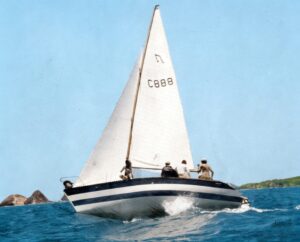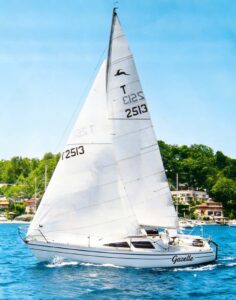
Pittwater yacht designer Joe Adams set out to bring speed and fun back to weekend sailing when he drew the lines of a missile-like 10-metre racing machine some years earlier. The Adams 10 proved that sailing could be faster and more enjoyable by dispensing with elaborate interiors, and as a stock fibreglass one-design it was relatively affordable, though still beyond the reach of many average buyers.
Adams responded by designing a stock fibreglass 8-metre sister ship, aimed at sailors who want to challenge the top of the fleet in their home waters and unsettle the owners of larger boats. Unlike the 10-metre, the 8-metre includes a cabin top and basic interior accommodation, broadening its appeal. Like its bigger sibling, the Adams 8 targets low-cost, high-excitement sailing, achieved through strict one-design class rules covering the number of sails, winches, crew and deck gear.
The boat’s immediate appeal lies in its sail power, which exceeds most comparable new-breed one-designs. Designed as a genuine performer in 10 knots and under, the Adams 8 is capable of speed across all conditions with the right sail trim and handling. Built to cut through the flat water and shifty breezes typical of Sydney’s Pittwater and harbour, the design is slimmer, finer and carries more sail than its closest rival, the Perth-designed S80.
Test conditions proved ideal – Pittwater in a 10-to-15-knot sea breeze with patchy winds around the headlands – and in those conditions the Adams 8 felt alive and rewarding to sail. The design would suit close-quarters fleet racing, where sail power is needed to break clear of the pack. There is something of the classic metre boat in the design, which is unsurprising given Adams’s admiration for that tradition. Speed is felt acutely owing to the crew’s closeness to the water.
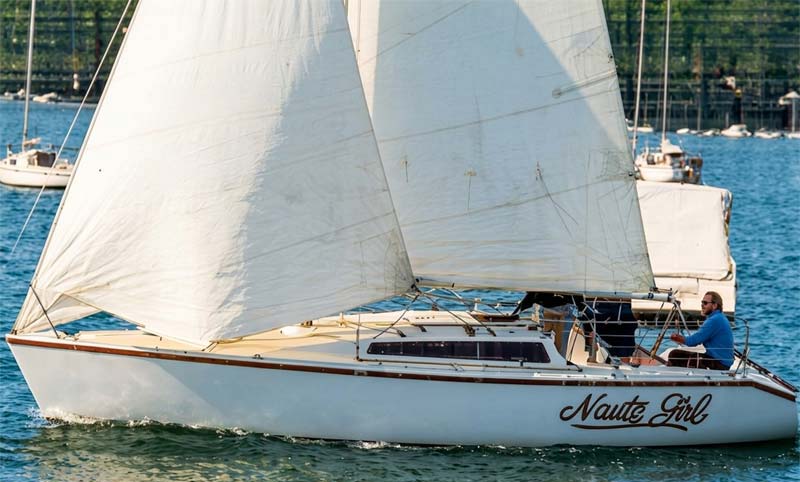
The test boat, Naute Girl – the first hull off the production line, owned by builders Naut Yachts of Mona Vale – felt faster than any comparable metre boat, including modern derivatives such as the Etchells. Though slim in form, the hull sections are nearly box-like, with a very flat bottom, a dinghy-style deep fin keel, and a deep rudder blade hung directly on the transom without a leading skeg.
Naute Girl reflected Adams’s vision for the class. Fitted with cushions for four bunks, a standard five-sail package, and bow and stern pulpits, the boat was a Stage 2 build at $13,460, with the total test-boat cost coming to around $16,000 – variable depending on the choice of sailmaker. The design has come in slightly above the original price target, though buyers can reduce costs by purchasing at Stage 1 for $8,063, which covers the hull, deck, and basic interior moulding. A hands-on owner completing their own fitout could bring the finished boat in at around $14,000, including $1,600–$2,000 for a five-sail inventory (1979 prices).
Class rules require all boats to be factory-built to at least Stage 1 and to meet a minimum displacement of 3,400 lb, while permitting owners to source their own brand of sails, spars, winches and deck fittings within a rigid sail and deck plan.
The Adams 8 offers an impressive array of sail controls, all within reach of the cockpit: main and headsail halyards, spinnaker halyard, spinnaker pole lift and kicker, cunningham, mainsail outhaul, two reefing lines, and the boom vang – all led to the coachhouse roof. Headsail sheets run via turning blocks on the side decks, along with spinnaker sheets and tweaker lines pulling the spinnaker sheets down just aft of the main shrouds. Halyards come with the mast at Stage 2; sheets and rope must be sourced separately, though all blocks for the mainsheet and vang are included.
The colour-coded rope system on deck can appear bewildering at first, but the boat rewards familiarity quickly. Off the wind the Adams 8 is lively, and under a tri-radial spinnaker the acceleration suggests the boat would plane readily in stronger breeze. With a three-quarter sloop rig, the spinnaker and headsails are manageable, and hoist and drop operations are straightforward. The spinnaker deploys behind the mainsail and does not fill until the sheet is applied.
At 3,500 lb displacement, the helm feels light for a boat of nearly 25 feet on the waterline, and the sail controls require less physical effort than most boats of equivalent performance. Upwind, the 8-metre points impressively even under the overlapping genoa, and during testing it matched an Etchells for speed and pointing angle. The class has since demonstrated its competitiveness by beating Etchells on harbour courses and besting offshore racing keelers up to 40 feet on elapsed time.
At the time of the test the boat’s tuning was still in early stages and the headsails had recently been recut following measurement issues, so Naute Girl had yet to race. Meanwhile, the second and third hulls were already posting strong results, beating one-tonners for line honours in short mid-week races and proving quick in winds above 20 knots.
Adams notes that dinghy sailors will adapt readily to the bendy mast and the full-width cockpit traveller, essential for upwind balance. Working the traveller on a 3:1 purchase is manageable for the helmsman, though the undersized jam cleats on the test boat did not hold reliably, requiring the lines to be held by hand. A notable handling virtue is that the helm does not load up as the boat heels, the lean hull lacks the bulging mid-body that causes grip and weather helm in beamier designs, and tacks with a lively ease that invites aggressive match-racing.
Upwind, crew weight belongs on the side deck outboard of the cockpit, as the design calls for weight aft rather than amidships. While the hull is sensitive to weight on the foredeck, the layout allows crew to remain aft and cross the boat at the cockpit during tacking exchanges. The cockpit is spacious, with bench seating set slightly below deck level and enough side deck width for sitting outboard. A stern drain sump with two large plastic tubes exits through the transom.
The mainsheet traveller sits just forward of the helm position and uses a Fico I-beam mounted on a fibreglass moulding. The cabin is low and lacks a pop-top, Adams taking the view that good sitting headroom is sufficient for this style of boat. Non-skid surfaces are provided in key deck areas and the cockpit, though the absence of handrails makes moving forward less secure. The deck is kept uncluttered, with cockpit lockers, anchor hatches and handrails omitted.
The mast on the test boat was a Yachtmast of Australia SC section with taper above the jibhead, supported by a single set of swept-back spreaders eliminating the need for running backstays or an inner forestay. The backstay connects to a 4:1 rope purchase for quick and effective mast bend adjustment. A fabricated metal collar around the mast carries turning blocks for the halyards, saving the weight of reinforced mountings on the cabin top. Standard Stage 2 specification includes four No. 6 halyard winches and two No. 16 sheet winches.
Class rules permit a mainsail with two reefs, a 150% genoa, a small jib, a non-overlapping large jib, and an IOR-style spinnaker.
Below decks, accommodation includes two quarter berths and two settee berths with backrests against the hull, plus a forward galley unit around the mast. The galley is equipped with provision for a two-burner stove, a sink and cupboards. A chemical toilet is housed under a bench in the forepeak, which resembles a small forward double berth but is realistically suited only to sail stowage.
Hull and deck construction is fibreglass with Airex core for a light, stiff moulding. An inward-facing hull flange mates with the deck mould, joined with waterproof compound and glass tape. The fin keel is a solid lead casting secured by eight large bolts, and the mast steps on a metal casting. Interior surfaces are finished in flowcoat with modest timber trim and a varnished timber sole running the length of the saloon above the bilge. The interior is straightforward rather than luxurious, but comfortable enough for the crew to relax below after racing (Hill 1979: 24-26).
It is typically powered by a small outboard motor (usually ranging from 3.5 hp to 8 hp), mounted on an outboard bracket.
| Specifications | |
| LOA | 8.077m (26ft 6in) |
| LWL | 7.55m (24ft 9in) |
| Beam | 2.43m (8ft) |
| Draft | 1.47m (4ft 10in) |
| Displ | 1542kg (3400lb) |
| Sail Area | 32.79sq.m (353sq.ft) |
| Basic Mouldings | $8063 |
| Sailaway | $16,000 approx. |
Source: Hill, James (1979) ‘Test: Adams 8 Metre’, Australian Sea Spray, October, pp. 24-26.
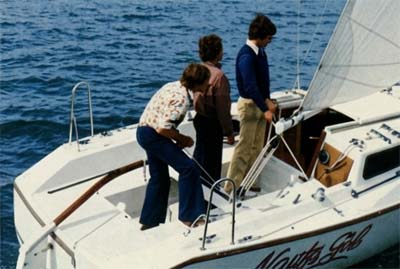
Historical photograph reproduced for identification and historical research purposes. Copyright remains with the original rights holder.
Quick tip: Keep in mind that trailer sailers can vary quite a bit, even within the same class. Take the RL28, for example: they might not all have outboard wells as designed. Some originally may have had inboard engines, and when those were removed, the owners swapped them for a standard outboard mounted on the stern.