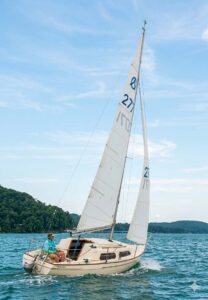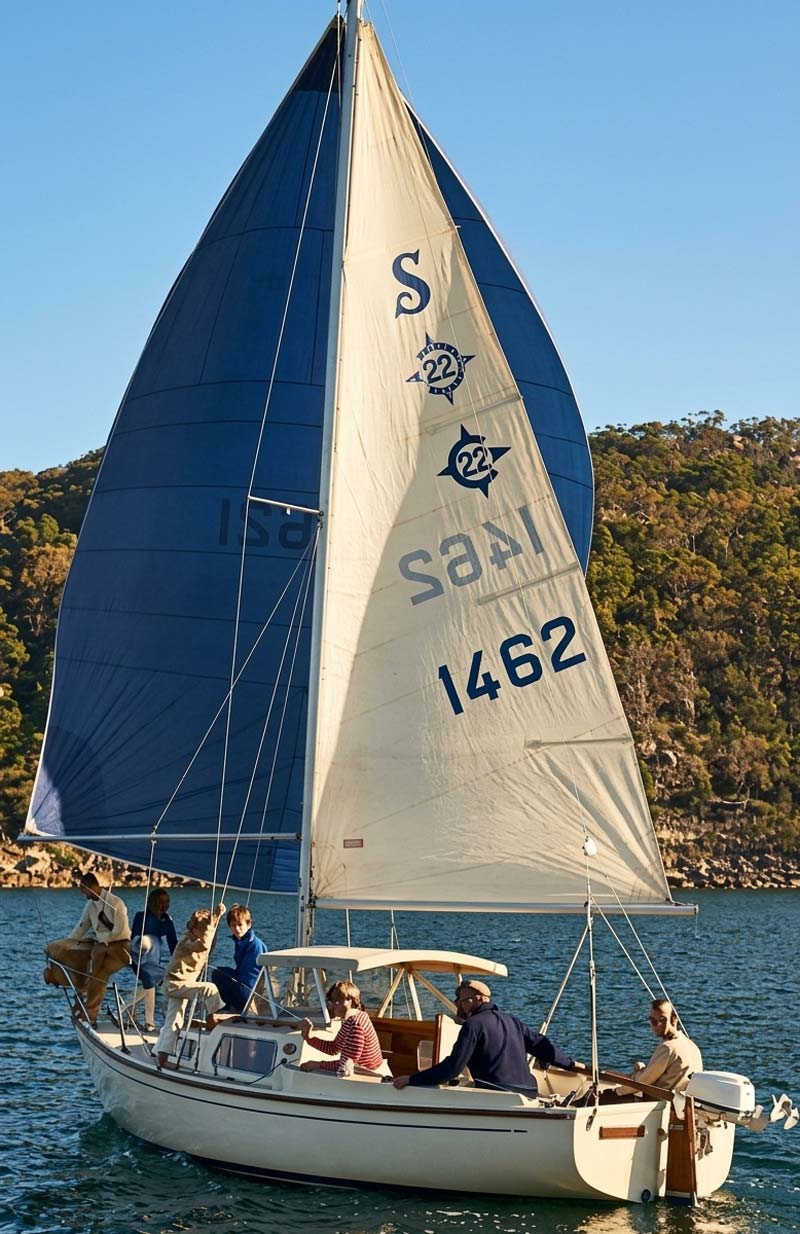
Careel 22 (Compass Careel 22)
In June 1971, Seacraft magazine tested Compass Careel No. 7, describing it as the flagship of a remarkable success story. In 1975, 193 of these exceptionally finished trailer sailers had been built.
The story began when David and Pam Rose of Palm Beach, Sydney, acquired the rights to build the Adelaide-designed Duncanson 18, which they renamed the Compass Careel 18. Their boats quickly gained a reputation for outstanding craftsmanship and interior fit-out.
Even in those early years, the Roses dreamed of creating a larger Careel. After years of planning, setbacks, and perseverance, that vision finally became reality. Sydney designer Joe Adams was commissioned to draw the larger yacht. Following numerous delays and construction challenges, the hull plug was eventually transported by water from Ken Beashel’s boatshed at Elvina Bay to the mainland.
Several more months passed before the female mould was completed and ready for the first production hull.
Creating a quality fibreglass hull was only part of the challenge. David Rose was determined to develop a superior centreplate lifting system and began experimenting with hydraulics. Although costly, the hydraulic arrangement proved highly successful.
The hydraulic centreplate system was manufactured by Hydraulic Specialists Pty Ltd of Brookvale, NSW, a company that also supplied similar equipment for adjusting backstays on major ocean-racing yachts. In 1975, 25 Careel 22s had been built. Seacraft sailed two of them: Rose’s own prototype, which served as the development boat, and Careel 22 No. 8, a well-raced yacht owned by engineer John Wheeler.
The first test sail took place on a summer evening during daylight saving time, with a strong northeasterly breeze blowing across Pittwater. The yacht delivered an exciting reach to The Basin and a comfortable close reach back to Careel Bay, home of the Careel fleet. Once moored, the crew raised the pop-top cabin roof and enjoyed the cooling airflow it provided on a warm evening.
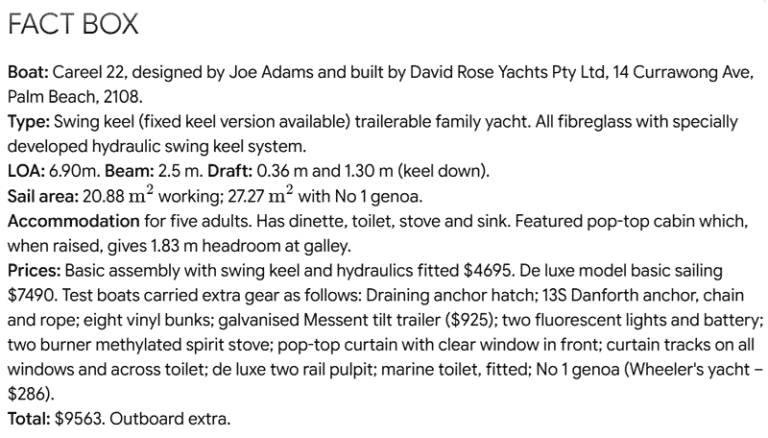
The Careel 22 was far more than a typical trailer sailer. With a centreplate providing approximately 40 percent ballast ratio, she possessed many characteristics of a larger keel yacht. The centreplate weighed 385 kg, while an optional fixed-keel version carried a 545 kg keel. Her masthead rig featured a large overlapping headsail, further reinforcing her yacht-like performance and handling.
Although the prototype had been in service for several years, its hydraulic system operated more smoothly than that of the newer boat. Rose had recently replaced the original pressure hose with stainless steel piping, resulting in noticeably improved performance. On No. 8, the pump felt less precise and the oil reservoir showed signs of leakage, although this boat was later upgraded with stainless steel piping as well.
One advantage of the hydraulic system was accessibility. By removing the top of the centreplate case, owners could easily reach the ram, piping, and associated mechanisms. The design also prevented the heavy centreplate from falling out through the bottom of the hull. While the hydraulic setup cost around $430, it was considered more reliable than conventional wire-and-pulley systems. Instances of broken centreplate cables on other trailer sailers had occasionally required divers to manually reposition centreplates.
The Careel 22 was widely regarded as one of the most attractive and thoughtfully designed trailer yachts built in Australia. From the forward anchor well and non-slip decks to the insulated icebox and dedicated fuel locker aft, every feature appeared carefully considered.
One potential drawback was the gap created behind the mast when the pop-top roof was raised. A careless step in rough conditions could easily result in injury, encouraging most owners to keep the roof lowered while underway.
Questions also remained about the pop-top’s watertight integrity in the event of a severe knockdown. While highly practical for sheltered cruising, it was arguably less suitable for offshore work than a conventional fixed cabin roof.
The boats tested used a shock-cord-assisted lifting system that required the roof to be raised and locked in a single movement. Later models featured an improved design introduced at the Sydney Boat Show, allowing the roof to be raised at either end or tilted as required. The additional standing headroom was particularly appreciated when using the galley.
Accommodation was exceptional for a trailer sailer of its size. Sleeping space for five people, a dinette, enclosed toilet, and 1.83 metres of standing headroom in the galley placed the Careel 22 in a class of its own. Large storage compartments beneath the cockpit seats and numerous practical design touches enhanced its suitability as a cruising boat. While a longer cruise would undoubtedly reveal minor shortcomings, none were apparent during the review.
Towing, however, required a substantial vehicle. The combined weight of the yacht and trailer was estimated at between 1,155 kg and 1,360 kg, making it unsuitable for small tow vehicles. The Roses believed many owners would keep their boats on permanent moorings, which was one reason they offered a fixed-keel version. They also suggested that some competing trailer sailers were heavier than their published figures indicated.
The article argued that yacht builders should provide verified weight figures, perhaps supported by a weighbridge certificate, allowing buyers to accurately assess towing requirements. After all, a vehicle’s ability to stop a heavy trailer safely can be just as important as its ability to tow it.
The Careel 22 was described as a beautiful and highly capable yacht. However, quality came at a price. In 1975, a fully equipped Careel 22 cost $8,638, with an additional $925 for the trailer and approximately $400 for an outboard motor, bringing the total close to $10,000.
Although direct comparisons with competing yachts were not conducted, the boat appeared to perform well under sail. Reports suggested that it was at least as fast as, and possibly faster than, the Hood 23. Owner John Wheeler, despite not being an expert sailor, achieved respectable results in Sydney racing events.
The Careel 22 possessed an excellent hull and was not intended as a pure racing machine. Instead, it came closer than any other trailer sailer tested to the ideal family cruising yacht.
Source: Hopkins, Paul, ‘The Ideal Family TS’ , SEACRAFT, October, 1975, p. 23.
Historical photograph reproduced for identification and historical research purposes. Copyright remains with the original rights holder.