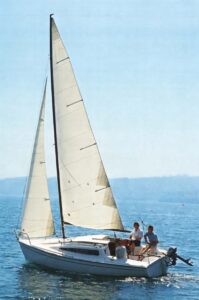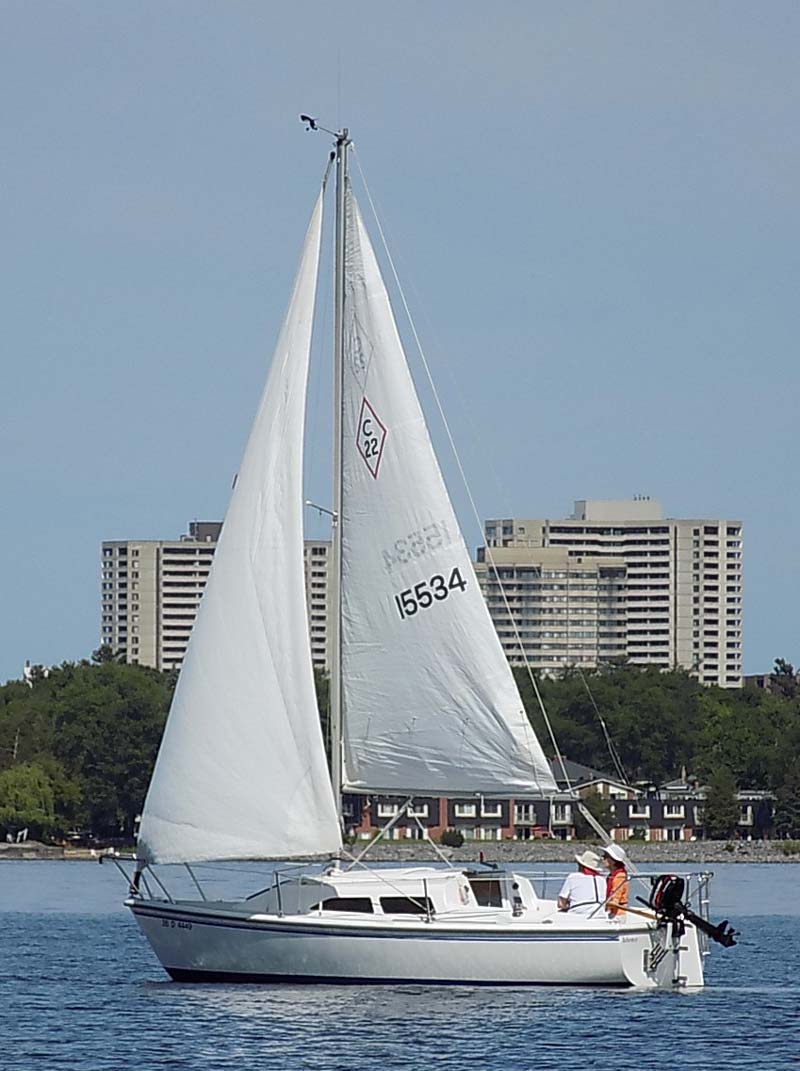
The Boomaroo 22 was originally designed by Frank Butler as the popular Catalina 22 in the United States, where over 4,500 units had already been produced by 1976. Licensed by Catalina Yachts, the design was manufactured globally under different names: the Alacrity 22 in the UK, the Jaguar 22 in Europe, and the Boomaroo 22 in Australia (Hopkins 1976, p. 33). Constructed with hand-laid fiberglass, it features molded-in colors and non-skid deck surfaces for low maintenance and longevity. For safety and excellent stability, the hull is built with a 2.3-metre beam and achieves a 1.5-meter draft when its swing keel is fully lowered. The retractable keel includes a dedicated locking mechanism to secure it safely at any angle, making the vessel economical and easy to trail (Boomaroo Products n.d.). However, because the 270kg swing keel does not retract fully up into the hull, a choice made to preserve cabin room, the boat’s minimum draft is slightly increased (Payne 1981, p. 50).
Below deck, the interior maximizes space through afunctional layout. The cabin features a standard teak-veneer dinette that is cozy for two adults and two children, and it easily folds down to create a double bed (Webster 1981, p. 50). To optimize sleeping arrangements for up to five adults, consisting of two forward V-berths, a settee berth, and the convertible double dinette berth, the unique galley unit slides completely away under the starboard cockpit seats when not in use, eliminating the need for cramped quarter berths and maximizing cabin seating (Boomaroo Products n.d.). This compact galley comes complete with a stove, drawer, sink, manual pump, 27-liter water tank, and an icebox. Additionally, 75% of the cabin roof lifts up as a pop-top to expand the interior headroom to a comfortable 1.7 meters [5’9″], while an optional, private marine toilet is tucked neatly under the forward V-berth (Boomaroo Products n.d.; Webster 1981, p. 50).
The Boomaroo is generally easy to launch, floating in 0.5 meters of water, provided there is at least 0.25 meters of depth at the end of the ramp (Webster 1981, p. 50). To aid this process, the custom-designed trailer uses large rocking rollers that allow the boat to float off easily, eliminating the need to submerge and damage the trailer’s wheel bearings (Boomaroo Products n.d.). Skippers should note, however, a minor quirk discovered during a test sail: bringing the rudder hard to port can cause the blade to foul the outboard motor’s propeller (Hopkins 1976, p. 33).
Sailing: “With the basic jib and main, we took the Boomaroo out into a very stiff westerly to put her through her paces and were delighted with the result. Out into the open, she started to get the full blast of the westerly and revelled in it. Hard on the wind she got her toe rail down quickly and settled to a good angle of heel, at the same time scooting forward through the chop in the style of an offshore racer… summing it all up, then, I was impressed with this Californian-designed T-S, as she showed some nice characteristics when viewed as a family cruising boat, and quite a nice turn of speed when considered as a possible racer” (Trailer sailers – John Crawford Marine Library).
SPECIFICATIONS
| Specification | Details |
| Boat | Boomaroo GRP trailer sailer (built by Boomaroo Products, Kingsgrove, NSW under licence for Catalina Yachts, USA) |
| Designer | Frank Butler |
| LOA (Length Overall) | 6.55 m |
| LWL (Length Waterline) | 5.89 m |
| Beam (Width) | 2.34 m |
| Draft | 508 mm (board up) / 1.52 m (board down) |
| Ballast | 249.5 kg |
| Displacement | 839.2 kg; Kerb weight of 1.45 tonnes |
| Sail Area | 19.69 m² |
| Mast Height | 7.62 m |
| Accommodation | Sleeps five. Excellent cabin layout with all facilities. Galley rolls away under starboard cockpit seats. |
| Construction | Hand lay up fibreglass. Complete inner liner for smooth finish. Cabin overhead liner with grained texture. |
| Rigging | Masthead rig with permanent backstay and permanent lowers. |
| Original Price | Basic: $3,900 / Sail away model: $6,100 |
Outboard on Transom Bracket. [Verify that the rudder does not interfere with the outboard propeller during use, particularly if a high-thrust propeller is installed.]
Sources
Boomaroo Products 1976, Demonstrated by Ian Findlay, promotional flyer, Boomaroo Products, Kingsgrove, NSW.
Hopkins, Paul. (1976), ‘Two “New” Trailer Sailers / Best from the States’, Australian Seacraft, January, p. 33.
Payne, Webster & Davidson. (1981) ‘Boomaroo 22’, Australian Boating, January, p. 50.
John Crawford Marine (n.d.) Boomaroo 22, Trailer Sailer Library. Available at: https://www.johncrawfordmarine.com.au/advice/trailer-sailer/boomaroo-22 (Accessed: 26 May 2026).
Figure 1: Wikipedia (2026), Catalina 22, digital image, viewed 19 May 2026, https://en.wikipedia.org/wiki/Catalina_22.
Figures: 2 & 3 Boomaroo Products 1976, Demonstrated by Ian Findlay, promotional flyer, Boomaroo Products, Kingsgrove, NSW.
Quick tip: Keep in mind that trailer sailers can vary quite a bit, even within the same class. Take the RL28, for example: they might not all have outboard wells as designed. Some originally may have had inboard engines, and when those were removed, the owners swapped them for a standard outboard mounted on the stern.
Historical photograph reproduced for identification and historical research purposes. Copyright remains with the original rights holder.