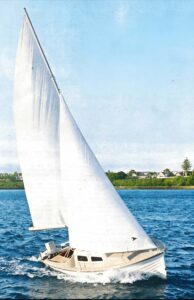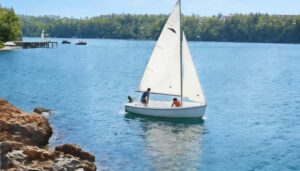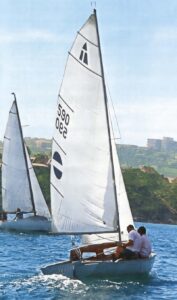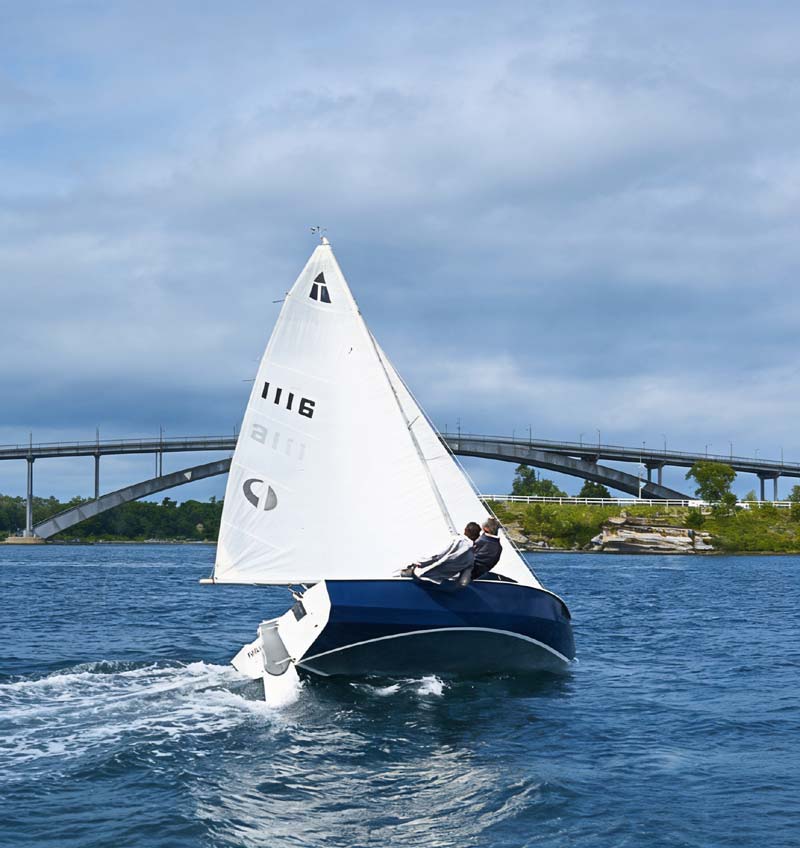
Many dinghies were originally built from plywood, but when sailors wanted something larger, New Zealand designer Richard Hartley created a hybrid craft, part centreboard dinghy, part small cabin yacht, known as the Hartley TS 16.
The boat had a boxy, utilitarian shape with chunky cross-sections, short bows and stern, and double-chined topsides. Despite its ungainly appearance, it became popular with weekend builders who could construct one in their garage at low cost. It was also easy to trailer, and helped spark a trailer sailer movement that gathered momentum as fibreglass construction arrived.
Early TS 16 owners were genuine pioneers. The boat served well as a camping platform, though its steel centreboard contributed only 100 lb (45kg) of its 800 lb (363kg) total weight, leaving it vulnerable to capsize. That said, it was an honest design, if it went over, sufficient built-in buoyancy kept it afloat, and it was light enough for the crew to right it themselves.
The boat’s simplicity and impressive sail area relative to its light displacement make it surprisingly quick. Many newcomers to trailer sailing are caught off guard when a well-tuned Hartley 16 leaves larger boats behind. The two-sail sloop rig, not unlike the Olympic Star’s approach, is highly effective on all points of sail.
The large mainsail, carried on a stiff, non-bendy rig, generates serious power. Experienced TS 16 sailors learn to exploit it skilfully, regularly catching and passing newer trailer sailers carrying scaled-down versions of full yacht rigs. Running downwind with the headsail poled out and sheeted from a point a short distance in from the bow, the boat moves with real urgency. With boom vangs and twickers applied, it can even get up and plane.
For racing, crews tend to be kept light, typically just two, though for cruising or relaxed racing the roomy cockpit comfortably fits three or four.
Taking the approach of joining what they couldn’t beat, the class produced a fibreglass version of the design that is both attractive and competitively priced. The concern was that this would invite direct price comparisons with other GRP mini-trailer sailers, but class leaders were determined to avoid turning the TS 16 into an expensive, off-the-shelf product.
An Adelaide manufacturer was producing bare fibreglass hulls from around $2,800 ex-factory. A plywood kit boat built from scratch came to roughly $3,000 fully fitted with sails and hardware in 1979. Completing one of the new GRP hulls yourself would take around two weeks of evenings and weekends, coming in at no more than $4,000 all up, including a bow buoyancy tank that doubles as a sleeping shelf in the cabin (1979 prices).
Sydney agent Norm Brown was offering fully finished boats with trailers for around $6,000, competitive with other trailer sailers on the market. Even so, his preference was to promote the owner-completion option, believing the class drew its strength from its appeal to sailors of modest means looking to get out on the water with family or friends.
From a distance the fibreglass version looks almost identical to the original, with one notable difference: a more upright forward cabin face, which was a practical necessity to allow the moulding to release from the tool. Everything else, including the distinctive cockpit coaming shape, reads unmistakably as a Hartley.
The test boat belonged to Drummoyne fleet sailor Bruce Woolner, an Australia Post employee who had finished it in the company’s red and white livery.
Coming from modern trailer yachts like the Farr 6000 or Cole 23 with their yacht-style deck layouts, the Hartley feels more like a 16-foot family skiff. The difference matters most when racing two-up, where toe-straps and active hiking are essential in a breeze.
In fresh conditions the boat demands constant mainsheet work to prevent overpowering and excess heel – ease off and speed bleeds away upwind. The payoff is boat speed and a decent workout. One of the first surprises for anyone new to the TS 16 is the stiff, cabin-top-stepped tapered alloy mast, which cannot be tuned to depower through bend. Instead, sailors must go back to basics easing the main in gusts, sheeting on in the lulls. Heavier crews naturally enjoy strong winds, while lighter crews work harder to keep the boat upright.
The boat is demanding to race but fair: the skipper carries the hardest job managing the mainsail, while the crew handles only the jib and centreboard. One pleasing feature was how light and manageable all the gear was, a single-handed rig-up within 15 minutes is perfectly achievable with a sensible layout of control lines. In practice, though, the rigging arrangements on most boats, including the newer fibreglass ones, were more complicated than necessary and added time to the process (Hill 1979: 65-67).
| Hartley TS 16. | |
| Designer: | Richard Hartley, NZ. |
| Builders: | GRP Mouldings Furness Ave, Edwardstown, SA. |
| LOA: | 4.99m (16ft 5in) |
| Beam: | 2.73m (7ft 2in) |
| Draft board up: | 230mm (9in) |
| Draft board down: | 1.37m (4ft 6in) |
| Weight: | 362kg (800lb) |
| Ballast: | 45kg (100lb) |
| Working Sail area: | 16.72m² (180sq ft) |
| Price: | DIY in plywood $3000 approx. |
| DIY from GRP mouldings $4000 approx. |
Source: Hill, James (1979) ‘Hartley Goes Glass’, Seacraft, June, pp. 65-67. Photos Graeme Andrews. Historical photograph reproduced for identification and historical research purposes. Copyright remains with the original rights holder.
Quick tip: Keep in mind that trailer sailers can vary quite a bit, even within the same class. Take the RL28, for example: they might not all have outboard wells as designed. Some originally may have had inboard engines, and when those were removed, the owners swapped them for a standard outboard mounted on the stern.