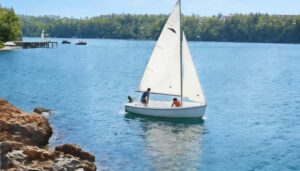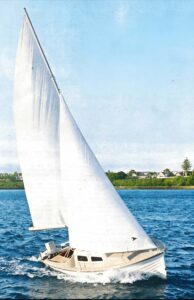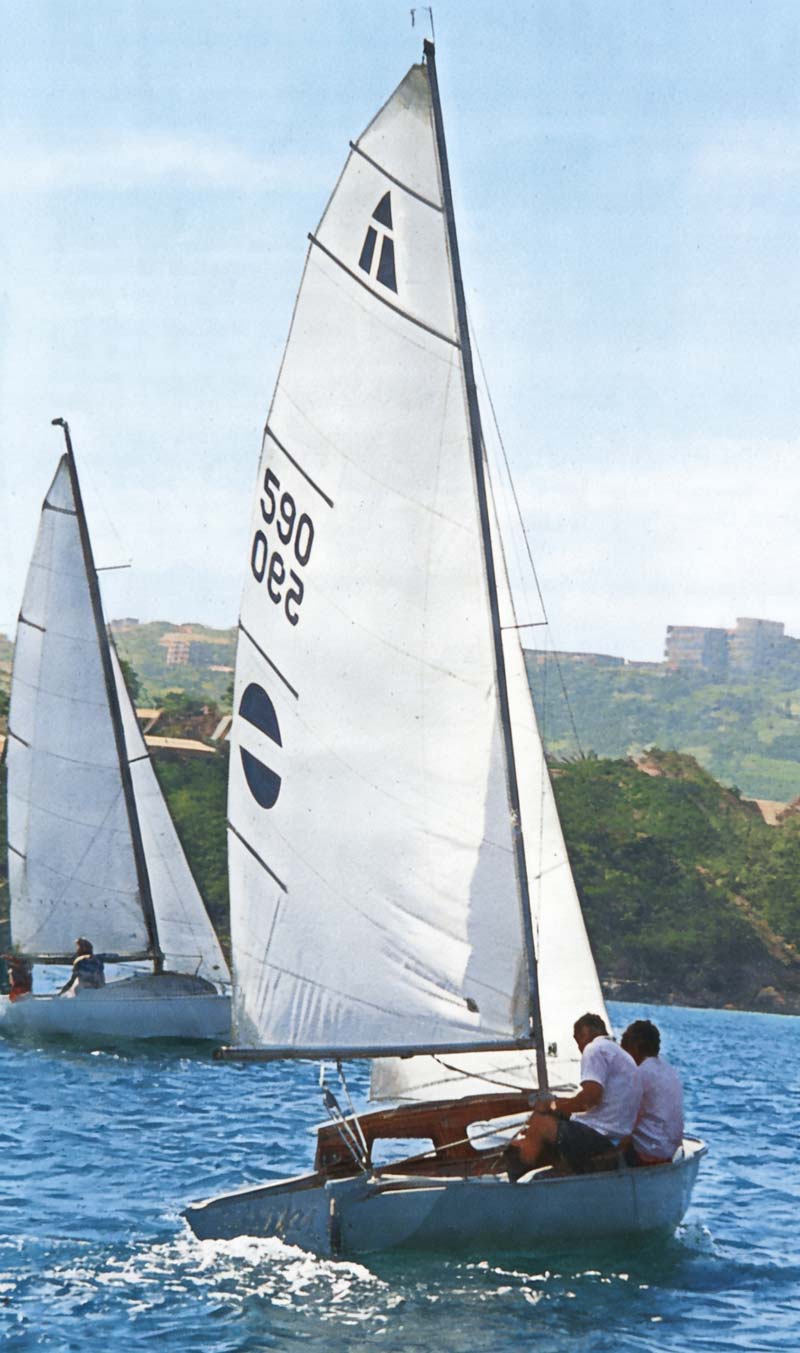
Measuring just over 16 feet in length with a 7-foot beam and drawing just 9 inches with the board raised, the TS16 is compact and light enough to be towed by a small four-cylinder vehicle.
For those less inclined to sail, the boat performs admirably under a 5hp long-shaft outboard, giving it the look and feel of a small cabin cruiser making it an exceptionally versatile package for its price point.
Since Peter Fletcher first brought the Hartley 16 design to Australia via Pittwater, it has had a transformative effect on recreational sailing in the country. Rebranded as the TS16, the design spawned a whole generation of similar vessels.
The trailer sailer market has since grown to encompass boats from 14 feet, predominantly in fibreglass, yet the original design remains hard to beat. A home build can be launched for under $900, and its class association (in 1972) remains the most active of any trailer sailer in Australasia.
A professionally built, fully outfitted TS16 with trailer and motor can be purchased for around $2,500, while a home-built version comes in at roughly $1,500 for the complete package. A mast and boom extrusion is available for $70, with a full sail wardrobe costing $205 (1972 prices) (Andrews 1972: 18-20).
LENGTH 5m BEAM 2.35m
Freeboard Forward 686mm; Aft 533mm;
Depth of Hull Amidships 686mm;
Draft with plate up 228mm; Plate down 1245mm;
Length of Cockpit 1830mm.; Length of Bunks 1830mm;
Waterline Length 4700mm; Waterline Beam 1676mm.
Length of Mast 6400mm; Length of Boom 3505mm.
Weight: 363 kg.
Ply: 11 sheets 2440mm x 1220mm x 7mm and 5 sheets 2440mm x 1220mm x 6mm.
Timber: 200 super feet.
Sail Areas: Mainsail 11.62 sq. m; Jib 5.1 sq. m.
Storm Jib 2.33 sq. m; Spinnaker 10.9 sq. m
Source: Andrews, Graeme (1972) ‘King of the TS16s’ Seacraft, December, pp. 18-20, 89.
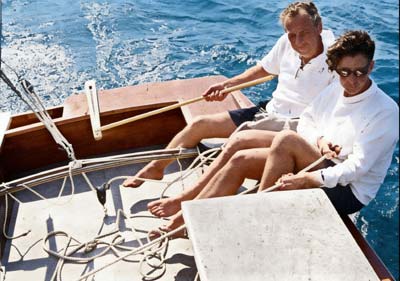
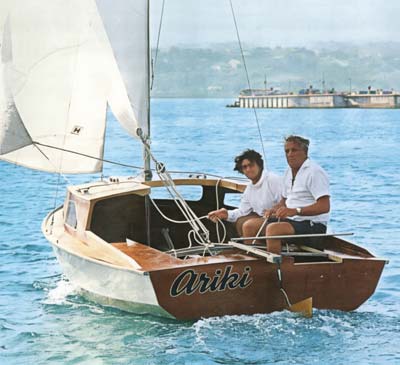
Historical photograph reproduced for identification and historical research purposes. Copyright remains with the original rights holder.
Quick tip: Keep in mind that trailer sailers can vary quite a bit, even within the same class. Take the RL28, for example: they might not all have outboard wells as designed. Some originally may have had inboard engines, and when those were removed, the owners swapped them for a standard outboard mounted on the stern.