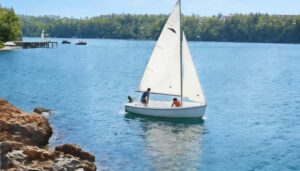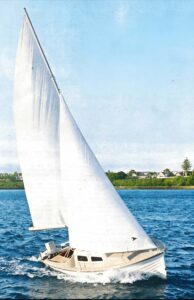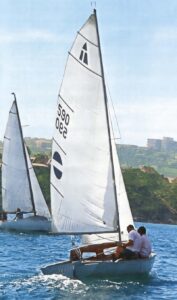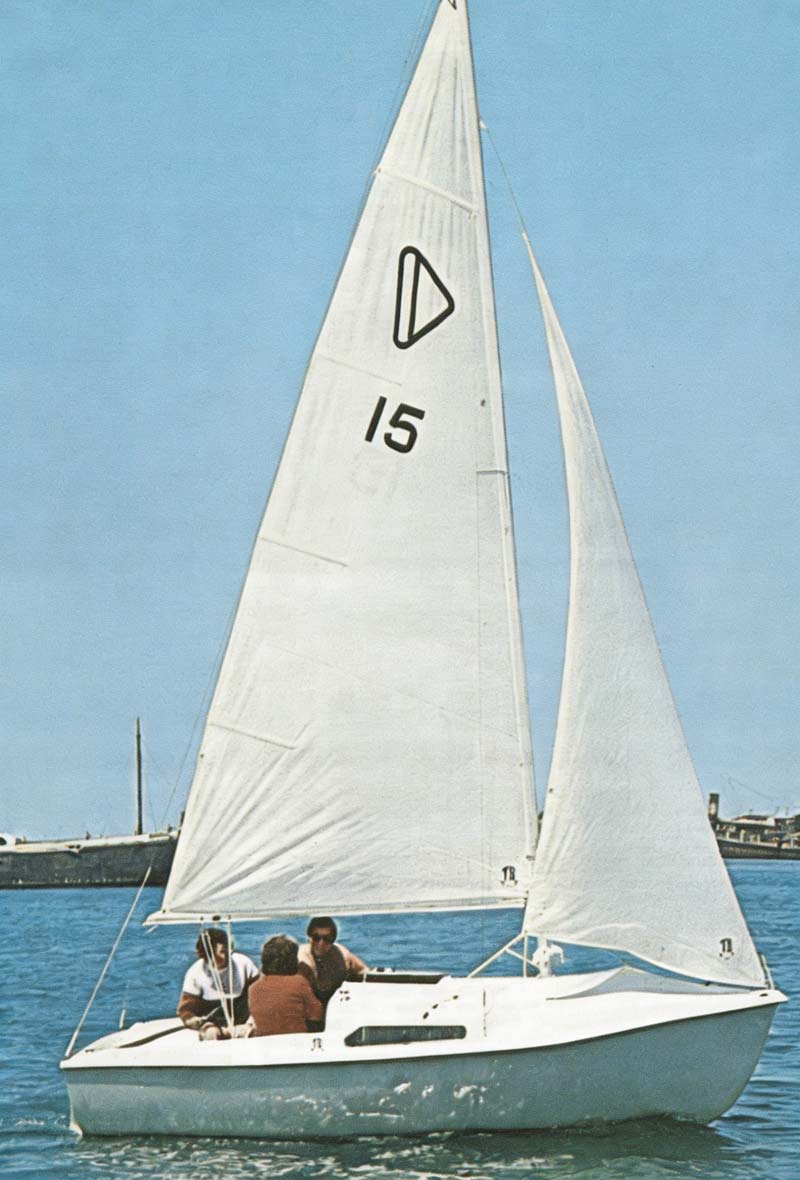
The TS500 made its appearance at Parsons Marina in Williamstown, Victoria, where Dick Underwood, sales manager for Dennis Yachts, prepared to launch a brand-new example of the design.
According to Dennis Yachts, the TS500 offers more interior volume, cockpit space, and usable deck area than any comparable boat in its class in Australia. The raised, non-skid deck slopes gently, providing a full-width area suitable for sunbathing, while the full-length false floor allows room for four berths measuring approximately 2.1 metres (7 feet) in length, as well as storage space for a portable chemical toilet.
Compared with many Australian trailer sailers, the TS500 features relatively high topsides. This gives the boat a larger appearance and provides comfortable sitting headroom beneath the companionway.
The flat cabin roof also creates a generous outdoor leisure area. During testing, the companionway hatch cover had not yet been completed; removable boards slid into vertical guides and were secured by the cover. The aluminium rudder housing was particularly well executed.
An American-style production method helps keep manufacturing costs down. The hull is moulded first, followed by installation of the flat floor, after which a one-piece deck and cockpit moulding is joined to the hull. Foam-sandwich deck construction, combined with the buoyancy compartment beneath the full-length floor, provides a high level of flotation.
The mast was straightforward to step and featured a comprehensive rig, including upper and lower shrouds, forestay, backstay, and crosstrees. Constructed from an untapered 470-series aluminium section, it carried a square-backed sail track designed for performance.
Both mainsail and headsail were conventionally rigged with simple lacing attachment points. The headsail sheet leads ran on imported curved tracks, the same type used on Dennis Yachts’ Olympic 470 dinghies. Standard fittings included fixed mainsheet blocks and a boom vang.
Under sail, the TS500 crossed the main channel on a port tack before entering Port Phillip Bay, where stronger winds pushed the boat along at a lively pace. Initial heeling was quick, but stability increased noticeably once the boat settled. A series of short tacks demonstrated responsive handling and suggested that sailors of modest experience could manage the boat comfortably in normal conditions.
On the return journey to Williamstown, the accommodation was examined more closely. The cabin could sleep four adults, although the centrally positioned table would require some compromise in comfort and foot space.
One of the boat’s most distinctive features is its centreplate arrangement. The case is concealed within the false floor, and the plate is raised using a multi-purchase block-and-tackle system mounted on the cabin roof directly above it.
The centreplate incorporates low-mounted ballast, contributing to an overall ballast ratio of nearly 30 percent, sufficient to provide self-righting capability.
The fully rigged yacht, excluding crew, weighs approximately 363 kilograms (800 pounds). The centreplate itself weighs around 72.5 kilograms (160 pounds), while internal ballast contributes an additional 45.4 kilograms (100 pounds), resulting in the ballast ratio close to 30 percent.
In standard form, the centreplate’s leading and trailing edges are merely rounded. Owners seeking greater performance could improve efficiency by reshaping both the centreplate and rudder into proper foil sections.
Some rudder vibration was detected during the trial sail, though this would likely be eliminated with careful fairing and refinement.
The standard interior is functional rather than luxurious, lacking lockers, dedicated storage spaces, and a foredeck hatch. Built-in features include a reinforced transom mounting pad for an outboard bracket, a mast support post, a small table mounted atop the centreplate case (with provision for extensions), and a recessed footwell seating area.
Overall, the TS500 left a very favourable impression. It combines enjoyable day-sailing characteristics with accommodation suitable for two adults and a couple of children.
The vertically lifting centreplate proved simple to operate. When lowered, it is secured by a cleat intended to prevent movement in the event of a capsize. However, concerns were raised about whether the cleat would withstand the shock load of the 72-kilogram centreplate attempting to drop suddenly. A substantial locking bolt would likely offer a safer and stronger solution.
As the boat approached the launching ramp, the centreplate was progressively raised to suit the decreasing depth. It was disappointing that the test period could not be extended, as the TS500 showed considerable promise. Within five minutes the headsail was furled, the mainsail lowered and stowed, and the boat was back on its trailer.
Even at the ramp, interested onlookers gathered to ask questions. Many were surprised that a trailer sailer measuring only 5 metres (16 feet 5 inches) could appear so spacious while remaining so affordable.
Underwood emphasised the boat’s safety, citing its 30 percent ballast ratio and substantial built-in buoyancy. His enthusiasm was evident, but it was easy to understand why. The TS500 was an impressive design, combining practicality, safety, value, and enjoyable sailing performance in a remarkably compact package (Hopkins 175: 22-25).
FACT BOX TS500 built by Dennis Yachts, 17B Slough Road, Altona, Victoria, 3018. All fibreglass family trailer sailer with self-righting capabilities.
LOA …………….. 5 m (16 ft 5 in.)
Beam ……………. 2.16 m (7 ft 1 in.)
Draft …………….. .25 m (10 in.)
Draft plate ……… 1 m (39 in.)
Drop keel weight … 72.5 kg (160 lb)
Internal ballast …. 45.4 kg (100 lb)
Complete weight .. 362.9 kg (800 lb)
Ballast ratio ……… 30 percent
Sail area – jib …….. 4.9 m² (53 sq ft)
Mainsail ………….. 8.2 m² (88 sq ft)
Mainsail and jib have reef points. When reefed, mainsail measures 5.9 m² (64 sq ft) and jib measures 3.3 m² (35 sq ft).
Price – ex-factory ……………… $2798 including tax (trailer extra)
An outboard motor on transom of up to 7.46 kW (10 hp) would be suitable for auxiliary power.
Source: Hopkins, Paul (1975) ‘TS Breakthrough’, SEACRAFT ACTION-TEST 41, January, p. 22.
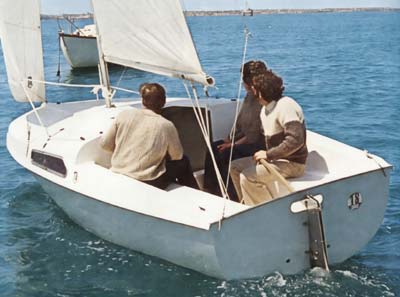
Historical photograph reproduced for identification and historical research purposes. Copyright remains with the original rights holder.