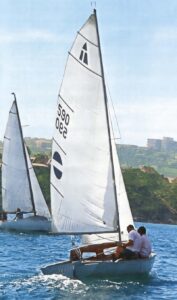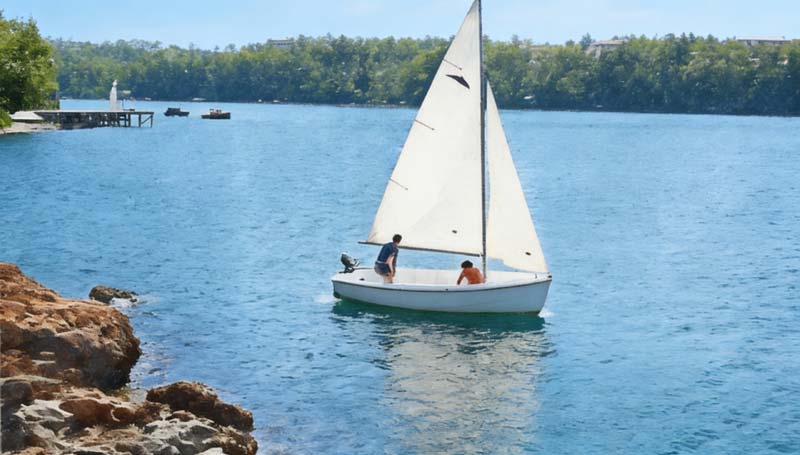
Introduced at the 1974 National Boat Show, the Dolphin quickly proved popular, generating a strong influx of orders for Savage Fibreglass Industries. Earlier this year Seacraft reviewed the outboard-powered launch version and came away favourably impressed.
To properly assess the sailing model, we took the Dolphin out on two occasions in the upper reaches of Sydney’s Middle Harbour, first in fresh, gusty westerly winds and later in very light conditions.
The first outing served a dual purpose: evaluating the boat’s performance in strong winds and providing Ron Young, Savage’s National Sales Manager, with his first experience at the helm of a sailing boat.
In the challenging breeze, the Dolphin performed admirably. It felt stable, handled gusts confidently, and tacked with ease.
Its performance in light airs was less impressive. After each tack, the bilge keels tended to lose effectiveness, causing the boat to fall off course before regaining enough speed to point properly. Once the wind increased beyond about five knots, however, the boat became much more responsive and sailed noticeably better.
The auxiliary outboard proved valuable when returning to the marina. In winds below five knots, with the breeze shifting direction constantly, there was insufficient power in the sails to maintain steerage. A centreboard could improve handling in such conditions, although this would sacrifice one of the boat’s key advantages, the ability to sail directly onto a beach and remain upright on its bilge keels.
A half-cabin version is also available and may appeal to family day sailors. Even the open version can accommodate a boom tent, providing shelter for four or five people overnight. The flat cockpit floor between the side seats offers exceptional legroom compared with other boats of similar size.
Storage space is plentiful, with compartments located forward, aft, and along the sides. Additional gear, food, and drinks can be stored beneath the removable floor sections.
Maneuvering under power can be awkward with the outboard mounted in the transom well. When reversing out of a marina berth, there was insufficient rudder authority to swing the bow around, requiring a jibe to clear the area.
Flotation is provided by foam buoyancy compartments glassed beneath the side seats and coamings. Because this buoyancy is positioned high in the hull, it should help keep the boat floating upright in the event of swamping (Hopkins 1975: 20).
At $2570 (1975) the Dolphin sailer is not cheap. Typically Savage, she is built strong and guaranteed to last.
BOAT: Savage Dolphin fibreglass family sailer (bilge keels). Built by Savage Fibreglass Industries, Melbourne. Test boat supplied by Spit Bridge Marina, Sydney.
LOA: 4.9 m. LWL: 4.57 m. BEAM: 2.06 m. DRAFT: 450 mm.
SAIL AREA: (sloop) 12.54m2. PRICE: (as tested) $2570 plus outboard and trailer (say $600).
Source: Hopkins, Paul (1975) ‘Special Purpose Dolphin’, Seacraft, December, p. 20.
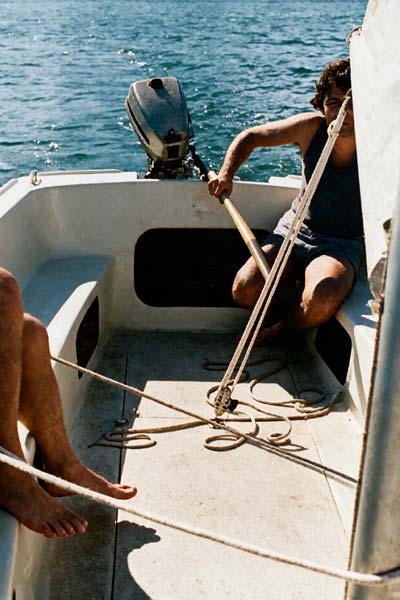
Historical photograph reproduced for identification and historical research purposes. Copyright remains with the original rights holder.