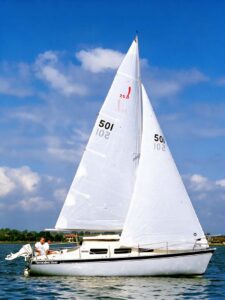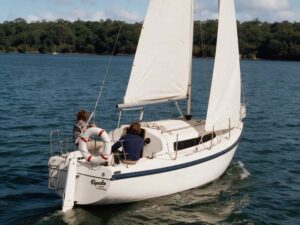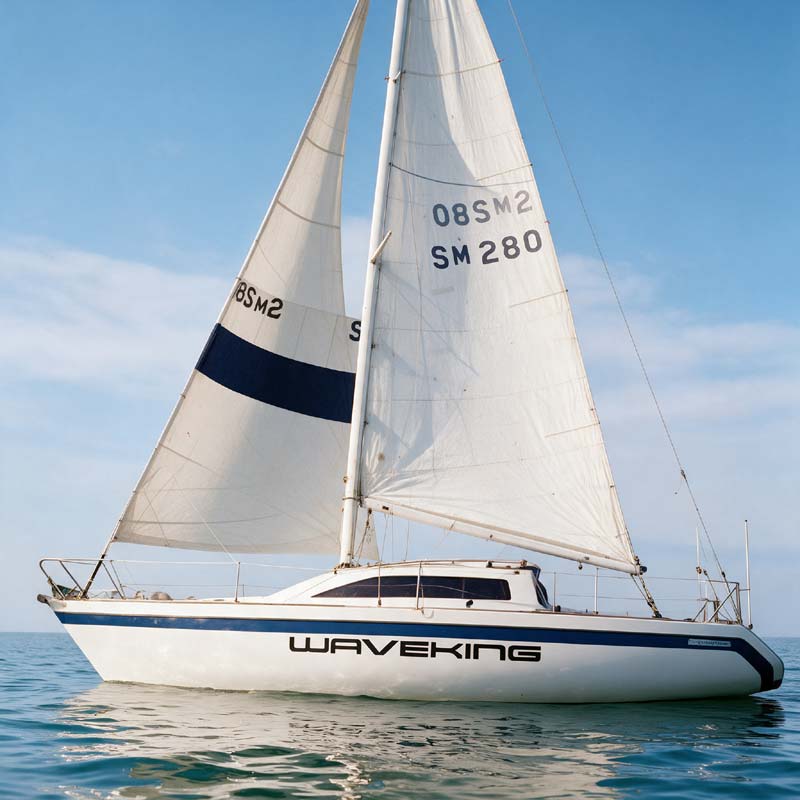
The Seaway 25 Elite, reviewed by Neil Baird, stands out as one of Australia’s most well-established large trailer yacht classes. Designed by Doug Peterson of San Diego and built by Tom Stephenson of Stephenson Sailboats Pty Ltd, this vessel functions as a miniature ocean racer that serves as an excellent stepping stone for small-boat sailors moving up to larger craft. Over its seven-year production history, the design underwent several revisions across roughly three models. The most substantial recent update produced the Elite model, which maintains the boat’s original sailing performance while significantly enhancing interior comfort for cruising. Although older models feature a slightly less functional cockpit and tighter below-deck quarters, the Elite model is the primary version available new and offers strong commercial appeal.
In terms of build quality and seaworthiness, the Seaway 25 exhibits the structural strength typical of traditional keelboats. It has proven its durability in harsh conditions, such as enduring a major collision during the Petersville Series with only minor deck-gear damage while another yacht sank. Seaways regularly compete across major Victorian waters in varying weather conditions without reporting significant structural faults. While not intended for trans-Tasman voyages, the boat is well-suited for safe coastal cruising. It easily complies with Victorian Trailable Yacht stability tests and remains remarkably steady even when carrying a shy spinnaker in heavy winds.
Despite its strong racing performance, many owners tend to overburden their boats with excessive gear, winches, and rigging line. Removing this surplus weight could noticeably improve speed and handling efficiency. On the water, the Seaway 25 performs admirably for its weight and hull shape, balancing competitive speed with practical features. In Victoria, its racing fleet size is second only to the Etchells class, offering a high standard of competition at the top while remaining accessible and fun for families and beginners.
The interior layout differs between the standard and Elite versions. The standard model contains basic accommodations, a Porta Potti, and a small galley alongside the centreboard case that is primarily useful for quick snacks while anchored. The Elite model provides a bare forepeak, two large settee berths surrounding a table built around the centreboard trunk, a starboard galley, a port-side chart table, and a spacious double quarter berth aft. Generous headroom at the companionway and extra port lights create a bright, comfortable interior suitable for week-long family cruises in areas like Port Phillip or the Gippsland Lakes. Although fitted with a retractable centreboard, rules often require it to remain locked down while racing, though the retracting mechanism remains invaluable for avoiding groundings in shallow waters.
Buyers could purchase the boat at various stages of completion, ranging from a bare hull and deck to a turnkey setup. A fully fitted boat including a trailer and sails cost around $30,000, with savings available for home builders, while second-hand models typically range between $16,000 and $24,000 depending on condition and equipment (Neil Baird).
SEAWAY 25 ELITE SPECIFICATIONS:
– Length Overall (L.O.A.): 7.83 m
– Beam: 2.49 m
– Draft (Keel Up): 0.33 m
– Draft (Keel Down): 1.55 m
– Displacement: 1,600 kg
– Internal Ballast: 480 kg
– Keel Ballast: 180 kg
– Rig Dimensions: I = 7.85 m, J = 2.58 m, P = 8.23 m
– Designer: Doug Peterson (San Diego, California)
– Builder: Stephenson Sailboats Pty Ltd (Labrador, Queensland)
Source: John Crawford Marine. “Seaway 25” Trailer Sailer Library. Accessed November 4, 2026.
https://www.johncrawfordmarine.com.au/advice/trailer-sailer/seaway-25
Photograph reproduced for identification and historical research purposes. Copyright remains with the original rights holder.
Quick tip: Keep in mind that trailer sailers can vary quite a bit, even within the same class. Take the RL28, for example: they might not all have outboard wells as designed. Some originally may have had inboard engines, and when those were removed, the owners swapped them for a standard outboard mounted on the stern.