The Van de Stadt 710 represents the evolution of a proven 1980 mini-tonner racing design into a high-performance trailer-sailer. The design was originally brought to production in Adelaide by Mander Marine, who built a single true International Offshore Rule (IOR) racing version named Cannonball in 1984. Cannonball achieved strong competitive success before being sold to Melbourne. Seeking to transform the concept into a true trailerable yacht with practical accommodation, engineer Allan Bradley collaborated with Mander to design a new deck based on the Dehler 22. This new superstructure retained the signature Van de Stadt aesthetics while dramatically improving interior headroom and usable space. Following his retirement as chief draftsman at Telecom in South Australia, Graham Jones formed GJ Tech, acquired the moulds, removed the original IOR hull humps, and refined the deck styling for production.
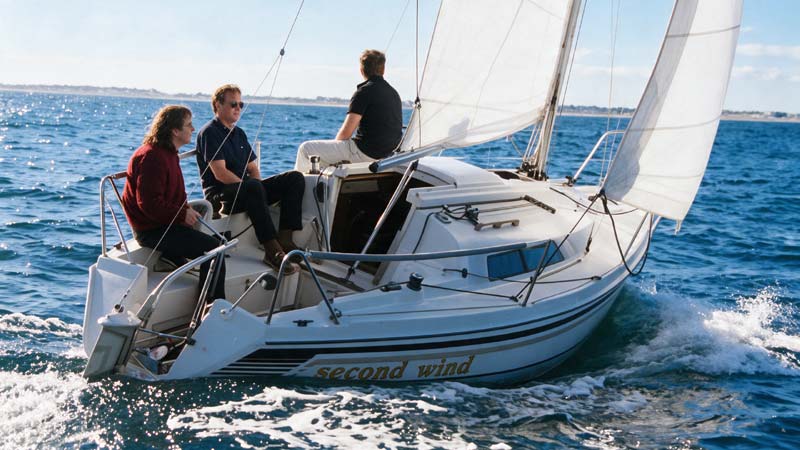
The resulting production demonstrator, named Second Wind and built by Brett Young’s Young Marine Services. The IOR-derived displacement hull delivers excellent sail-carrying capability and stability, offering peace of mind to family cruisers during sudden squalls by delaying the need to reef or drop sail area. The rig is designed for performance, built around a tapered Baverstock BS10 mast.
A key technical highlight of the Van de Stadt 710 is Graham Jones’s patented transom-hung rudder system. Traditional transom-hung rudders pivot along their leading edge, forcing the skipper to absorb intense hydraulic loads via the tiller during heavy steering conditions. While hull-penetrating rudders solve this by balancing 10 to 15 percent of the blade area ahead of the pivot axis, achieving this balance on a transom-hung, lifting rudder has historically been challenging. Jones solved this by engineering a dual-pivot mechanism using stainless steel arms that distribute rudder forces across a wide section of the transom. This system keeps the helm remarkably light and controllable even during hard reaching in heavy winds, while maintaining tactile feedback for the helmsman and eliminating unsightly forward-raked blade designs that catch sea grass.
The interior layout of Second Wind offers impressive versatility and accommodation for a boat of its size. The forepeak houses a V-berth with a chemical toilet underneath, separated from the main cabin by a privacy curtain. Moving aft past the mast bulkhead, the main cabin features an icebox to port and a compact galley to starboard equipped with a sink and a two-burner spirit stove featuring a flame-deterring top. Settees line both sides of the cabin, with raised backrests that double as storage bins to maximize berth width, while a fold-down dining table cantilevers directly from the centreboard case. Overall cabin headroom, light, and ventilation are expanded via a pop-top roof hatch. The standard build uses continuous interior bank mouldings, allowing owners to customize layouts with options such as an enclosed head, navigation station, extended berths for up to five adults, or alternative galley configurations.
Externally, the cockpit is open at the transom with high-backed seating and expansive under-seat storage lockers, including a dedicated compartment for the outboard engine fuel tank. The mainsheet traveller track is neatly recessed into the bridge deck, and the outboard engine (such as the 9hp engine fitted on Second Wind) is mounted in a central cockpit floor well. Construction utilizes high-grade materials, incorporating Arma Coremat in the hull and Divinycell foam coring in the deck. GJ Tech targeted owner-builders by offering the boat in various stages of completion, ranging from a bare bonded hull and deck kit to a fully fitted Deluxe model (Ross, Bob).
SPECIFICATIONS:
* Length Overall: 7.10 m
* Waterline Length: 5.70 m
* Beam: 2.50 m
* Minimum Draft: 0.30 m
* Maximum Draft: 1.30 m
* Keel Weight: 260 kg (Lead-ballasted fibreglass dagger keel, 5:1 tackle, 50 winch turns to raise/lower)
* Total Displacement: 1100 kg
* Mainsail Area: 15 sq m
* Foretriangle Area: 8.1 sq m
* No. 1 Genoa Area: 12 sq m
* Complete Deluxe Model ($38,700) (At time of Test): Fully fitted, including all above items plus 2-burner stove, icebox, chemical toilet, cushions, interior/nav lights, switchboard, and battery.
* Trailer ($4,680): Deluxe Mackay tilt trailer with walkway, hot-dip galvanised tandem axle, and 4-wheel hydraulic disc brakes.
* Builder G.J. Tech, Panorama SA.
Source: John Crawford Marine. “Van de Stadt 710” Trailer Sailer Library. Accessed November 6, 2026.
https://www.johncrawfordmarine.com.au/advice/trailer-sailer/van-de-stadt-710
Photograph reproduced for identification and historical research purposes. Copyright remains with the original rights holder.
Quick tip: Keep in mind that trailer sailers can vary quite a bit, even within the same class. Take the RL28, for example: they might not all have outboard wells as designed. Some originally may have had inboard engines, and when those were removed, the owners swapped them for a standard outboard mounted on the stern (Hill, James).