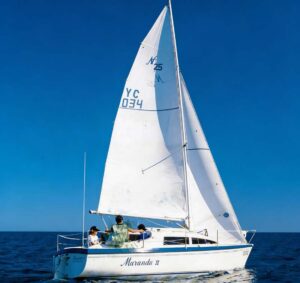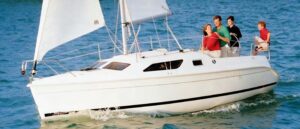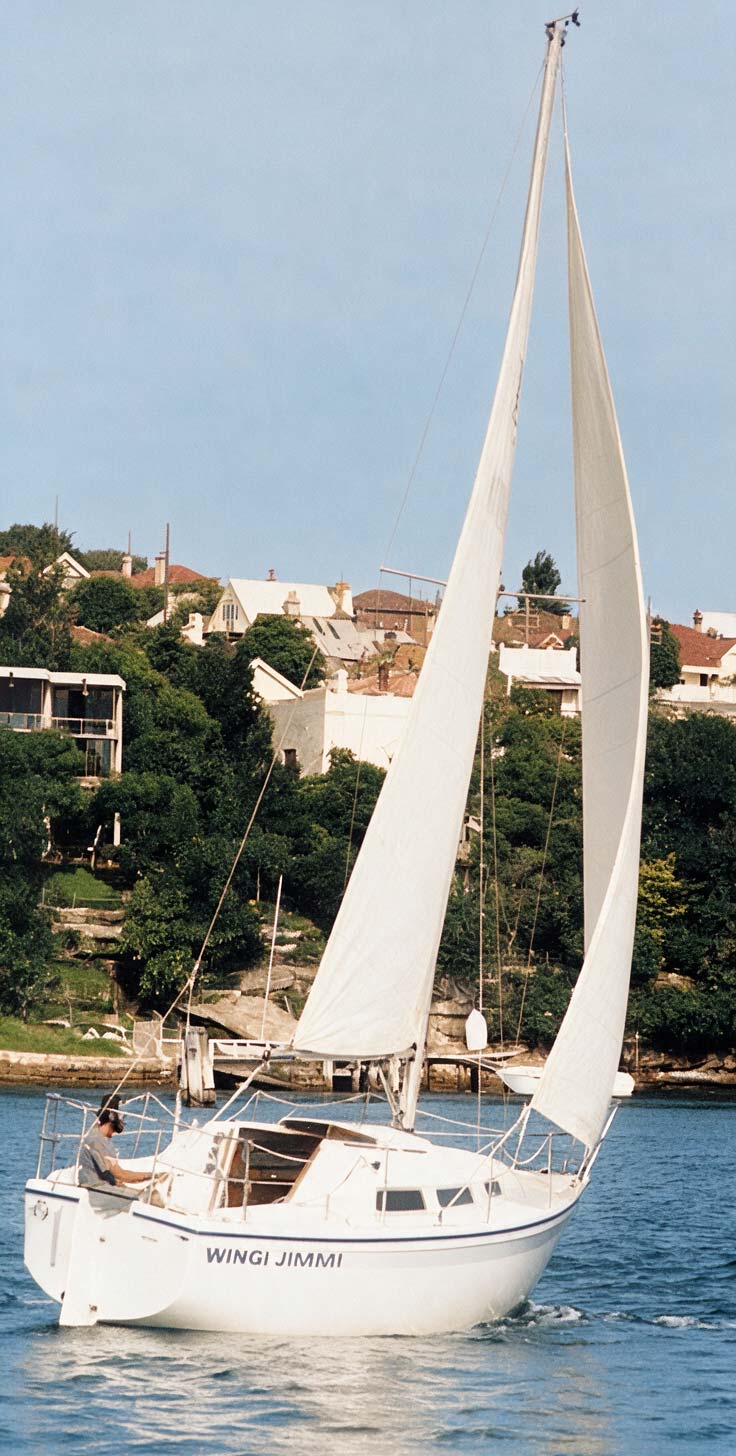
The Boomaroo 25 represents a natural evolution from the earlier Boomaroo 22 trailer-sailer. While it shares the same high standard of finish typical of Geoff Hall’s Boomaroo Yachts and retains the distinctive touch of American designer Frank Butler, who designed the widely successful Catalina 22, the Boomaroo 25 is fundamentally a distinct vessel. Now in its third year of Australian production, it stands out as a complete small yacht offering an inboard diesel engine and masthead wind instruments. It comfortably accommodates up to four adults and two children, providing ample elbow room and storage space for a family to holiday aboard for extended periods without feeling cramped.
Unlike many modern performance boats with fine bows and bulbous hulls, the Boomaroo 25 features a solid, conventional shape. Designed to combine good speed with a smooth motion, the vessel has a moderate V bow, slightly rounded hull sections, and a square transom with a moderately raked stern. Its centreboard is a swing keel mounted just behind the mast step, displaying a noticeable rake when fully extended. Incorporating a winch built into the companionway, the rudder operates at the same draft as the hull when the centreboard is raised, allowing the boat to take to the ground easily. On deck, the cockpit is spacious enough to seat at least four to six people comfortably, featuring smooth rooflines that taper cleanly into the foredeck, where a large anchor well is built into the bow section.
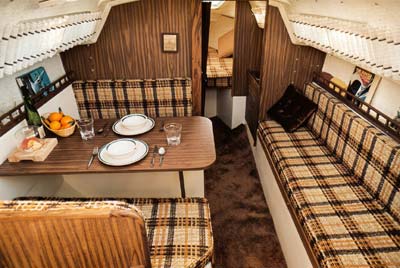
The layout below deck is thoughtfully arranged. To port, there is an L-shaped galley and a good-sized dinette, with a settee berth located opposite. The galley features the sink and icebox placed athwartships alongside a two-burner metho stove mounted on gimbals. Crucially, the cook has a dedicated, separate area out of the main pathway. While this configuration sacrifices a quarter berth on that side, it makes room for a large cockpit locker accessible from above. Forward of the saloon, a separate compartment houses the toilet opposite a washbasin and hand shower equipped with under-bench lockers. An open-plan setup connects this area to the bow’s double V-berth, though a two-way door or curtain can be fitted for privacy. To starboard, opposite the companionway, lies a large quarter berth suitable for two children, complete with its own locker shelf and fiddle rail. The test boat featured a 5kW BMW diesel inboard engine boxed under the cockpit floor, with control switches mounted on a bulkhead behind the sink. Despite the saloon headroom measuring around 1.6 metres, the cabin feels spacious and airy overall.
Rigged as a masthead sloop, all sail controls are led back to the cockpit via turning blocks. The rig includes a cap shroud, two lowers, a forestay, and an adjustable backstay. The mainsheet attaches to a transom-mounted track, while sheets are handled by cockpit-mounted winches. Under sail, the Boomaroo 25 proves to be more performance-oriented than its smaller predecessor. During a test sail on Sydney Harbour in an 8 to 10 knot north-easterly breeze with unpredictable gusts, the boat proved fast, responsive, and willing to point well into the wind. Although it heels quickly in sudden gusts, it remains predictable once settled.
In terms of purchasing options, the Boomaroo 25 was offered in several stages, starting from a basic hull and deck package with key fittings for $12,100 (1981), up to a fully optioned version with the BMW 5kW diesel engine for around $22,000, with custom trailers available separately. Overall, the boat reflects the expertise of a highly experienced trailer yacht designer, offering quality construction, attractive finishing, and a balance of speed and stability that appeals to both performance sailors and cruising families.
SPECIFICATIONS:
• LOA: 7.62m
• LWL: 6.76m
• Beam: 2.44m
• Draft (Board Up): 0.813m
• Draft (Board Down): 1.524m
• Ballast: 680kg
• Displacement: 1882kg
• Sail Area: 25 sq. m.
• Mast Height: 8.54m
Source: ‘Boomaroo 25’ Australian Boating, 1981, May, pp. 68-69.
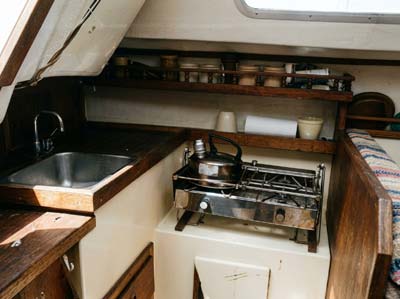
Historical photograph reproduced for identification and historical research purposes. Copyright remains with the original rights holder.
Quick tip: Keep in mind that trailer sailers can vary quite a bit, even within the same class. Take the RL28, for example: they might not all have outboard wells as designed. Some originally may have had inboard engines, and when those were removed, the owners swapped them for a standard outboard mounted on the stern.