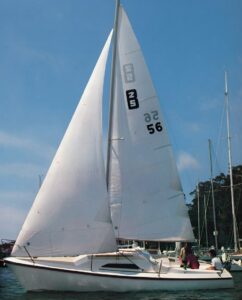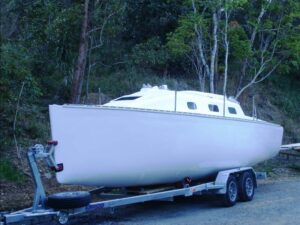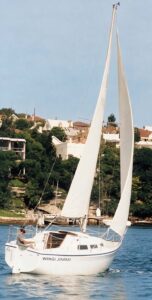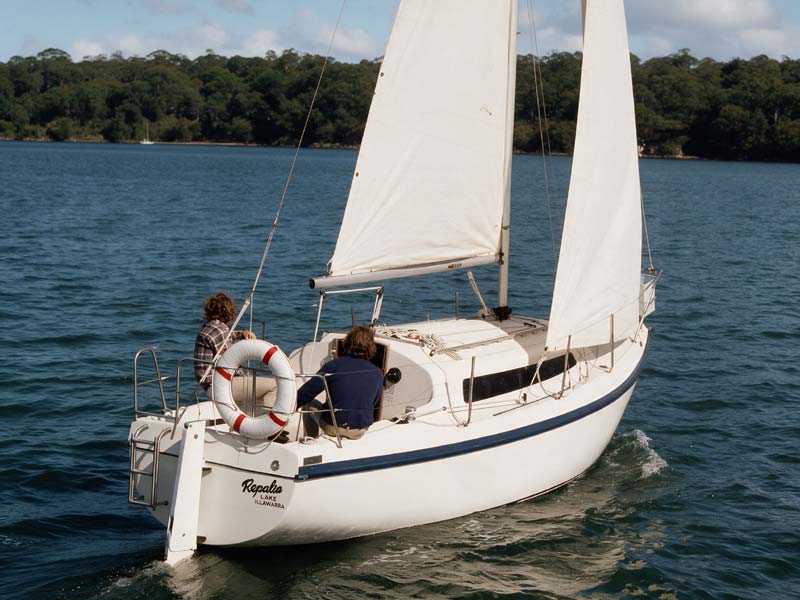
The South Coast 25 marked a notable milestone in Australian boatbuilding as one of the first production “maxi” trailerable yachts designed purely for cruising rather than racing. Built by NSW South Coast craftsman Rudy Waalkens, the vessel was developed directly from Bruce Roberts’ popular Roberts 25 design after an arrangement where Waalkens traded production rights in exchange for built models used in Roberts’ global promotional campaigns. Waalkens incorporated several key modifications to the original design, including an overhauled galley layout and an extended skeg to protect an inboard diesel propeller shaft. The resulting boat offers true highway trailer ability alongside remarkable interior volume, providing 6-foot headroom and comfortable sleeping arrangements for up to six people.
Featuring high topsides, cambered decks, a soft stem, and a slightly reversed transom, the yacht presents a massive profile out of the water that can initially seem daunting to tow. Below decks, however, this hull shape yields an exceptionally roomy interior. The accommodation includes a forward v-berth section, an enclosed head to starboard, a dinette and galley in the main cabin, and two large quarter berths extending aft. The centreboard casing, housing a 404 kg ballasted keel raised and lowered by a hydraulic pump, doubles as a central settee when locked down. The overall build quality and attention to practical detail are high, featuring teak handrails, quality French hatches, stainless steel fittings, and an ingenious folding boarding ladder and retractable rudder blade assembly. Construction employs hand-laid woven rovings and chopped strand mat, reinforced in high-stress upper deck areas with an end-grained balsa sandwich for structural rigidity.
Under sail, the South Coast 25 performs as a stable, forgiving family cruiser. While it initially heels easily up to about 10 degrees, it quickly firms up on its bilge, demonstrating strong secondary stiffness and excellent windward pointing capabilities even in blustery 20-knot conditions. Power can be supplied by an outboard engine in a recessed well or an optional small inboard diesel, such as the 7.5 hp Arona unit which pushes the hull to around 5.5 knots. Although its sheer size requires a capable V8 tow vehicle and careful handling at launch ramps, the rig is simple to step and handle single-handedly, making the vessel an ideal balance between a roomy keelboat for family holidays and a portable trailer-sailer.
SPECIFICATIONS:
* Designer/Origin: Direct development from the Roberts 25 by Bruce Roberts; modified and built by Rudy Waalkens (NSW South Coast, Australia)
* Length Overall (LOA): 7.69 metres (25 feet)
* Length Waterline (LWL): 6.44 metres
* Beam: 2.49 metres
* Displacement: 1.587 tonnes (retractable keel version); fixed keel version adds 500 kg
* Draught (Retractable Keel): 0.4 m (board up) to 1.6 m (board down)
* Draught (Fixed Keel): 1.42 m
* Keel Ballast: 404 kg (centreboard version), hydraulically operated
* Sailplan / Rigging: Single-spreader sloop rig, internal halyards, Barlow 15 winches, 3:1 backstay tackle; fixed keel version features an 8.53 m mast
* Auxiliary Power Options: Inboard diesel (e.g., 7.5 hp Arona diesel yielding ~5.5 knots) or outboard motor mounted in a recessed cockpit well
* Accommodations: Full 6-foot headroom, up to 6 berths (v-berth, convertible dinette/centreboard seat, two spacious quarter berths), enclosed head, full galley with ice chest and stove nook
* Construction: Fiberglass hull with hand-laid woven rovings and chopped strand mat; balsa-core sandwich deck reinforcement in stress areas; stainless steel hardware and teak trim
Source: John Crawford Marine. “South Coast 25” Trailer Sailer Library. Accessed November 6, 2026.
https://www.johncrawfordmarine.com.au/advice/trailer-sailer/south-coast-25
Photograph reproduced for identification and historical research purposes. Copyright remains with the original rights holder.
Quick tip: Keep in mind that trailer sailers can vary quite a bit, even within the same class. Take the RL28, for example: they might not all have outboard wells as designed. Some originally may have had inboard engines, and when those were removed, the owners swapped them for a standard outboard mounted on the stern (Hill, James).