Design
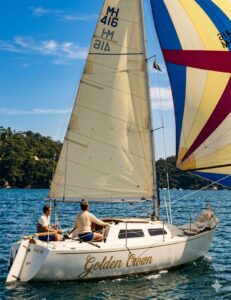
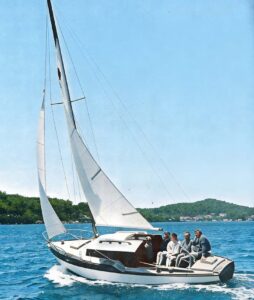
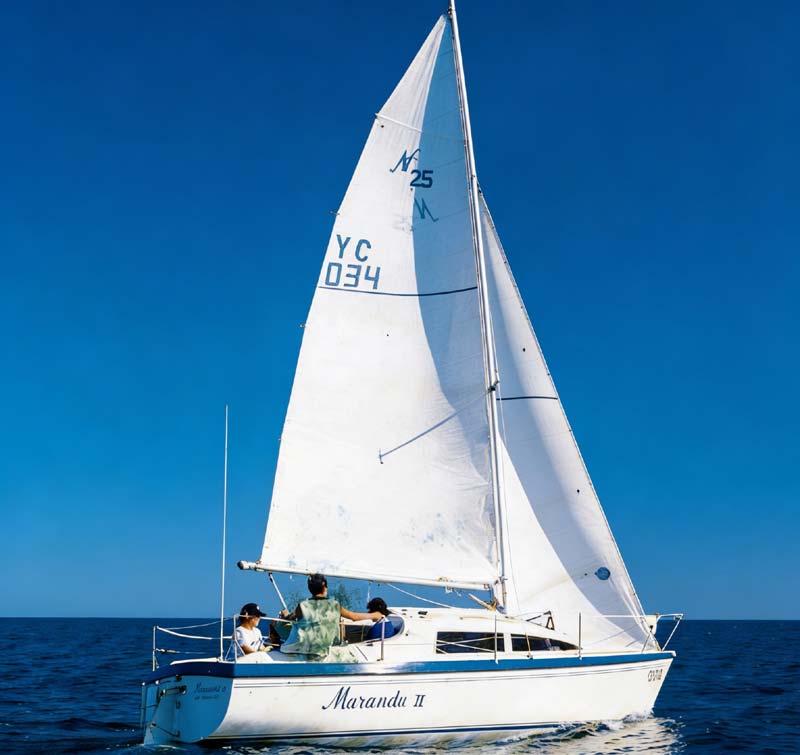
When designing the Noelex 25, Alex Tretheway and Steve Marten’s aimed to build a high-performing, uncomplicated vessel that was straightforward to rig, light enough to trail easily, and equipped with an unmatched interior cabin. Thanks to its strong competitive track record and widespread popularity, the New Zealand Yachting Federation recognized the boat as an official national class making it the sole 25-foot trailerable yacht to receive this distinction. Furthermore, since making its debut in Australia, the Noelex 25 has become a highly popular choice, bringing enjoyment to more than two hundred families. Today, it is a well-established racing class in Australia (Noelex Yachts n.d.).
To reinforce the build, Coremat is utilized to stiffen the deck and the bottom of the hull up to just above the waterline, whereas the topsides consist of solid fibreglass. To construct the deck, the deckliner moulding is vacuum-bagged directly to the main deck moulding, sandwiching a layer of filler between the two skins. Even with a comprehensive interior fitout featuring substantial timber trim, the boat has a displacement of 1180kg, and the deluxe model carries a towing weight of 1780kg. Beneath the hull, a long and shallow solid fibreglass keel is specifically designed to handle the stresses of trailing (Tranter n.d.).
The boats dimensions measure 7.77m by 2.50m, featuring a retractable drop keel that achieves a 1.4m draft when fully lowered. Inside, the keel trunk is kept low, rising to only half the height of the cabin, though its front edge extends to the ceiling to provide structural support for the mast. Because this keel casing is so short, it avoids splitting the cabin down the middle, keeping the interior open and easy to move around in.
To raise or lower the keel, a winch handle is inserted into the top of the casing, operating with a horizontal winding motion. The boat’s ballast consists of lead ingots housed entirely within this fibreglass keel, not in the hull, which is further reinforced by an internal, full-depth timber spar (Tranter n.d.).
The boat features high topsides, a moderately angled bow, narrow forward sections, and a flat hull shape toward the stern. A skeg extends along the centerline from just ahead of the centerboard casing back to the transom, where an outboard rudder is mounted using two pintles. When the centerboard is pulled completely up, the boat has a remarkably shallow draft of just 300 mm.
The maximum beam reaches the legal towing limit of 2.50 m. This width is maintained across roughly twenty percent of the boat’s total length just behind the middle of the boat, allowing it to settle stably onto its broad, flat stern when sailing downwind. The slender bow and low-volume forward sections provide excellent wave-piercing capability when sailing upwind (Australian Sailing, 1989).
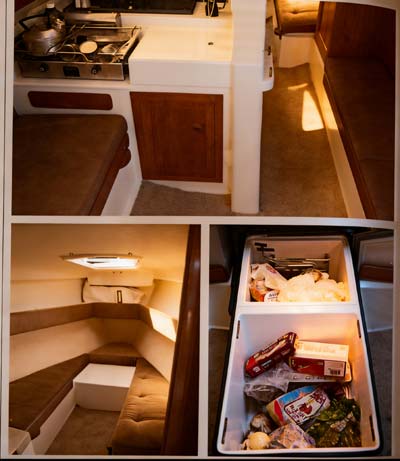
The cabin features an efficient design that comfortably sleeps up to six people. The sleeping arrangements consist of a forward V-berth, two quarter berths, and an innovative settee that converts into a double bed once the cabin table is folded down.
For functionality, a sight glass is positioned beneath the mast step to monitor the position of the retractable keel within its slot, while a sliding storage container is neatly tucked away beneath the cockpit. The amenities also include a built-in sink fed by an underlying 45-liter water reservoir (Australian Sailing 1989). To maximize space, the toilet is located in the forecabin, positioned around the corner behind the half bulkhead and centrecase structure (Tranter n.d.). [Check the sliding fridge/container’s opening is not restricted by the table. The table may have to be lowered to access it.]
While someone has occasionally fallen into the outboard well slot on other yachts with a similar layout, the Noelex design makes this difficult to do. To operate the system, the motor head is tilted forward, bringing the outboard leg inside the boat. The remaining opening in the hull is then closed using a dedicated moulding, which is maneuvered into position with a tubular alloy handle and wedged securely in place. Though this setup might appear complex at first glance, it is easy to get accustomed to. It successfully keeps water from entering the boat, prevents dropped items from falling through the slot, and keeps the outboard motor safely inside where it is easy to service and maintain. This design keeps the motor off the transom where it would otherwise disrupt the boat’s clean lines (Tranter n.d.).
Sailing: “A clue to the Noelex’s character is an obvious one — you reach for the tiller extension and there it ain’t. You sit in this TS, not out on the sidedeck. The hull sections are quite rounded underwater, so there’s not a terrific amount of initial stiffness, but the Noelex doesn’t heel too far before settling down. She tacks instantly, and is a pleasure to work up a narrow channel in a shifting southerly, as we did while heading back to the ramp at Pittwater’s Bayview. There is no lurching or unpredicted change in direction of travel, either. This is not a boat to frighten the unwary, or scare the kids, or petrify the skipper when it attempts to take charge and attack a moored boat or a channel market” (Noelex Yachts n.d.).
|
Specification |
Measurement |
|
Length |
7.77m |
|
Beam |
2.50m |
|
Draft (board up) |
0.30m |
|
Draft (board down) |
1.40m |
|
Displacement |
1079kg |
|
Sail Area (working) |
21.37 sq m |
|
Spinnaker |
32.03 sq m |
|
Flanker |
21.08 sq m |
|
Towing Weight |
1600kg [Approx] |
|
Construction |
GRP/polyester sandwich |
Built by Noelex Yachts (Aust): Maurice Perry, Director
- Low-aspect sail plan is easy to handle.
- Outboard located in a well gives positive manoeuvrability.
- Tandem trailer had power winch and good roller system.
- Jib is on a self-tacking track.
- The galley is compact and well-equipped.
Other Features
- Anchor locker
- V-berth
- Hanging locker
- Galley
- Table
- Settee berth
- Food bin and refrigerator
- Aft lockers
Sources
Boat Review: Noelex 25, Australian Sailing, January 1989, p. 62.
Noelex Yachts n.d., Noelex 25 brochure, John Crawford Marine Trailer Sailer Library, viewed 20 May 2026, https://www.johncrawfordmarine.com.au/advice/trailer-sailer/noelex-25.
Tranter, Barry n.d. ‘Noelex, No Less’ Trailer Sailer, p. 57.
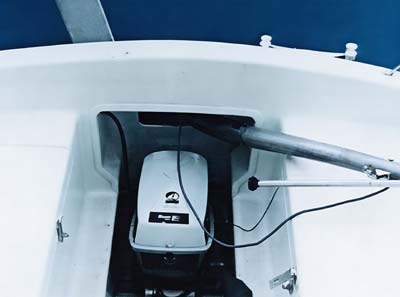
Historical photograph reproduced for identification and historical research purposes. Copyright remains with the original rights holder.
Quick tip: Keep in mind that trailer sailers can vary quite a bit, even within the same class. Take the RL28, for example: they might not all have outboard wells as designed. Some originally may have had inboard engines, and when those were removed, the owners swapped them for a standard outboard mounted on the stern.