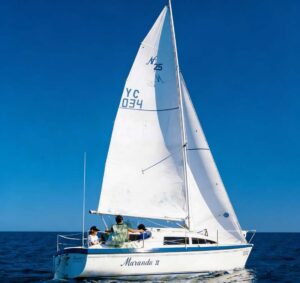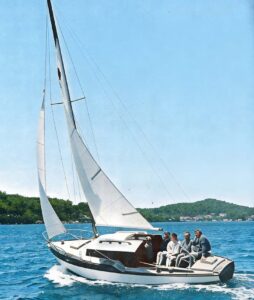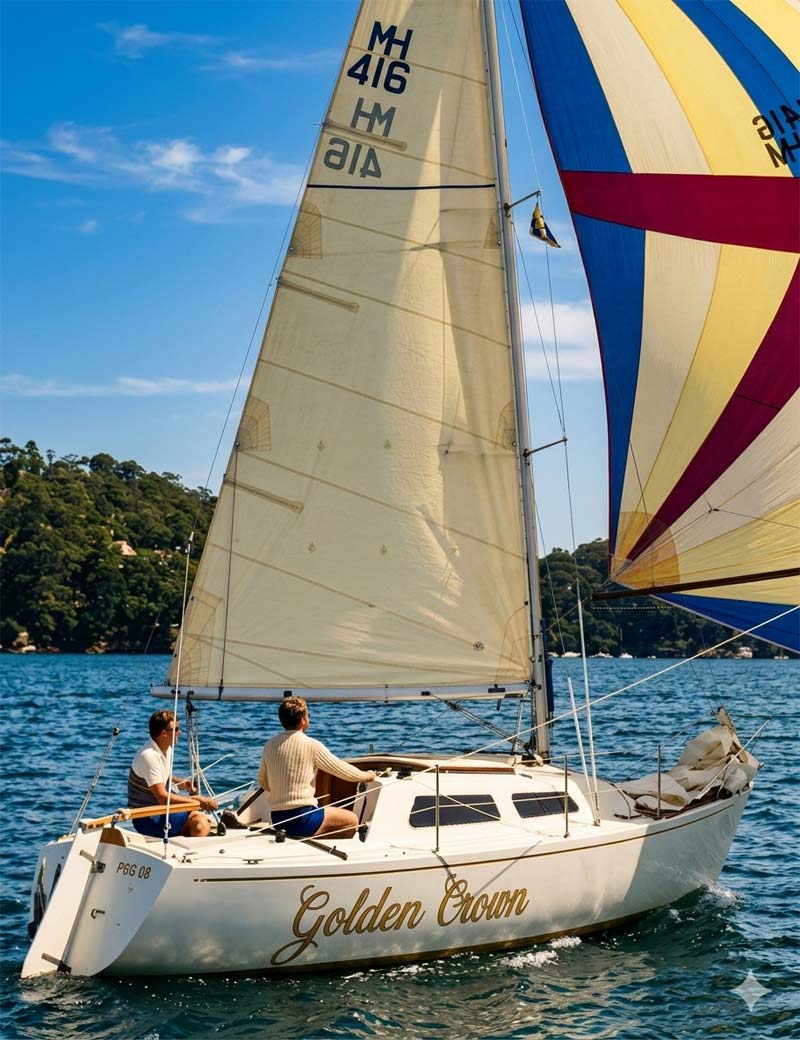
When he designed the boat, 25-year-old Duthie Lidgard was already recognized as one of New Zealand’s premier master boat builders and designers carrying on a long family legacy in yacht racing and construction. Seeking new opportunities, Lidgard moved his young family across the Tasman to Australia to act as the local agent for WEST (Wet Epoxy Saturation Technique) System products.
The WEST System works by fully saturating a core material, like wood, to create a completely sealed, dual-sided barrier. This process preserves and enhances the timber’s natural properties far beyond its organic limitations. While the technology now enjoys a global, near-cult following among amateurs and professionals alike, Lidgard was ahead of the curve. He recognized that successfully marketing the epoxy required introducing innovative new boat designs, not just selling resin by the gallon.
Though Lidgard’s initial plans for the Lidgard 25 were well-received, skeptical Australian buyers chose to wait until a physical prototype was completed. The resulting yacht showcases Lidgard’s exceptional craftsmanship and highlights the finish achievable through the WEST System:
-
The Interior: Features warm, hand-rubbed timber that gives the cabin an inviting glow, avoiding the cold, sterile feel common in mass-produced fiberglass (G.R.P.) boats.
-
The Exterior: Possesses a mirror-like finish so flawless that an untrained eye would never guess the boat is made of wood. This look is the result of good preparation, multiple coats of two-part polyurethane, and the inherently smooth, “fair” hull produced by Lidgard’s construction method.
To put the yacht into production, Lidgard needed a building method that allowed amateurs to achieve professional-grade results. He evaluated and ruled out several traditional materials:
-
Fiberglass & Aluminium: Impractical or impossible for one-off amateur builds.
-
Foam or Balsa Core Sandwich: Offered some benefits, but building the required mold/plug was as complex as building the boat itself.
-
Sheet Plywood: Fast and easy to handle, but largely restricted to hard-chine (less rounded) hulls.
-
Cold-Moulded Timber: Offered excellent structural stiffness but was far too complex for amateurs.
Lidgard sought a compromise that combined the simplicity of plywood, the low maintenance of fiberglass, and the strength of cold-molded hulls, all while being fast, affordable, and accessible to builders anywhere.
By collaborating closely with WEST System development teams in New Zealand and America, he pioneered a new solution: a composite system utilizing Western Red Cedar strip-planking running lengthwise (fore and aft), reinforced inside and out with unidirectional E-glass glass and WEST System epoxy running across the grain. This breakthrough approach offers a variety of exciting structural advantages (Australian Boating 1982: 63).
The Lidgard 25 is a very typical Kiwi-style light displacement sailingcraft that is available with a fixed keel to moor or berth in a marina, or for owners in Queensland or Western Australia who wish to trailer their craft, it is also available with a lifting centreboard. There are minor rig and sail plane changes, but these Lidgard will detail separately on application.
The mast is a Tasker 52 section with double swept back spreaders, tapered and sleeved up to the bottom spreaders for additional support. Jumpers, struts or stays have been fitted to reduce whip and support the the upper section as the racing spinnaker hoists above the hounds. The boom is the Tasker S3 section with external jiffy reefing and internal outhaul. The spars were well put together by La Mer Spars, of Melbourne.
The Lidgard 25 is a classic New Zealand-style, light-displacement sailing craft designed for swift cruising and racing in warm, windy conditions.
Buyers can choose a fixed-keel version (ideal for marinas and moorings) or a lifting centerboard version (perfect for trailering, particularly in Queensland or Western Australia).
The hull features a narrow, straight-sided bow to pierce through chop, underwater U-sections that widen two-thirds of the way aft, and a moderately wide transom. This balanced configuration ensures reliable, all-around performance and forgiving handling.
The specifications for the fixed-keel version highlight high-quality hardware and a sophisticated, bendy three-quarter rig:
The spars built by Melbourne’s La Mer Spars, featured a Tasker 52 mast (tapered and sleeved for extra support with double swept-back spreaders, jumpers, and stays to minimize whip when the racing spinnaker is hoisted) and a Tasker S3 boom with external jiffy reefing.
Supplied by Lidgard Sails (NZ), including a durable Twintex mainsail, a large 56.5 sq. m. cruising spinnaker, and a highly efficient, self-tacking headsail.
Departing from conventional layouts, the interior prioritizes the real-world needs of a family of four or five. Swapping a rigid dining table for maximum lounging space, the layout accommodates the reality that families usually eat in the cockpit or on the long cabin settees.
Instead of cramped, impractical forward V-berths, the boat utilizes two wide, well-ventilated, and highly comfortable quarter berths.
The marine toilet (head) is positioned forward behind a bulkhead for easy curtained privacy, while the bow area offers an abundance of storage space for sails and duffels.
During a test sail on Middle Harbour, shared by designer Duthie Lidgard, the author, and debut reviewer Chris Thompson, the yacht proved to be exceptionally fast, well-balanced, and stable.
The large, skeg-hung rudder provides superb tracking. Even when intentionally overpowered and heeling past 25°, the boat maintained a straight course with minimal weather helm and no tendency to round up. It bears away effortlessly, promising manageable handling in heavier winds. The only minor drawback is the tight spacing between the tiller and the traveler, which can make moving around the cockpit a bit clumsy; a lifting tiller would resolve this.
The small, self-tacking headsail is a standout feature. It can be tacked and trimmed easily without winches or tracks (using a simple block near the shrouds and a windward sheet for barber-hauling), making it easy enough for a child to operate. Protective brass plates prevent the cabin top from chafing. Despite its smaller surface area, the test boat proved highly competitive, securing three 1st-place finishes and two 4th-place finishes against a tough J-24 fleet.
The mainsail is large but easily depowered using a full-beam traveler. Downwind, the boat truly comes alive under its massive spinnaker. The spinnaker setup features safety-enhancing “tweakers” to stabilize the sail in heavy winds, though the brace sheets run from the quarters to the winches, partially obstructing the side decks. Most secondary controls (cunningham, vang, topping lift) are located at the mast where the hiking crew can easily reach them.
The Lidgard 25 is highly accessible, offering two distinct paths to ownership:
- Turnkey ($20,000) [1982]: Fully completed and outfitted by Duthie Lidgard, ready for immediate racing or cruising.
- Amateur Build ($9,000 – $10,000): A comprehensive kit for home builders that includes professionally cut sails, standing rigging, and running rigging. Enthusiastic builders could even pare this cost down by a few thousand more by sourcing some elements independently.
By blending the natural strength of timber with advanced epoxy chemistry, the Lidgard 25’s WEST System construction eliminates the traditional drawbacks of wood. It delivers one of the finest, most beautifully balanced helms available in the 7-to-10-meter class (Australian Boating, 1982, pp. 64-68).
The specifications below are for the fixed keel yacht:
| Specifications | ||
| Overall Length | 7.80 m | 25′ 7″ |
| Waterline Length | 7.15 m | 23′ 5″ |
| Maximum Beam | 2.48 m | 8′ 2″ |
| Draft | 1.675 m | 5′ 6″ |
| Displacement | 1180 kg | 3110 lb |
| Ballast | 725 kg | 1600 lb |
| Ballast Ratio | 51.5 % | |
| Mainsail | 17.8 sq.m | 190 sq.ft. |
| 100% Jib | 9.86 sq.m | 105 sq.ft. |
| Racing Spinnaker | 56.5 sq.m | 605 sq.ft. |
| Cruising Spinnaker | 44.0 sq.m | 470 sq.ft. |
Source: Australian Boating Test 192, Australian Boating, April 1982, pp. 63-68.
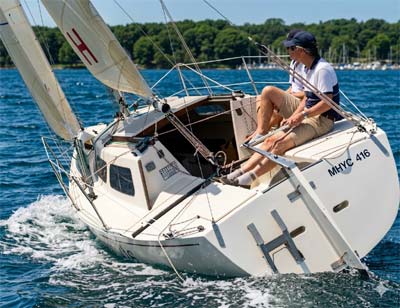
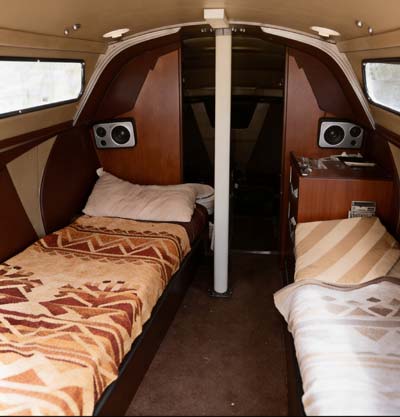
Historical photograph reproduced for identification and historical research purposes. Copyright remains with the original rights holder.
Quick tip: Keep in mind that trailer sailers can vary quite a bit, even within the same class. Take the RL28, for example: they might not all have outboard wells as designed. Some originally may have had inboard engines, and when those were removed, the owners swapped them for a standard outboard mounted on the stern.