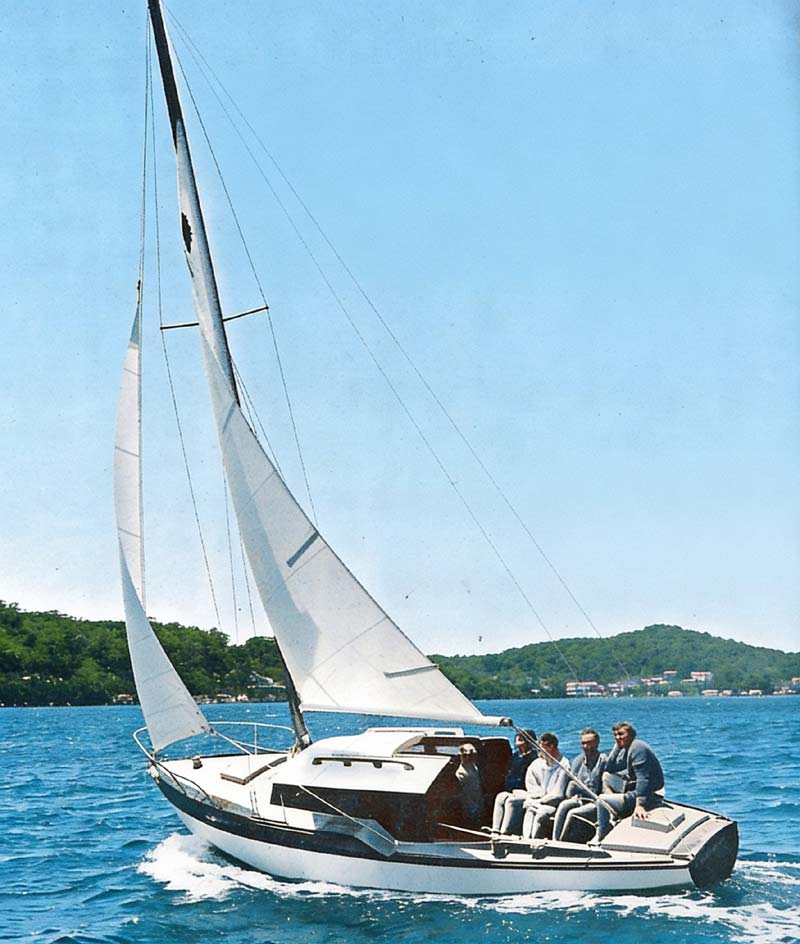
Gosford yacht designer Dennis Knight successfully incorporated full six-foot headroom into a 25-foot boat, a rare feat for a boat of this size. Built from 7/16-inch Bruynzeel mahogany marine plywood across 11 heavy frames, the hull features unique triple chines, making it robust and massive. A varnished finish on the raised deck and cabin helps visually balance her naturally high topsides. The prototype was remarkably economical to build, costing under $2,000 [1970 prices] including the outboard motor.
The Crusader prioritizes interior living space over raw racing performance, sleeping four adults comfortably. The layout includes two forward bunks beneath the fore hatch and two quarter berths in the main cabin that convert into dual dining tables. It features a built-in stove and sink, ample storage, and space between the forward bulkheads for a future enclosed marine toilet and wardrobe. On deck, the deep, 5.5-foot self-draining cockpit offers excellent protection from the elements thanks to high seat backs acting as coamings, a flush anchor hatch, and a noise-reducing engine cover.
While the boat excels in interior space, its sailing performance left something to be desired. Tested in Brisbane Waters during a 15-to-20-knot southerly breeze, the Crusader handled the gusty conditions well under full sail but exhibited a jerky motion and a distinct “keel slap” when waves struck the windward side. It was quick to heel and snap back upright, though reefing the mainsail and swapping to a 70-square-foot jib stabilized the ride. When compared to Knight’s established 22-foot design, Waratah, the Crusader lagged behind in speed and pointing ability to windward, though it held its own when reaching or running.
The yacht utilizes 1,250-pound (567kg) twin bilge keels rather than a traditional deep keel. While bilge keels perform poorly in light weather, they shine in heavy winds by remaining vertical on the leeward side to reduce leeway. Crucially, they allow the boat to stand upright on its own “legs” and navigate shallow, shoaling waters safely. To combat the prototype’s jerky motion, Knight has already modified the blueprints to position the keels closer together.
A standout innovation is the metal twin-rudder steering system. Positioned directly behind each keel, these small, powerboat-style rudders allow for remarkably well-balanced, hands-free cruising. Ultimately, the Crusader is a spacious cruising yacht optimized for comfort.
| Specification | Details |
| YACHT | Crusader, bilge-keel family sailer. Plywood construction |
| DESIGNER | Dennis Knight, Green Point, Gosford, NSW. |
| LOA | 24 ft 9 in. |
| LWL | 21 ft |
| BEAM | 7 ft 6 in. |
| DRAFT | 2 ft 6 in. |
| DISPLACEMENT | 5000 lb |
| BALLASTED KEELS | 2500 lb total |
| MAINSAIL | 140 sq ft |
| GENOA | 140 sq ft |
| JIB | 70 sq ft |
| AUXILIARY | outboard to 10 hp housed in special engine room. |
| ACCOMMODATION | sleep four. Two forward, two in main cabin. Six feet headroom throughout main cabin. |
| COSTS | $80 for plans, $1800 for complete yacht (ready to sail), $500 for suitable outboard motor. |
Source: Hopkins, Paul (1970) ‘Knights Crusader’, Seacraft, February, pp. 28-29.

Historical photograph reproduced for identification and historical research purposes. Copyright remains with the original rights holder.