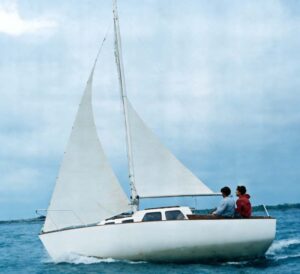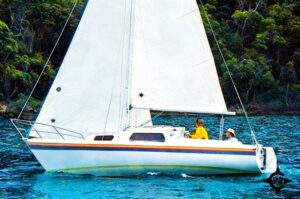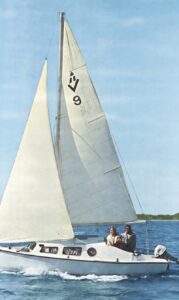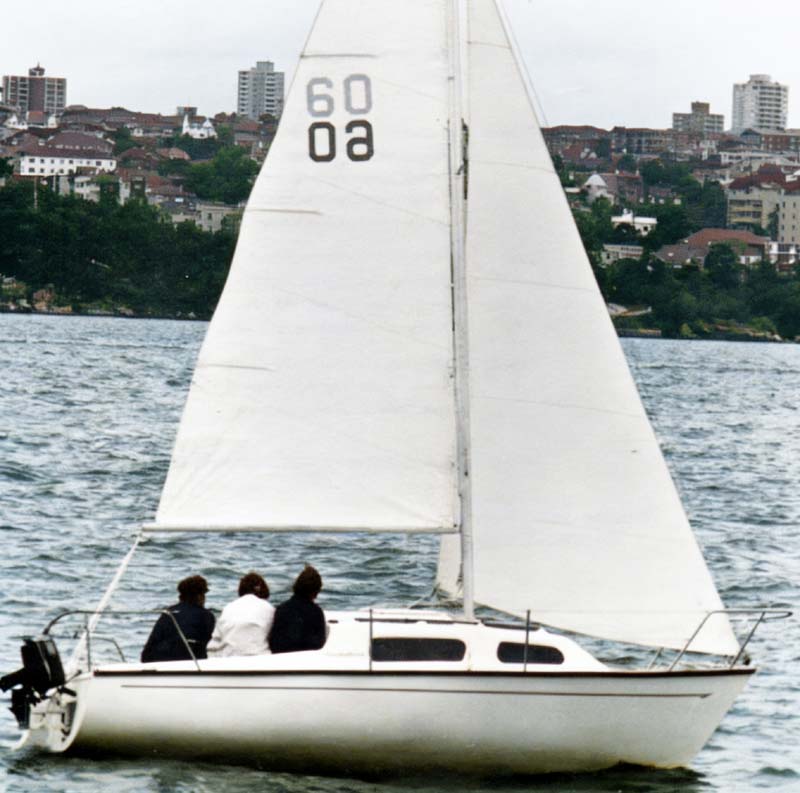
At just 5.6 metres overall, the Investigator, designed by Kevin Shepherd, punches well above its weight. Its combination of a shallow fin keel and a swing centreboard gives it strong upwind performance and an impressive ballast-to-displacement ratio of 47 percent, making it exceptionally stable and able to self-right after a knockdown. The design earned a Gold Award from the Industrial Design Council of Australia.
Though conceived and built in Sydney, the boat found its greatest following in Queensland, where sailors tend to favour trailer sailers capable of handling rough offshore conditions. The build quality is functional rather than luxurious, but the Investigator carries a distinctly yacht-like character – curved sheerline, a neatly tucked stern, and a reverse transom – that sets it apart from the more dinghy-like trailer sailers on the market.
Shepherd came to the design with serious credentials, having raced Gwen 12s and 16-foot skiffs before managing Rolly Tasker’s Sydney marine centre, working on Admiral’s Cup campaigns, and eventually joining Hood Sails as a sailmaker. His central design brief was safety: the boat had to be self-righting in exposed waters regardless of how many people were aboard. The centreboard-in-keel configuration solved several problems at once – achieving the target ballast ratio while freeing the cabin of an intrusive centreboard case.
The rig is straightforward. The 6.71-metre mast pivots on a stainless steel pin and can be raised by two people without too much difficulty. The jib halyard doubles as a forestay, with furling gear operable from the cockpit – a system Shepherd had used on earlier designs. Nearly all running controls, including the centreboard pendant, are led aft so the boat can be managed single-handed.
Launching is smooth enough, though the solid rudder blade couldn’t be fitted until the boat was in the water, which was mildly inconvenient on an awkward ramp. Once underway in a fresh breeze, the Investigator felt secure and confidence-inspiring. In lighter conditions it moved well with just mainsail and jib, and performed comfortably on all points of sail. The centreboard was essential upwind and made a noticeable difference to speed when raised on a reach or run.
Below decks the boat opens up surprisingly well for its size. Shepherd arranged four fixed berths – two settees in the saloon and two vee berths forward, separated by a structural bulkhead that also carries the mast step load. The galley is a clever slide-away arrangement: a stove to port and a sink to starboard, each stowing under the cockpit when not in use. A head can be optionally fitted between the forward berths. Headroom is a reasonable sitting height, extending to around 1.6 metres when the pop-top is raised.
The cockpit seats four adults in comfort, with backrests, and includes two lockers – one large enough for an outboard motor. On-deck details are well considered: anchor well, sturdy handrails, good non-skid surfaces throughout, and notably, moulded boarding steps in the transom, an elegant safety feature.
In base form the boat was priced at $5,450 in the late 1970s, rising to around $8,800 fully equipped with trailer, furling gear, lighting, heads, and safety gear. The Investigator is considered this good value for an honest, well-built little yacht with genuine offshore capability and handsome lines (Hill 1981: 82-84).
FACT BOX
INVESTIGATOR by Kevin Shepherd from Investigator Yachts, Sydney.
- LOA ………………………..… 5.6 m
- Beam ……………………..… 2.13 m
- Draft ………………………….533 mm/914 mm
- Displacement …………… 659 kg
- Ballast ……………………… 317 kg
- Working sail area ……. 14.64 m²
Quick tip: Keep in mind that trailer sailers can vary quite a bit, even within the same class. Take the RL28, for example: they might not all have outboard wells as designed. Some originally may have had inboard engines, and when those were removed, the owners swapped them for a standard outboard mounted on the stern.