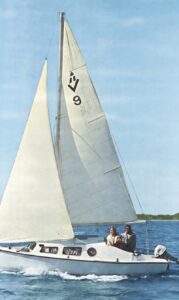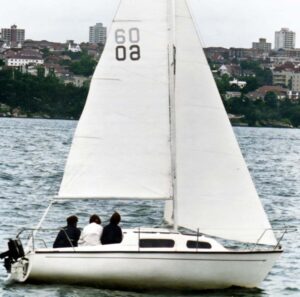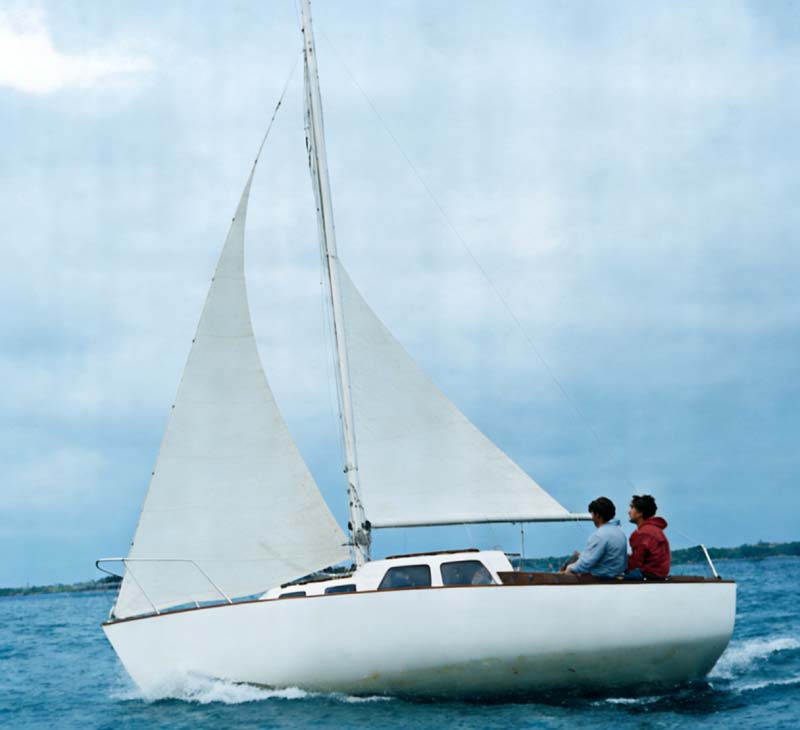
“When in Adelaide, do as the South Australians do — sail in winds that would blow the hair off a billiard ball. And that’s what we did to test this worthy fibreglass trailer/sailer.”
The Duncanson 18 trailer sailer was designed by Australian naval architect John Duncanson in 1968. It was initially manufactured in Adelaide, South Australia. Shortly after its release, David Rose Yachts (based in Sydney, NSW) acquired the manufacturing rights and molds. They renamed the boat the Careel 18, which went on to become one of Australia’s most popular trailer sailers.
The Duncanson 18 is a roomy, family-oriented trailer sailer with a wide beam that provides generous interior space and comfort. Its hull and deck are moulded separately and joined at the sheerline, while timber gunwale cappings, coamings, and grab rails give the boat an attractive finish.
The deck features moulded non-slip surfaces in a contrasting colour, providing secure footing in rough conditions. A self-draining cockpit and reinforced transom allow water to exit quickly over the stern and accommodate an outboard motor.
Inside, the centreboard case occupies part of the cabin sole but is no more intrusive than those found in similar boats. The swing centreplate is winch-operated, constructed from steel, and protected with an epoxy coating for durability. Built-in polyurethane foam buoyancy compartments provide flotation and appear adequate for the yacht’s intended load.
The aluminium mast and boom incorporate internal sail tracks, while roller reefing allows sail area to be reduced quickly when conditions freshen. The boat is equipped with stainless steel standing and running rigging, including shrouds, forestay, halyards, and rigging screws.
The sails, built by Barry Quin of Port Adelaide using Contender sailcloth, were reported to perform well in demanding weather. The standard sail plan consists of a 134 sq ft mainsail and an 81 sq ft jib.
Accommodation below decks includes four berths arranged around the centreboard case, allowing four adults to sleep aboard. A folding teak table mounted over the centreboard case provides dining space for the crew.
Standard equipment includes two insulated iceboxes, interior lining panels, and practical storage compartments. Space is also provided for the installation of a galley and marine toilet according to the owner’s preferences, while additional storage beneath the bunks helps keep the cabin uncluttered.
Although not designed as a racing yacht, the Duncanson 18 offers one of the most spacious interiors available in an Australian trailer sailer of its size. With sufficient room for overnight trips and weekend cruising, it places comfort ahead of outright performance.
For home builders, a hull-only package was available, including bonded hull and deck mouldings, fitted gunwale cappings, cockpit coamings, cabin doorway framing, rudder fittings, prepared window openings, cockpit locker covers, fore hatch, and a moulded centreboard case.
During testing in strong and gusty conditions, the boat initially carried its full sail plan but became much easier to handle once reefed. Under reduced sail it showed good stability, with quick initial heel followed by a reassuringly firm feel once settled onto its broad bilges. It also demonstrated good speed on reaching courses.
Designer John Duncanson reported successful sailing in 30-knot winds on Gulf waters, describing the boat’s behaviour as excellent. Its generous freeboard, substantial beam, and inherent stability contribute to its reputation as a capable and confidence-inspiring family cruiser.
Rigging and launching the Duncanson 18 is straightforward and comparable to other centreboard trailer sailers. The mast can be raised or lowered by two people, and sail handling is simple, making the boat practical for regular trailering and family use (Hopkins 1969, pp. 26-29).
FACT BOX
-
Boat — Duncanson “18”, trailer sailer — Commodore.
-
Maker — Duncanson Marine Pty Ltd, Port Adelaide, SA.
-
LOA — 18 ft 4 in. Beam — 7 ft 5 in.
-
Draft — 1 ft (fully laden).
-
Mast — 23 ft above coach roof.
-
Displacement — 1344 lb
-
Sail area — standard: mainsail 134 sq ft; jib 81 sq ft (storm jib 28 sq ft; genoa 112 sq ft)
-
Accommodation — four berths. Ice boxes. Provision for galley and marine toilet. Ample storage. Large, deep self-draining cockpit.
-
Construction — all fibreglass, hull and deck. Teak trim throughout. Rigging — alloy spars, all stainless steel wires and gear. Roller reefing standard.
-
Price — ready to sail, including tax, $2760. Hull only $1295.
This boat later became the Careel 18.
Source: Hopkins, Paul (1969) ‘Gale Tested – Duncanson 18’, Seacraft, June, pp. 26-29. Historical photograph reproduced for identification and historical research purposes. Copyright remains with the original rights holder.