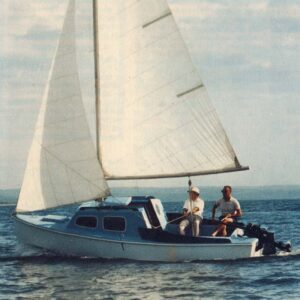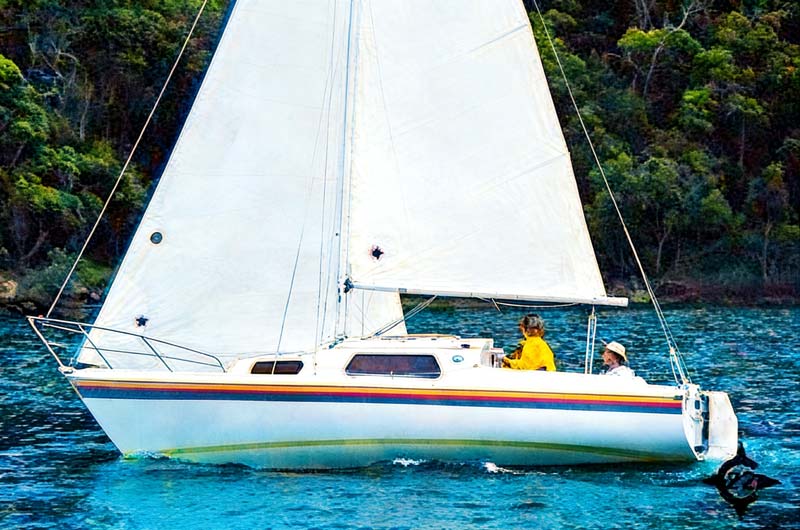
The Compass Careel is a redesigned Duncanson 18 with everything that opens and shuts.
According to Compass Careel retailer David Rose, the most significant changes to the yacht resulted from both the passage of time and a change in manufacturing. The revised production methods ensured a more consistent standard of construction, with each boat leaving the mould to the same quality as the one before it.
Construction techniques were also refined. The centreboard case became an integral part of the hull moulding, reinforced with marine plywood and fibreglass for added strength. A redesigned hull incorporated a gently curved transom, eliminating the need for screws where the hull and deck mouldings joined.
Numerous practical improvements were introduced. The original teak coamings were replaced by moulded coamings with integrated winch pads, reducing maintenance while improving comfort. Other additions included a foam-insulated icebox draining into the self-draining cockpit, a stronger and more attractive pushpit, a dedicated fuel locker for a five-gallon tank, and a block-and-tackle centreboard system that replaced corrosion-prone winches. A centreboard locking mechanism was also fitted, preventing the board from retracting into the case if the yacht was knocked down.
Further refinements included an efficient roller-reefing system proven in offshore racing, an insulated cabin roof, improved interior finishes with no exposed fibreglass, a teak mast support replacing galvanised pipe, and a completely redesigned interior moulding with provision for a marine toilet. Larger cabin windows improved visibility, while additional timber and plywood reinforcement in key structural areas enhanced both strength and seaworthiness.
Rose also highlighted a specially designed self-draining cockpit, upgraded teak interior panelling featuring cup racks and a fold-down stove arrangement, removable flotation that allowed easier access to deck fastenings, and a noticeable reduction in weather helm.
Non-skid surfaces were positioned where they were most needed. The Interior work was considered exceptional, with cabin joinery and finishing setting the Careel apart from many competitors.
The centreboard case had been made wide enough to accommodate a heavier board if required. As a result, the standard centreboard had excessive clearance and tended to move about in light winds, creating noise and reducing efficiency.
Aside from this minor issue, the Careel as close to ideal. Compared with many trailer sailers of the period, it offered an unusually high level of comfort and equipment, justifying its price of around $4,500 [1971 prices] complete with trailer, outboard motor on transom, toilet, and a range of extras.
For buyers seeking a more economical option, a basic sailing version without interior fit-out was available for just under $3,000, while a hull-and-deck package costing approximately $1,730 allowed owners to complete much of the finishing work themselves.
While Australia offered many excellent trailer sailers, the Compass Careel 18 stands alone as a genuinely luxurious example. With comfortable accommodation, tasteful furnishings, and high-quality craftsmanship, it provided a level of refinement rarely found in a trailerable yacht. Although some sailors might choose a similarly priced deep-keel yacht, the Careel offered one major advantage: when the weekend was over, it could be taken home on its trailer (Hopkins 1971: 39).
FACT BOX
MODEL: Compass Careel, luxury trailer sailer
BUILT FOR AND SOLD BY: David Rose Yachts Pty Ltd, 11 Currawong Ave, Palm Beach, NSW, 2108.
LOA: 18 ft 5 in.
BEAM: 7 ft 5 in.
DRAFT: board up, 1 ft; board down, 4 ft
DISPLACEMENT: 1200 lb
MAST HEIGHT: 23 ft
CENTREBOARD WEIGHT (standard): 140 lb (Deep keel also available.)
SAIL AREA: Main 134 sq ft; genoa 112 sq ft; jib 61 sq ft; storm jib 28 sq ft.
FIBREGLASS construction throughout. TEAK TRIM down below.
DECK AND CABIN INSULATED with foam between glass.
BASIC ASSEMBLY (with interior moulding): $1730
BASIC SAILING (main and jib included): $2895
DE LUXE MODEL: $3095 (with some accommodation work)
OPTIONAL EXTRAS: $1038 (anchors/toilet/stove/trailer/etc)
SIX HP Outboard Motor: $360
AS TESTED: $4500
Source: Hopkins, Paul (1971) Seacraft, June, p. 39.


Historical photograph reproduced for identification and historical research purposes. Copyright remains with the original rights holder.