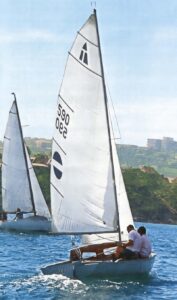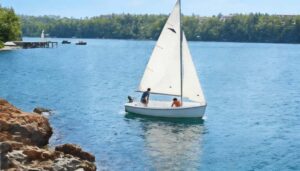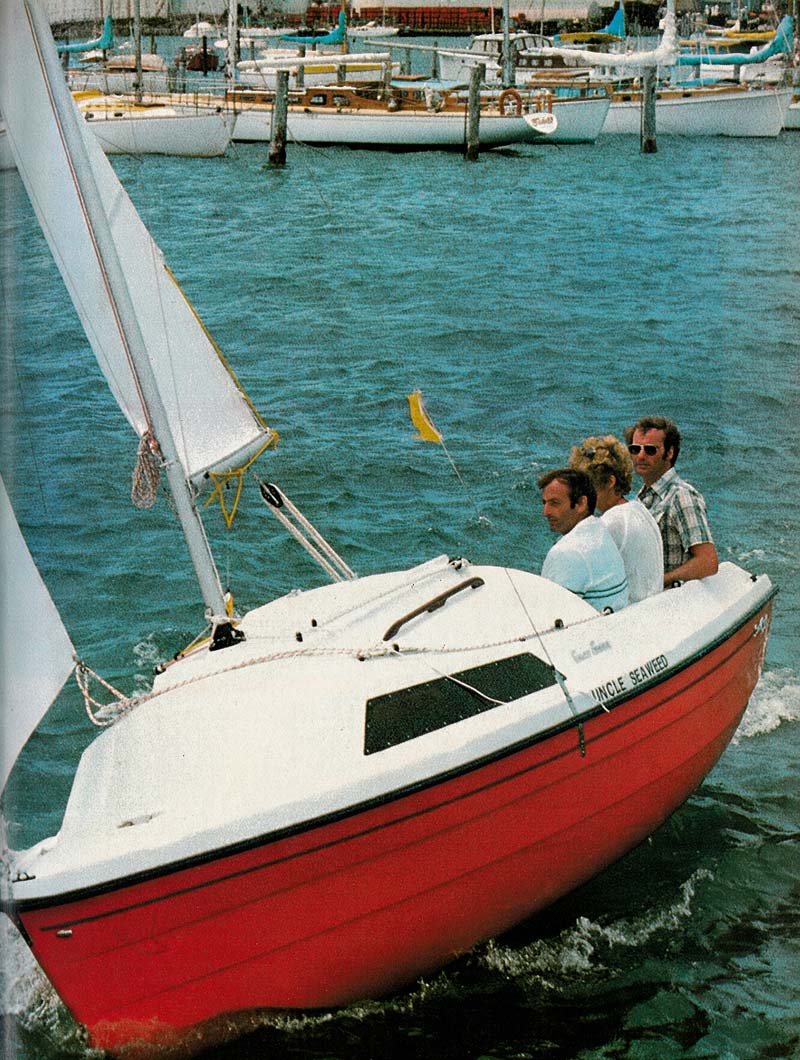
The Farr 5000 is introduced as a highly versatile 16-foot trailer sailboat designed by Bruce Farr to set a new benchmark for small family cruising yachts in the 1980s. Despite the existing market saturation of trailer sailers, this design stands out by offering a compact, affordable, and sleek alternative to larger models like the Farr 6000. It is engineered to deliver comfortable overnight accommodations for a family of four while remaining lightweight enough to be easily towed long distances behind average cars without requiring specialized heavy-duty vehicles.
In terms of design and hull construction, the boat features a beam carried well aft toward a wide stern to support crew weight in the cockpit. The hull utilizes a gentle sheerline, a relatively flat entry, and simulated clinkers that enhance hull stiffness while breaking up the visual height of the topsides. To maximize interior sitting headroom without sacrificing aesthetics, the cabin incorporates significant camber alongside high coamings in the cockpit area. For safety and performance, the boat is engineered with a self-draining cockpit, heavy ballast, and a swing keel that enables automatic self-righting if knocked down, keeping the cabin dry and high above the water even if hatch boards are removed.
The interior layout is straightforward and functional, equipped with four full-sized adult berths, two full-length bunks running along the sides and two quarter bunks aft. Storage is provided beneath the cushions, and provision is made for a marine head along the centre-line. The molded GRP cabin floor includes small anti-slip ridges for foot bracing, and a steel support pipe supports the mast structure, which can double as a base for custom storage if desired. The cabin also offers comfortable seating headroom for up to six adults, with an optional galley area and optional pop-top feature to enhance internal space during extended stays or trips to caravan parks.
On the water, the Farr 5000 displays responsive performance, stability, and ease of handling across varied conditions. Testing in Auckland’s Waitemata Harbor demonstrated its ability to tackle up to 25-knot wind gusts and short chop without taking spray into the cockpit. Controls are engineered for minimal hassle, featuring a 6/8 rig setup where most sail lines, including the main halyard and cunningham, lead back to the cabin top within easy reach of the helmsman or crew. The swing keel is operated via a winch equipped with a window to monitor cable tension, while the kick-up rudder keeps the tiller clear of the water when not in use.
Overall, the boat represents an ideal entry-level or club-racing craft for families, couples, and young sailors. It balances predictable, forgiving handling characteristics with competitive speeds capable of holding its own in fleet racing. While minor factory tweaks, such as improved sail trimming, added handrails, and revised locker latches, were identified during testing to optimize usability, the package provides an exceptional balance of affordability, road transportability, and genuine cruising ability (Andrews 1979, pp. 10-13).
SPECIFICATIONS:
-
Model: Farr 5000 TY
-
Designer: Bruce Farr
-
Builders: Sea Nymph Boats, Glen Eden, Auckland
-
Test Area: Auckland’s Waitemata Harbor
-
Test Conditions: Westerly 10–25 knots with slop to 0.5–0.75m (1–2 ft)
-
Length Overall (LOA): 5.09m (16 ft 8 in)
-
Waterline Length (LWL): 4.62m (15 ft 2 in)
-
Beam: 2.25m (7 ft 4 in)
-
Draft (Up): 0.3m (1 ft)
-
Draft (Down): 1.24m (4 ft)
-
Total Weight: 510 kg (1125 lb)
-
Ballast: 180 kg (397 lb)
-
Price (with trailer): Around $6,500 NZ / Estimated $7,000 AUD (1979)
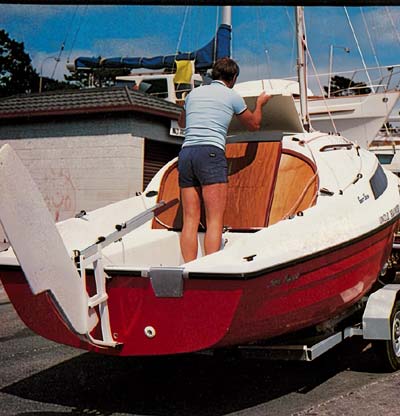
Historical photograph reproduced for identification and historical research purposes. Copyright remains with the original rights holder.
Quick tip: Keep in mind that trailer sailers can vary quite a bit, even within the same class. Take the RL28, for example: they might not all have outboard wells as designed. Some originally may have had inboard engines, and when those were removed, the owners swapped them for a standard outboard mounted on the stern.