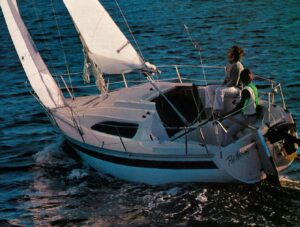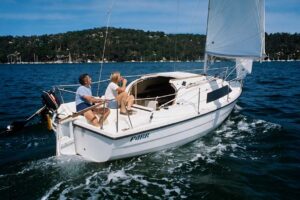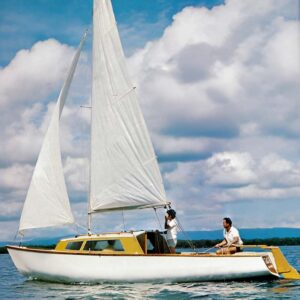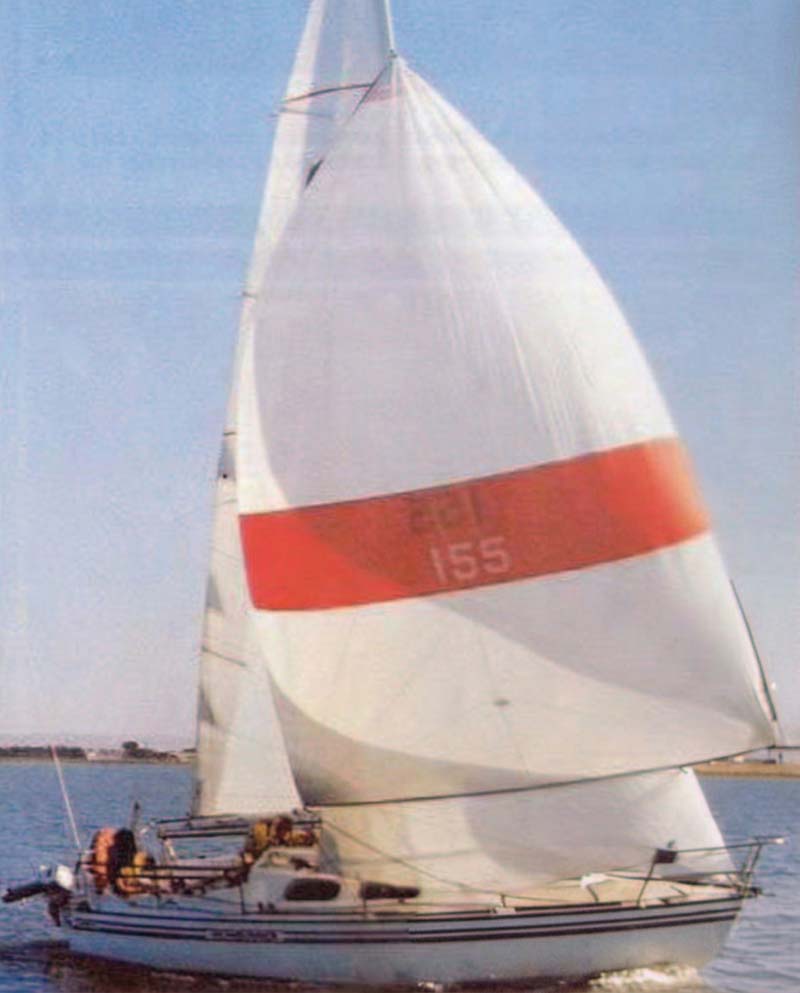
Trailer yachts are often categorized as either enlarged dinghies or compact yachts, and given the choppy waters off Adelaide, a locally built trailer yacht like the Austral 24 naturally leans toward being a true small yacht. Designed by Adrian Keough, the Austral 24 followed the success of the Allen Blackburne designed 20-footer, which had previously excelled in the Tripolis Race. While the 24-foot model enjoyed immediate racing success upon its initial release, market demands shifted over time toward comfortable cruising, leading Austral to reposition the vessel for that market segment. The standard package reflects this cruising orientation by including features such as a jib furler and a roller reefing main.
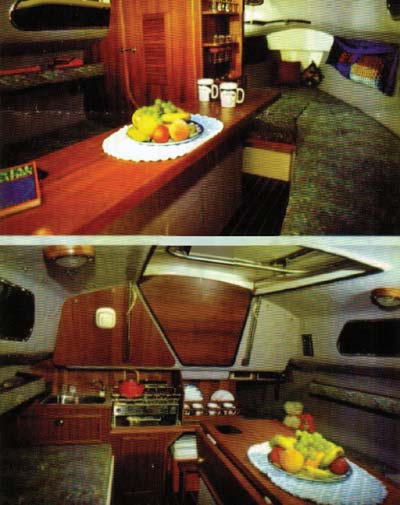
The design features a hull length of 7.47 meters, a moderate beam of 2.36 meters, a total displacement of 1,650 kilograms, and 595 kilograms of ballast housed inside a heavy lead swing keel. (There were also dop and fixed keel versions.) The test yacht belonged to New South Wales agents Theo and Evelyn Schmeider and featured a manual winch with a Kevlar line to raise the keel, avoiding the need for annual steel wire replacements, though hydraulic or electro-hydraulic systems remained available options. While earlier models utilized a lifting keel that restricted cabin space, the design was modified so that the lower keel casing functions as a saloon table with folding leaves on both sides. This casing connects to a portside half-bulkhead that creates a semi-enclosed toilet space, though buyers can also choose no interior division or a full bulkhead depending on their preference.
The exterior layout includes a narrow stern, noticeable tumblehome along the topsides, and heavily cambered foredeck and side decks. While these steep deck angles can make walking around while at rest somewhat awkward, they provide excellent foot placement when the vessel is heeled under sail, supplemented by inboard teak toerails. The interior features a pop-top roof and a galley located along the cockpit bulkhead on a moulded step, where a two-burner methylated spirits stove slides out from a sheltered position beneath the cockpit structure.
Despite the inclusion of the head enclosure, the forecabin comfortably accommodates two adults, with the apex of the bow reserved for an anchor locker. Space beneath the cockpit handles foresail storage through a raised hatch, and this compartment can also house an inboard auxiliary engine, though most owners prefer outboard engines due to the rising costs of inboards. Storage is comprehensive throughout, featuring three large drained lockers under the cockpit seats (including an insulated icebox), a portable icebox behind the companionway, under-berth storage in the saloon, and full-length shelves with padded edges that act as backrests for the settee seats.
Construction quality is evident in the carpet-lined interior, which creates a cosy, insulated cabin feel. Hardware and handrails are through-bolted using chrome domed nuts on the headliner, and the portholes feature chromed brass trim. The hull is hand-laid fiberglass, while the decks utilize a balsa-core sandwich construction. The saloon sole presents a traditional splined wood finish, complemented by balanced teak woodwork and thick cushion upholstery.
The sail plan is a straightforward three-quarter rig with single spreaders on an untapered mast. Halyards for the mainsail and jib lead back to clutches on the cabin roof serviced by a single winch, while primary sheet winches sit on the coamings alongside cleats for the jib sheets. The mainsail sheet attaches to a short traveller on the cockpit floor, and the backstay is adjustable. Power on the test vessel was provided by a 9.9 horsepower electric-start Mercury outboard mounted on an easily operated bracket, while the glass rudder blade is secured within a heavy-cast alloy frame using two dedicated control lines for raising and lowering.
Under sail in gusts exceeding 25 knots, the boat demonstrated strong sea-keeping qualities and tracking stability. Although the roller-reefing mainboom made reducing sail area straightforward, the vessel handled the strong breeze comfortably without reefing. In tight maneuvering along a lee shore and among moored boats, the Austral 24 proved agile, responsive, and close-winded, displaying the performance and feel of a true keelboat.
Specifications:
* Model: Austral 24
* Length: 7.47 m
* Beam: 2.36 m
* Draft: 0.38 m to 1.22 m
* Displacement: 1,650 kg
* Ballast: 595 kg (Swing Keel)
* Main Sail Area: 15.05 m²
* Working Jib Area: 11.15 m²
* No. 1 Genoa Area: 16.72 m²
* Builder: Austral Marine Pty Ltd, Hackham, SA
Source: John Crawford Marine. “Austral 24” Trailer Sailer Library. Accessed October 20, 2026. https://www.johncrawfordmarine.com.au/advice/trailer-sailer/austral-24
Historical photograph reproduced for identification and historical research purposes. Copyright remains with the original rights holder.
Quick tip: Keep in mind that trailer sailers can vary quite a bit, even within the same class. Take the RL28, for example: they might not all have outboard wells as designed. Some originally may have had inboard engines, and when those were removed, the owners swapped them for a standard outboard mounted on the stern.