
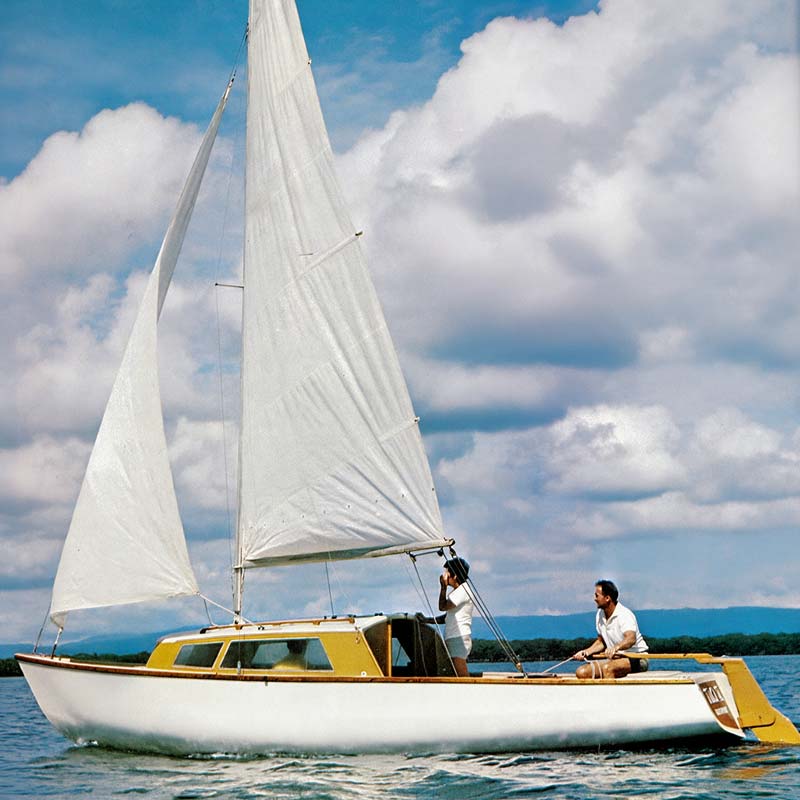
The RL-24 in 1973 was the largest trailerable yacht in the country and also its fastest. Designed by Gold Coast boatbuilder Rob Legg, this 24-foot centreboard yacht bridges the gap between speed and value. Legg, previously known in Melbourne as a skilled builder specializing in hot-moulding at Mouldcraft, relocated to Queensland after falling in love with the region during a holiday. After running a boatbuilding operation in Bundaberg, he moved south to Labrador to work as the foreman for Bruce Harris’s Shark Cat business. Drawing on his background as a top dinghy and Flying Fifteen skipper in Melbourne, Legg recognized the need for a fast, family-friendly boat and custom-designed a 24-foot vessel for his own family’s use, which they named the RL-24.
The boat quickly earned a reputation at the Southport Yacht Club Sailing Squadron as a severe challenge for handicappers. Under the club’s percentage handicapping system, where a standard “scratch” boat holds a 100 rating, Legg’s prototype, named Tiki II, consistently outpaced expectations. Even when penalized with a heavy plus 24 handicap, Tiki II continued to win races against high-performing vessels, including a Hood 23 and a TS16. Based on Victorian Yachting Council (VYC) yardstick ratings, the RL-24 earns an 85 rating, matching the speed performance of an International Dragon and running 39 units faster than a TS16. In its debut season alone, Tiki II secured the club’s Cruising Sail Champion Shield for the fourth time while competing against up to 35 local yachts.
Despite its impressive speed, the RL-24 remains a highly practical family boat. Weighing 1,600 lb overall with a distinct “banana” hull shape that glides smoothly upon launch, the vessel offers a surprisingly spacious interior. Its cabin features 4 feet 2 inches of headroom, sufficient for most teenagers.
The vessel is designed for simple handling, allowing a two-person team to easily raise or lower the 26-foot mast using a dedicated pulley system, though a single operator can manage it if necessary. The entire unrigging and trailering process takes as little as three minutes. Combining impressive racing performance with ease of transport, fiberglass models were introduced at a price point under $3,000 (1973) ready-to-sail, offering an accessible mix of speed, affordability, and practical utility (Hopkins 1973: 14-17).
Specifications
| Metric | Imperial | |
| Length Overall |
7.3 metres |
24 feet |
| Length Water Line |
5.9 metres |
19 ft 6 in |
| Beam |
2.2 metres |
7 ft 4 in |
|
Sail-away Weight (Including mast, boom, mainsail and one headsail; excluding spinnaker gear, motor, fuel tanks, batteries, anchors, life jackets, fenders) |
660 kg |
1455 lb |
| Minimum draft (keel up) |
0.36 metres |
1 ft |
| Maximum draft (keel down) |
1.3 metres |
4 ft 3 in |
Source: Hopkins, Paul (1973) ‘Australia’s Fastest Trailer Sailer’ Seacraft, April, p. 14.
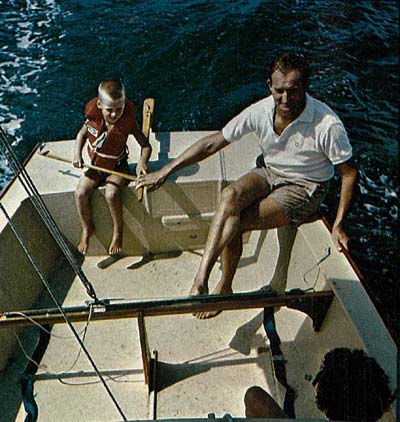
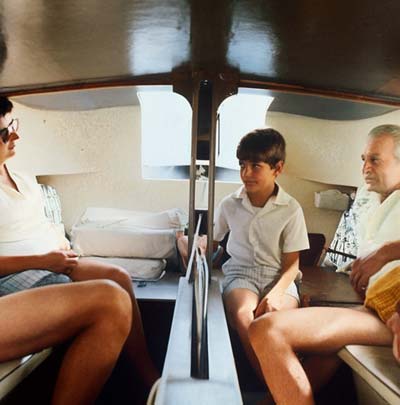
Historical photograph reproduced for identification and historical research purposes. Copyright remains with the original rights holder.
Quick tip: Keep in mind that trailer sailers can vary quite a bit, even within the same class. Take the RL28, for example: they might not all have outboard wells as designed. Some originally may have had inboard engines, and when those were removed, the owners swapped them for a standard outboard mounted on the stern.