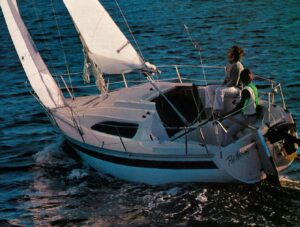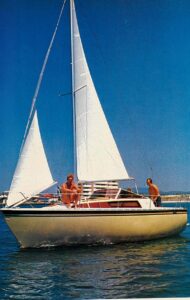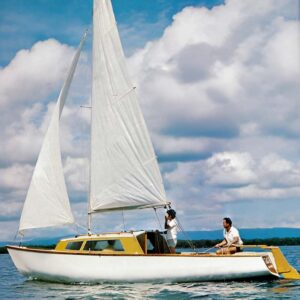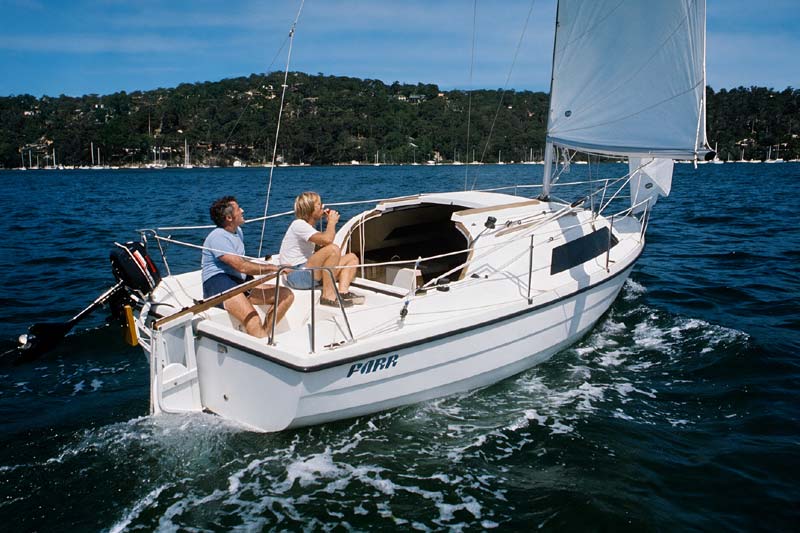
The Farr 750 stands at the peak of Bruce Farr’s trailer boat range. Beautifully built and presented by Sea Nymph Boats of New Zealand, this vessel leans more toward being a comfortable racer/cruiser than an outright competition boat. It provides below-deck refinements that set it apart from typical racers in its class, striking a sensible compromise between performance and comfort. The deck arrangement features fine attention to detail and practical sail control hardware. It utilizes a three-quarter fractional rig with swept-back spreaders and a long, low-aspect mainsail cut relatively flat. Included with the vessel are New Zealand-made Hood sails constructed to patterns held by the builder, a rudimentary mainsheet and traveller setup, as well as choices for two headsails and two spinnakers. The cockpit is exceptionally spacious, with side decks wide enough for comfortable hiking, although a foot brace across the cockpit floor would be a welcome addition for the helm. The cockpit also features a sunken bridge deck intended to house a small inboard diesel engine.
When evaluated on the water, the Farr 750 demonstrates strong overall performance. Under a full main and working jib in wind conditions averaging 15 knots with higher gusts, the boat sails close to the wind, tracking well while remaining remarkably easy to steer. Even carrying five adults onboard, it holds its line comfortably in an upwind breeze, though compared to pure sports models, extra crew weight helps keep the boat lively. Off the wind under spinnaker, it remains stable, balanced, and tracks neatly without excessive weather helm or a tendency to broach. Halyards lead back along the cabin top to clam cleats near the winch, making hoisting straightforward. Spinnaker pole controls are conveniently operated from the port side of the companionway, while the jib winches feature a unique design with clockwise action on the starboard side and anti-clockwise action on the port side, which may take a moment of adaptation for seasoned sailors.
From a racing standpoint, the boat trades pure speed for enhanced accommodations and deck functionality. Its hull lines share similarities with dedicated sports models but draw slightly more drag through the water. Its rig layout is less complex, relying on a main cut with moderate roach and flattening panels to serve as a versatile, all-around sail rather than a specialized racing canvas. The interior and cockpit remain comfortable for casual cruising, day sailing, or family outings, featuring a spacious cockpit, removable hatch boards, slide-in boards across the middle, and a pop-top roof for extra headroom. Overall, the Farr 750 delivers predictable handling, easy tacking, and solid stability, making it an ideal choice for recreational sailors seeking a fast, dependable cruiser (Davidson, Antill and Lewis 1982, pp. 52-53).
* LOA: 7.48 m (24′ 10″)
* DWL: 6.73 m (22′ 1″)
* BEAM: 2.500 m (8′ 2″)
* DRAFT (keel up): 0.462 m (1′ 6″)
* DRAFT (keel down): 1.800 m (5′ 11″)
* WEIGHT: 1166 kg (2570 lb)
* BALLAST: 366 kg (806 lb)
Davidson, Antill and Lewis (1982) ‘Farr 750’ Australian Boating, January, pp. 52-53.
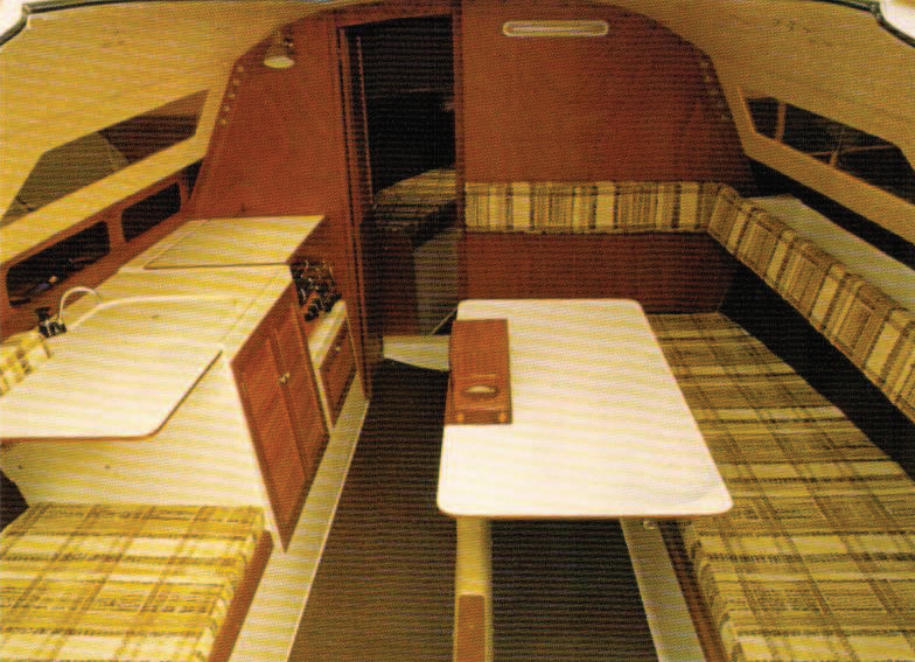
Historical photograph reproduced for identification and historical research purposes. Copyright remains with the original rights holder.
Quick tip: Keep in mind that trailer sailers can vary quite a bit, even within the same class. Take the RL28, for example: they might not all have outboard wells as designed. Some originally may have had inboard engines, and when those were removed, the owners swapped them for a standard outboard mounted on the stern.