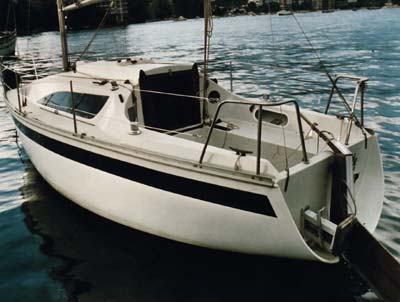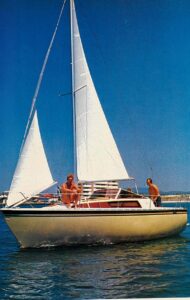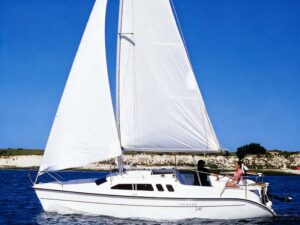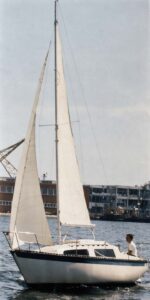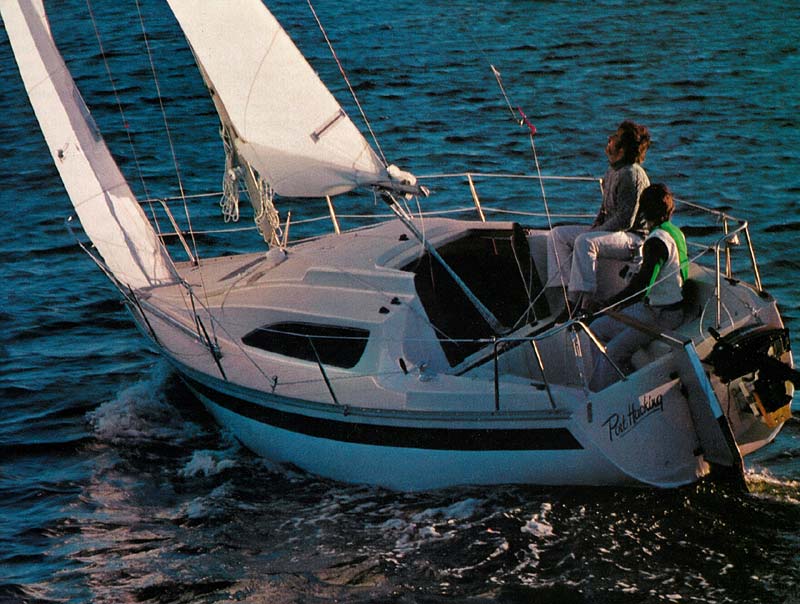
The rapid evolution of quarter and half-ton trailerable centreboarders in New Zealand has introduced a refined category of trailable yachts, exemplary of which is Compass Yachts’ newest stock vessel, the Compass 750. Designed by prominent New Zealand designer Alan Warwick, this 7.54-metre, three-quarter-rigged lifting centreboarder blends the spirit of a maxi trailer sailer or quarter-tonner with family-friendly features. It solves many common performance and handling issues linked to fast trailable boats, featuring a slightly narrower, conservative hull profile than radical Kiwi racers, yet retaining a short ended look with a broad stern section reminiscent of Farr designs. This provides a spacious deck, an unusually large cockpit for a 24-foot vessel, and exceptional stability.
Unlike traditional centreboarders that rely on weighted boards or heavy internal ballast, the Compass 750 utilizes a lightweight, 35kg alloy centreboard casting combined with internal ballast housed low in a small mini-keel. This setup keeps the board light enough to be raised easily by a simple rope tackle that even children can operate, while offering high stability for offshore sailing. During initial sea trials in light and variable winds on Botany Bay, as well as subsequent testing in heavy 20-knot winds off Pittwater during a trailer sailer event, the design demonstrated impressive balance and performance. The hull features a sharp fore-section that cuts through chop cleanly and tracks steadily, while broad aft sections and a cut-off transom allow the vessel to plane smoothly downwind without rounding up or fighting the helm.
In terms of rig and handling, the three-quarter sail plan employs relatively small headsails, making it considerably easier to manage than typical masthead-rigged 25-footers. The deck layout is uncluttered and designed with single-handed or shorthanded sailing in mind. All control lines, halyards, and reefing gear feed back to winches located near the companionway bridge deck and cockpit. The deep cockpit comfortably accommodates six adults with secure foot braces when heeled, while a wide transom opening and split pushpits provide easy access for boarding from the water or tenders. Below deck, the interior offers 1.73 metres (5ft 8in) of headroom and is finished with high-quality timber trim and carpet, foregoing the typical mid-cabin centreboard case trunk to create an unusually open, functional layout with sleeping accommodations for up to six people, a galley, and a head compartment.
Offered as a complete sailaway package that includes a custom trailer, dual sails, and full interior fittings, the boat represents high value within the under-$18,000 market. Although heavier than lighter trailable options, requiring a capable towing vehicle, its solid construction, stable sea-keeping qualities, and versatile offshore capabilities make it an attractive option for both club racing and family cruising (Hill 1978, pp. 19-21).
Source: Hill, James (1978) ‘Sail Report – Compass 750: The Quarter Ton TS’ Seacraft, November, pp. 19-21.
Specifications:
-
Builders: Compass Yachts (Australasia) Pty. Ltd., 4 Production Ave., Kogarah, NSW 2217.
-
Designer: Alan Warwick, New Zealand.
-
LOA: 7.54 m
-
LWL: 6.00 m
-
Beam: 2.49 m
-
Draft board up: 1 ft 3 1/4 in
-
Draft board down: 4 ft 10 in
-
Draft fixed keel: 4 ft 6 in
-
Headroom: 1.73 m (5 ft 8 in)
-
Displacement: 1,478 kg
-
Ballast: 544 kg
-
Working sail area: 241 sq ft
-
Sailaway price, including trailer (June 1978), two sails, fully fitted interior: $17,850