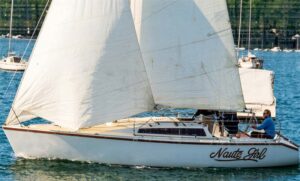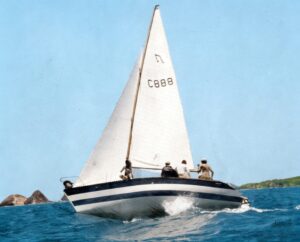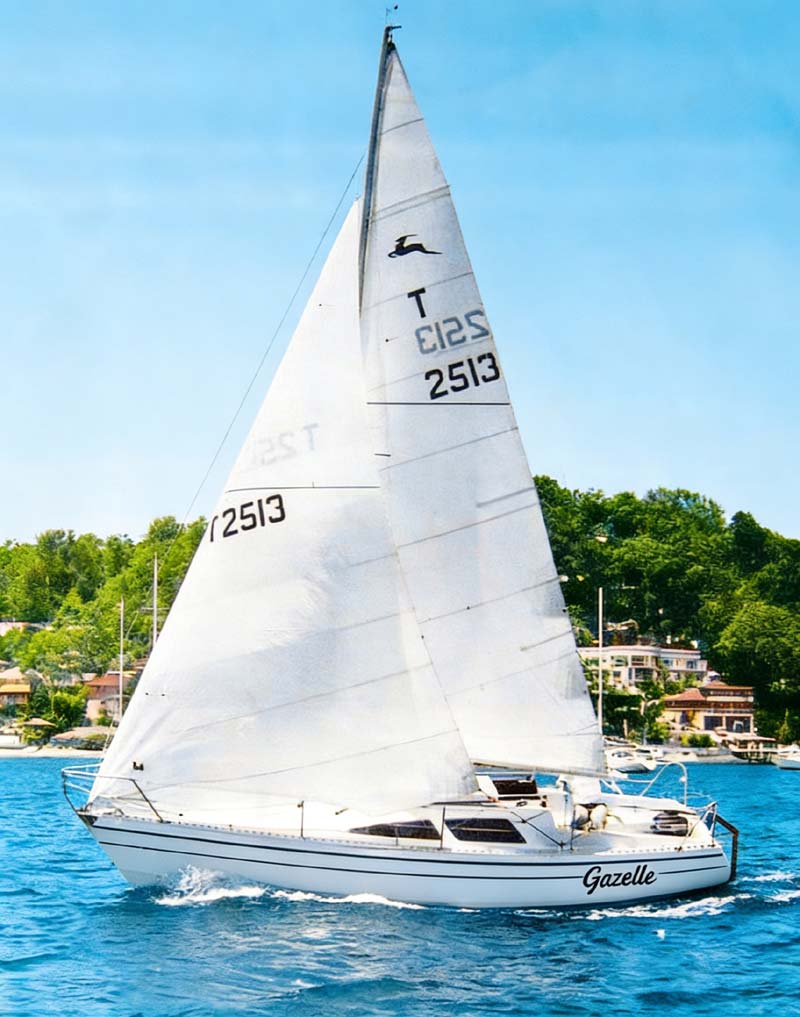
Introduced to Australia by former NS 14 champion Robin Rae, the Gazelle was born out of a personal quest to design and build the ultimate custom yacht (Australian Boating, 1985, p. 88). The yacht was designed by Trevor Adams and produced by Daryll McGee.
The craft features a robust, full-bodied hull constructed from woven rovings, chopped strand, and coremat, paired with an Airex-cored deck. Its design pairs a narrow, high-sided profile and short ends with a skegless underbody that transitions from moderate V-sections forward to a rounded aft (Australian Boating, 1985, p. 89-90).
Performance and handling are driven by a daggerboard rudder housed in a heavy-duty stainless steel frame, alongside a fully ballasted daggerplate centerboard. For propulsion, an outboard motor is mounted aft in the cockpit, engineered to swing up directly beneath the helm when retracted (Australian Boating, 1985, p. 89-90).
Below deck, the Gazelle efficiently accommodates up to six berths, a functional galley, shoulder-height padded shelving, and a clever slide-out cabin table. While the forepeak offers a cozy layout, adding an under-squab toilet would noticeably restrict the available space (Australian Boating, 1985, p. 88-90). The Gazelle features a sliding main companionway hatch on its deck, equipped with integrated mechanical arms. These arms allow the hatch lid to lift up, creating a small pop-top roof over the cabin entry. Although more compact than similar designs on other boats, this specific setup ensures that the structural strength of the cabin top is completely preserved.
While the Gazelle 26 does not offer standing headroom, it boasts impressive stability features, including a lift rudder and a lead-weighted lift keel. The cast iron keel houses a lead core; with 420kg of lead situated in its foot, the boat maintains about a 37.5% ballast ratio against its 1,120kg total displacement. Designed with a longer chord length for increased lift, the keel is raised via an electric winch or hydraulic system. (The MK1 had a hydraulic lift centre plate whereas the MK2 had an electric winch.)
Sailing: “In a word, electric! Our test sail was in light air but with a huge mylar No. 1 headsail and full main, the Gazelle showed astonishing acceleration, both on and off the wind. In one of the few gusts that caught us over-canvassed it behaved as typically as its genre, though the deep rudder gave more control than is normal. I found the thin kevlar sheets a little hard to use, especially in winter, and the boom is a real head-hunter in a tack or gybe, but sailing the craft it was easy to see why it did so well in the Goolwa race” (Australian Boating, 1985, p. 90).
| Spec | Dimension |
| LOA | 7.72 m |
| LWL | 6.47 m |
| Beam | 2.48 m |
| Draft (minimum) | 0.38 m |
| Draft (maximum) | 1.44 m |
| Ballast | 410 kg |
| Towing Weight (including trailer) | 1.6 tonnes |
| Price (Basic) | $23,500 [1985] |
| Price (Deluxe) | $27,800 |
Source
Source: ‘Gazelle — a Kiwi Trailer Sailer That’s Very Fleet’: AUSTRALIAN BOATING TEST NO. 293, Australian Boating, August 1985, p. 88.
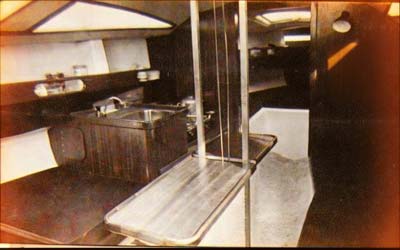
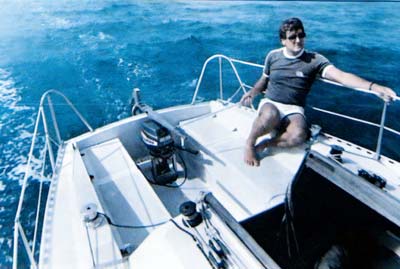
Historical photograph reproduced for identification and historical research purposes. Copyright remains with the original rights holder.
Quick tip: Keep in mind that trailer sailers can vary quite a bit, even within the same class. Take the RL28, for example: they might not all have outboard wells as designed. Some originally may have had inboard engines, and when those were removed, the owners swapped them for a standard outboard mounted on the stern.