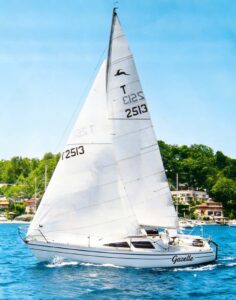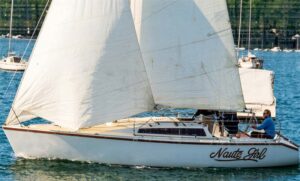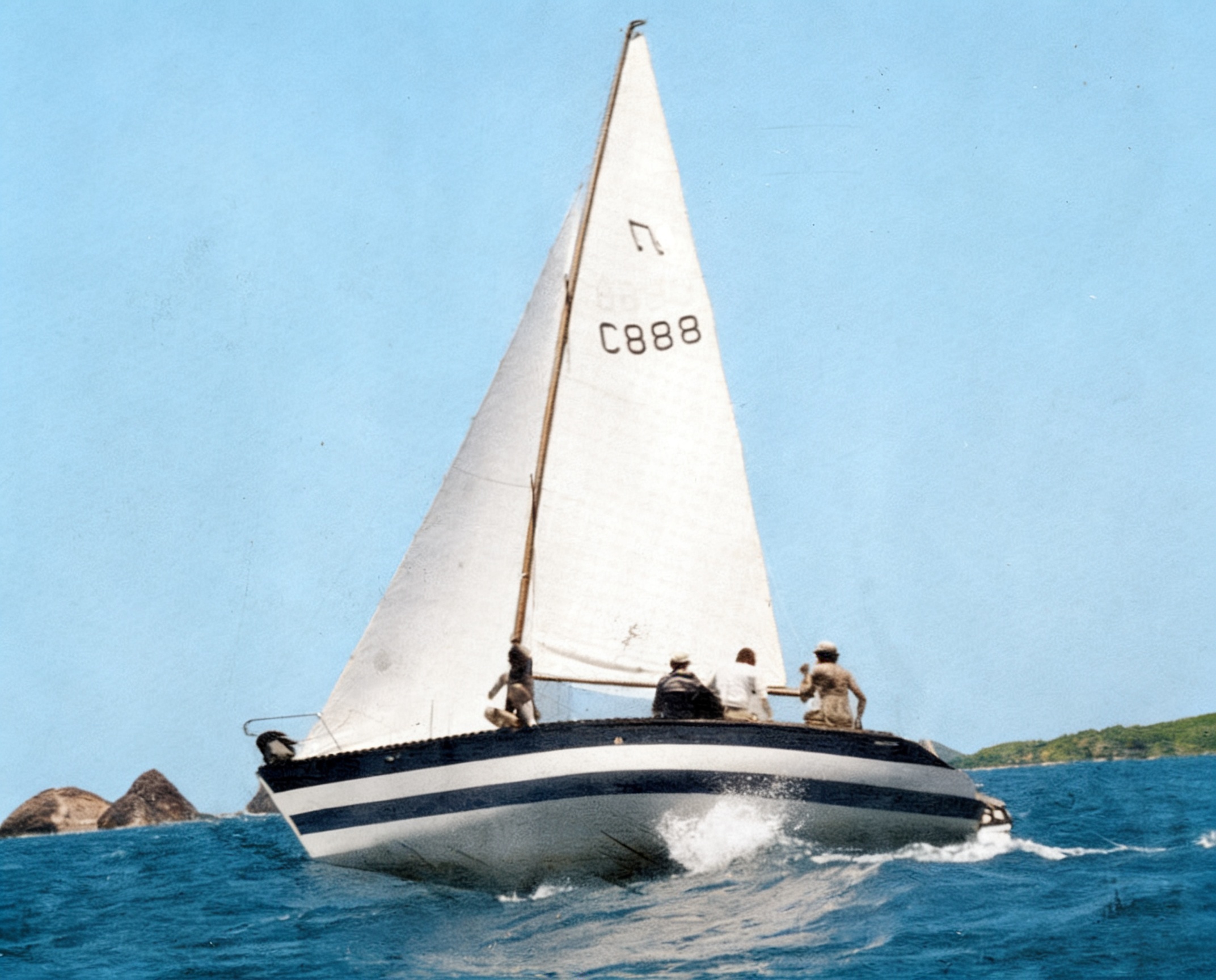
The Sonata 26 trailer yacht was originally designed by Jim Voysey and later manufactured and marketed in Australia by a few different builders, most notably David Rose Yachts. Later production runs were also branded as the Careel Sonata 26 (Sonata Yacht Association n.d.). Because this design underwent several incarnations over its production history, this article offers a snapshot of its evolution. For a deeper historical dive into original brochures and layout variations, it is highly recommended to visit the Careel Sonata 26 section of the John Crawford Marine Trailer Sailer Library (John Crawford Marine n.d.).
The primary complaints regarding the Sonata 8 centered on:
-
Cramped below-deck living spaces and minimal headroom;
-
A lack of dedicated storage for long-term cruising provisions;
-
A poorly positioned or undersized galley;
-
Minimal privacy for the marine toilet;
-
A leaky original forehatch and overly complicated rigging featuring running backstays (Voysey 1984, p. 119).
To address these flaws, the mid-80s redesign widened and extended the cabin top in a bid to attract family cruising interest (Rothfield n.d., p. 56), preserving the original, proven Sonata 8 hull lines while expanding both the headroom and overall interior cabin volume (Voysey 1984, p. 119).
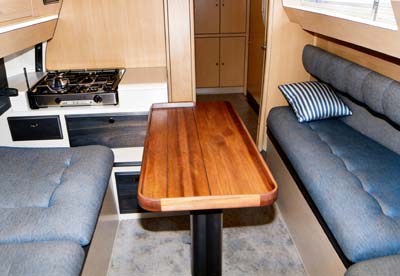
The updated interior layout maximizes every inch of the 2.5-meter beam to provide genuine comfort for extended family cruising (Voysey 1984, p. 119):
-
Generous Accommodation: Sleeping is arranged conventionally, featuring a forward V-berth, twin settees, and two single quarter berths running aft for a total of six berths. While rated for six, keeping a maximum of four adults aboard for any length of time is ideal (Rothfield n.d., p. 57). The V-berth makes an excellent area for quiet reading or a games area for children, with light from a large deck hatch;.
-
Private Amenities: Located forward of the main bulkhead is a Porta-Potti marine toilet and a compact sink unit. This space is serviced by hand-pumped freshwater drawn from a fibreglass tank under the starboard settee, effectively solving the privacy limitations of older designs;
-
Repositioned Galley: Moved from amidships to the area between the keel case and the port gunwale, the galley layout is backed securely by a bulkhead. It features a single sink that cleverly drains directly through the keel case, a good-sized cupboard, drawers, and dedicated space for a two-burner stove. Headroom here is just sufficient for the chef to stand, and cooking odours are free to escape through the pop-top roof;
-
Smart Storage: Instead of a restrictive, built-in icebox, a portable 45-litre Coleman cooler is utilized (Rothfield n.d., p. 57). This cooler locks securely into place beneath the companionway to double as a carpeted entry step;
-
Upgraded Deck Hardware: The problematic original forehatch was upgraded to a high-quality CANPA hatch that opens both inward and outward, matching Australian Yachting Federation (A.Y.F.) safety recommendations (Voysey 1984, p. 119). A simple pop-top roof provides a spacious 1.93 meters of headroom and excellent ventilation when at rest (Rothfield n.d., p. 57).
When Careel chief David Rose acquired the 26-foot production moulds in 1989, he determined that major modifications to the core hull shape were not needed. Instead, he spent five years upgrading the construction, engineering, and user-friendliness to a point where the boat could proudly wear the respected Careel badge (Rothfield n.d., p. 56).
Realising that older couples would represent a large portion of his customers, Rose engineered a patented mast-raising system to make erecting the 10-meter spar a solo task (Rothfield n.d., p. 56). The foot of the mast slides along a 3-meter track spanning from the top of the pulpit to the mast step. Supported athwartships by a pair of alloy arms acting as a fulcrum point, the spar can easily be winched up or down using a single hauling line, even on the water (Rothfield n.d., p. 56).
As a safety bonus, a crutch over the companionway acts as a defensive rollbar to catch the falling spar in the unlikely event of total failure. The mast automatically resides in its trailering position when lowered and sits high enough to allow full cockpit access and deployment of the cabin pop-top when using the boat as a land-based caravan (Rothfield n.d., p. 56).
The original 370kg dagger keel was notoriously difficult to lift using older block-and-tackle setups. Rose replaced this arrangement with a custom hydraulic lift system. While it takes roughly 200 pumps to fully raise the keel for beaching, giving the boat a remarkably shallow draft of just 210mm, it significantly minimized physical strain If the keel strikes the bottom (Rothfield n.d., p. 56).
Launching and retrieving a maxi trailer sailer weighing 1800kg can be daunting. To solve this, Rose worked with trailer specialists to design a custom multi-roller “Tracer” trailer rig. By leaving two inches of the boat’s keel exposed to slip perfectly between the centerline rollers, the trailer inherently self-centers the vessel during recovery. The rig achieves this on a single heavy-duty axle utilizing Alko independent suspension and vacuum-boosted override brakes (Rothfield n.d., p. 56).
The updated rigging features a tapered spar equipped with a welded masthead crane, single swept-back spreaders, caps, lower shrouds, a forestay, and an adjustable backstay. By pairing a larger mainsail with a self-tacking headsail, the boat utilizes an efficient yet straightforward sail plan. This design lowers operating and replacement costs compared to traditional masthead configurations or older Sonata 8 J.O.G. rated plans. Owners only need a core inventory to get the most out of the boat: a mainsail, self-tacking jib, No. 2 Genoa, and a spinnaker (Voysey 1984, p. 119).
On the water, the Sonata 26 preserves its classic windward tracking capabilities (Rothfield n.d., p. 57). Under sail, she is no express, but she performs respectably in mixed company. In light-air events, such as the 1993 Marlay Point Regatta where a Careel Sonata 26 claimed 5th on handicap in the big boat division, the design’s low wetted surface makes it a highly effective performer (Rothfield n.d., p. 58).
In heavier breezes (15 to 20 knots), it maintains an easy turn of speed and remains totally manageable. Upwind, it clocks roughly 4.5 knots while pointing to within 30° apparent wind, and peaks at 6 knots on a reach. While initially tender, her stability increases progressively as the 370kg ballast takes effect. It heavily benefits from keeping crew weight on the windward gunwale to keep boat speed up, as the cockpit itself offers limited room (Rothfield n.d., p. 58).
For auxiliary power, buyers could originally choose from an outboard motor on a stern bracket, an integrated outboard cockpit well, or a permanent inboard diesel engine (Voysey 1984, p. 119). When fitted with a standard outboard motor, such as a Tohatsu 8, it easily pushes the hull to six knots. However, due to the traditional narrowness of the stern design, the motor is shoe-horned tightly onto its bracket right alongside the rudder casing, which slightly restricts open access to the transom (Rothfield n.d., p. 57).
To sum up, the Careel Sonata 26 is a good cruiser that successfully blends a proven racing pedigree with a spacious, premium interior, making it an ideal choice for pocket-cruising families (Voysey 1984, p. 119).
| Feature | Measurement |
| LOA | 8.00 m (26 Feet) |
| LWL | 6.02 m |
| Beam | 2.50 m |
| Draft | 0.21 m C/B up |
| Draft | 1.55 m C/B down |
| Draft | 1.60 m FinKeel |
| Displacement | 1280 kg |
| Mast Height | 10.06 m |
| Boom Length | 3.58 m |
| Mainsail Area | 16.75 m² |
| Jib Area | 11.17 m² |
| Spinnaker Area | 40.96 m² |
| No.1 Genoa Area | 17.69 m² |
John Crawford Marine n.d., Careel Sonata 26, viewed 26 May 2026, https://www.johncrawfordmarine.com.au/advice/trailer-sailer/sonata-26.
Rothfield, M n.d., ‘A Rose… By Any Other Name: Test: Careel Sonata 26’, Trailer Sailer, pp. 56-58.
Sonata Yacht Association n.d., Sonata Yacht Association – for Sonata Yacht Owners, viewed 26 May 2026, https://sonatayacht.com.
Voysey, J 1984, ‘Design: Sonata 26’, Australian Boating, February, p. 119. Historical photograph reproduced for identification and historical research purposes. Copyright remains with the original rights holder.
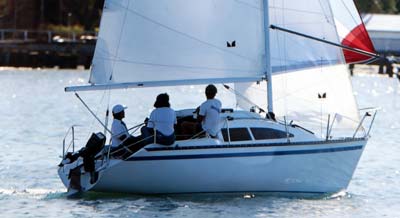
Historical photograph reproduced for identification and historical research purposes. Copyright remains with the original rights holder.
Quick tip: Keep in mind that trailer sailers can vary quite a bit, even within the same class. Take the RL28, for example: they might not all have outboard wells as designed. Some originally may have had inboard engines, and when those were removed, the owners swapped them for a standard outboard mounted on the stern.