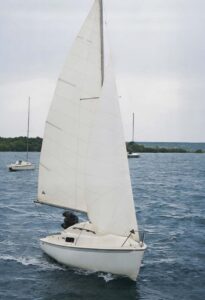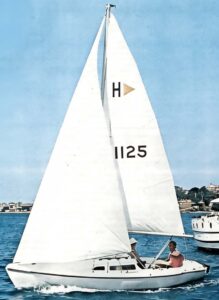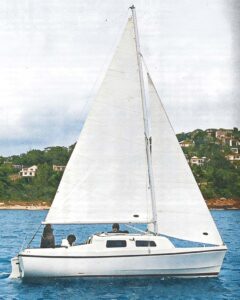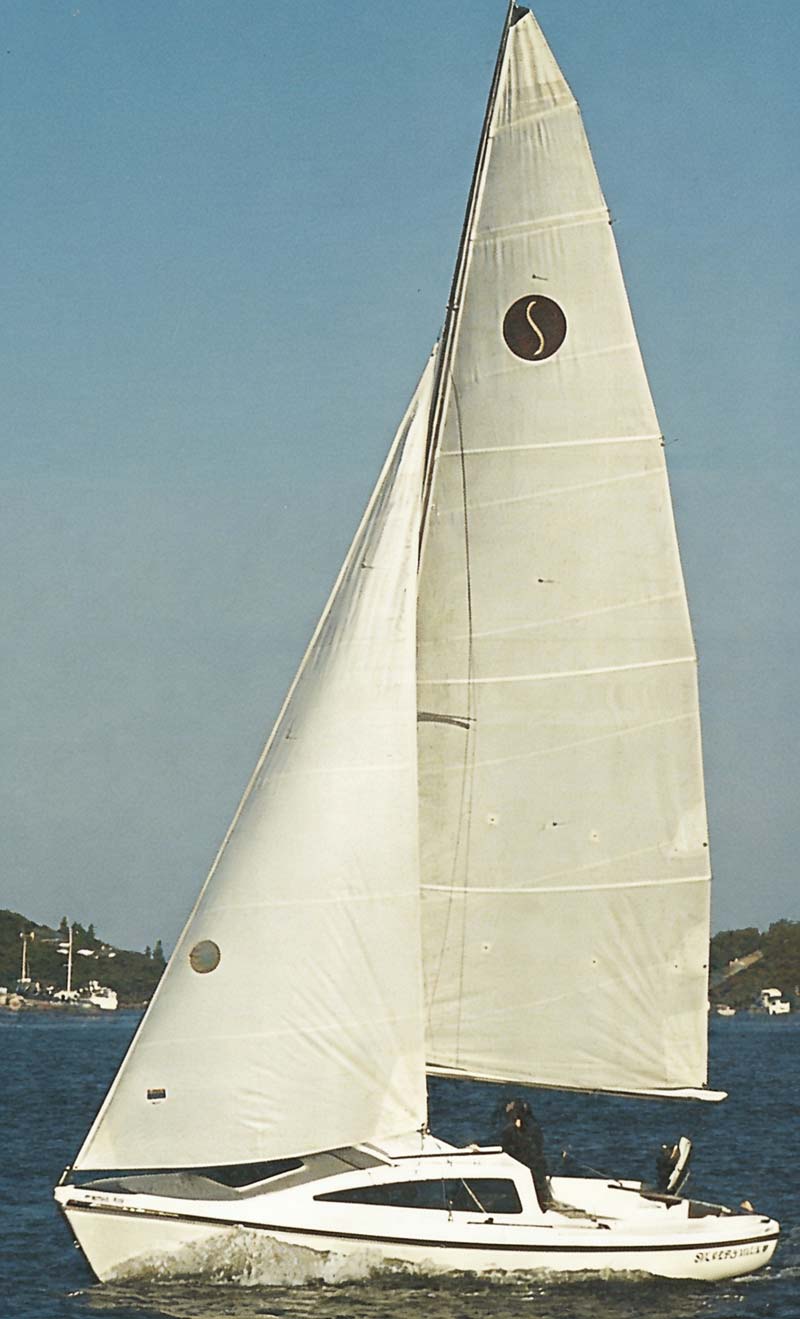
Builder Jon Simonds of Slipstream has produced one of the nimblest and quickest small trailer yachts to be tested in some time.
The design has an interesting background, tracing its origins to the BG van de Stadt Status 580 Day Sailer. The Status 580 initially found considerable success in trailer yacht competition, until state authorities ruled it failed to meet the definition of a true trailer yacht – a ruling that effectively ended its competitive career and left the moulds without purpose.
Jon Simonds saw an opportunity, and working with original manufacturers Rob and June Legg Yachts, developed a new deck and cabin mould that brought the Status 580 into compliance with trailer yacht regulations. By incorporating the minimum required cabin features – sleeping berths and enclosed space – Simonds produced a remarkably quick trailer yacht that closely resembles the original Status 580, distinguished mainly by a sleek new cabin in place of the van de Stadt blister.
Further modifications included a large foredeck hatch positioned to allow safe spinnaker handling below deck rather than on the narrow foredeck, and a substantial 36 per cent increase in total sail area to compensate for the added windage and weight of the new deck moulding.
All other specifications remained unchanged. The LOA is 5.80 m (19.03 ft), LWL 5.00 m (16.45 ft), draft 1.20 m (3.50 ft), and with the keel raised, draft reduces to just 0.20 m (6 in).
Working sail area totals 23 sq.m — 13 sq.m in the mainsail and 10 sq.m in the jib. A 32 sq.m half-ounce spinnaker is available for those seeking maximum performance, along with a more manageable 22 sq.m tri-radial alternative. Even without a kite, planing is achievable in suitable conditions.
As a trailer yacht, the Slipstream delivers on all fronts. Compact and easily managed, mast raising and lowering can be accomplished without winches or mechanical assistance. The forestay is supported by permanent upper and lower shrouds; the mast is walked upright and secured to the forestay fitting, and the rudder drops onto its moulded pintle bases in moments. With practice, launching, rigging, and parking the tow vehicle should take no more than 10 to 15 minutes.
On the water, the Slipstream impresses with superb handling, acceleration, and pointing ability, as demonstrated during a sail in light summer conditions on Pittwater. Simonds recommends two or three crew for racing, though a couple – with or without younger crew – would find the boat equally rewarding. Despite its lively character, the Slipstream is also a safe design, with strong form stability and inherent stiffness. Heel is self-limiting to around 10–12 degrees before the bilge engages and the boat stiffens progressively, translating wind pressure directly into forward speed.
Tacking, gybing, and pointing are all outstanding, which explains the boat’s strong record in trailer yacht racing -consistently competitive against designs up to two metres longer.
There is little to criticise in the Slipstream, though it must be noted that certain aspects of the finish, particularly the cabin fit-out and deck moulding lines, show the constraints of building to a price. These shortcomings are of no consequence to racing performance, but families seeking genuine cruising accommodation would be better served by Simonds’ other trailer yacht, the Timpenny 670. The Timp offers considerably more interior space, with proper berths, a head, and galley facilities, none of which feature in the Slipstream. Two berths exist in the technical sense, but the boat is not intended for anything more than a brief rest at anchor.
At 880 kg all-up on the trailer, the Slipstream falls comfortably within the legal and practical towing capacity of most four-cylinder vehicles.
In summary, the Slipstream is a light, fast, and easily sailed trailer yacht well suited to training purposes at both amateur and professional levels.
Source: ‘Status Slipstream – Australian Boating Test No. 245’, Australian Boating, November 1983, pp. 136-137. Historical photograph reproduced for identification and historical research purposes. Copyright remains with the original rights holder.
Quick tip: Keep in mind that trailer sailers can vary quite a bit, even within the same class. Take the RL28, for example: they might not all have outboard wells as designed. Some originally may have had inboard engines, and when those were removed, the owners swapped them for a standard outboard mounted on the stern.