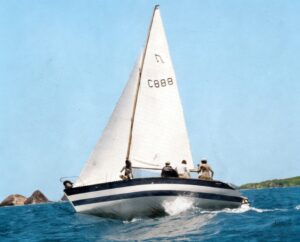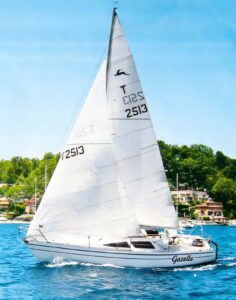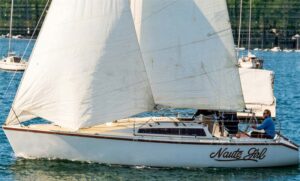
The Seaway 25 trailable yacht has a rich pedigree, originally conceived as a quarter-tonner and Junior Offshore Group (JOG) racer designed by the internationally renowned Doug Peterson alongside leading Australian offshore sailor Tom Stephenson. Designed to bridge the gap between inshore trailer sailers and offshore racing craft, the boat established a strong reputation for being stylish, fast, and seaworthy under both JOG and International Offshore Rule (IOR) handicaps, while remaining practical for family cruising. The class gained wide popularity across Australia, particularly through a active class association in Victoria, attracting notable sailors like John Bertrand and remaining consistently competitive over many years.
When builder Tom Stephenson moved operations from Victoria to Queensland’s Gold Coast, he introduced the Seaway Elite model to target the non-racing market. This iteration adapted the original hull and rig by adding a larger, squarer trunk cabin, a transom-hung retractable rudder, and a spacious double berth under the cockpit, suited for Queensland waters. Though the taller cabin altered some of the original design’s aesthetic lines, it provided superior headroom and a more open interior layout tailored to Australian conditions.
The rights and moulds for the design were subsequently acquired by northern New South Wales businessmen Des Thomson and Eddie Edstein, who established Seaway Yachts International. They focused on sales and marketing while subcontracting construction to Geoff Reichelt to maintain build quality and continuity. Under their leadership, the company continued offering the Elite while introducing the new Seaway 787 model, which combined the cruising benefits of the Elite with a redesigned, modernized cabin and deck line.
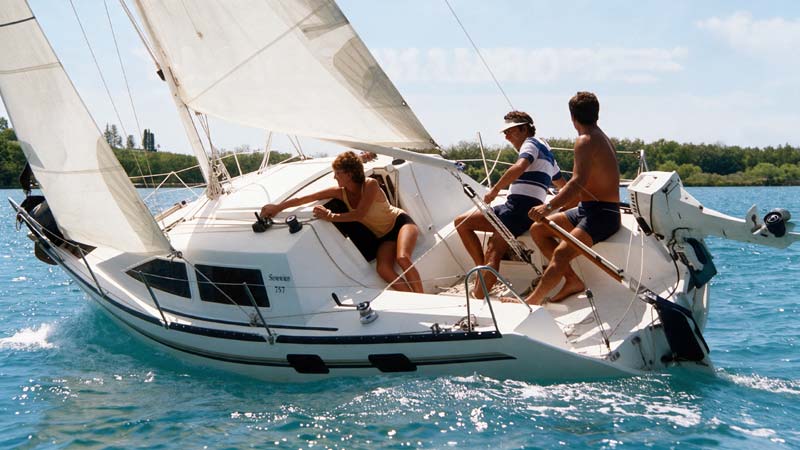
The Seaway 787 retains the original class specifications for hull shape, lift-keel design, rudder shape, and sail plan, preserving the performance of early models provided it is not overloaded. Its standout feature is a longer and wider cabin top, extended forward by roughly 50 centimetres and widened by 30 centimetres, styled with a sleek wedge profile and long one-piece window ports. This design brings additional natural light into the saloon, shifts the forward hatch onto the front face of the cabin for improved access and ventilation, and incorporates new deck features including dedicated cockpit lockers for fuel and storage, as well as an anchor locker on the foredeck. Although the wider cabin slightly narrows the side decks and pushes the genoa tracks farther outboard (which racers can offset with a tweaker system), it significantly enhances cabin space to compete with contemporary designs.
During a test sail in a 15-knot breeze on the Southport Broadwater during a club race, the Seaway 787 proved its speed and competitiveness against modern craft like the Young 7.8, easily pacing alongside older Elite models. The boat features a transom-mounted rudder with an ascending blade for shallow water manoeuvrability and a weighted dagger keel inside a half-height fibreglass casing that doubles as a functional saloon drop-leaf table. Optional swing keel or fixed keel configurations were also made available at no extra cost.
Below deck, the layout mirrors the Elite, providing a comfortable setup for up to four people. It includes a spacious aft double berth beneath the cockpit, an offset starboard galley with a sink and stove, a portside chart table with an integrated icebox, twin settee berths in the main saloon, and a forward head area with a toilet and washbasin enclosed by a curtain.
Constructed with an end-grain balsa-cored deck and a solid hull reinforced by a one-piece internal furniture moulding and heavy floor support around the keel case, the boat is engineered for offshore and inshore reliability. Offered in various build stages, ranging from bare mouldings to a complete “sail-away” stage four package, the boat weighs approximately 1,270 kg, making it light enough to be towed while meeting mini-maxi trailer sailer demands (Metcher, Colin).
Specifications:
* Boat Model: Seaway 787
* Overall Length: 7.87 m
* Length Waterline (LWL): 6.45 m
* Beam: 2.49 m
* Draft: 33 cm to 152 cm
* Internal Ballast: 530 kg
* Keel Ballast: 150 kg
* Total Weight: 1270 kg
* Working Sail Area: 27 m²
* Stage 4 Sail-away Price: $27,998 (When tested – Standard boat with mainsail, #3 jib, galley, sink, stove, and electronics; optional tandem wheel trailer and 8hp Evinrude outboard added $3,800)
* Manufacturer/Distributor Was: Seaway Yachts International, Lismore
Source: John Crawford Marine. “Seaway 787” Trailer Sailer Library. Accessed November 4, 2026.
https://www.johncrawfordmarine.com.au/advice/trailer-sailer/seaway-787
Photograph reproduced for identification and historical research purposes. Copyright remains with the original rights holder.
Quick tip: Keep in mind that trailer sailers can vary quite a bit, even within the same class. Take the RL28, for example: they might not all have outboard wells as designed. Some originally may have had inboard engines, and when those were removed, the owners swapped them for a standard outboard mounted on the stern.