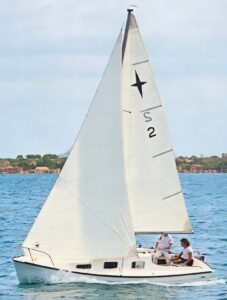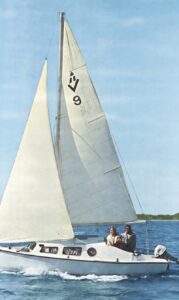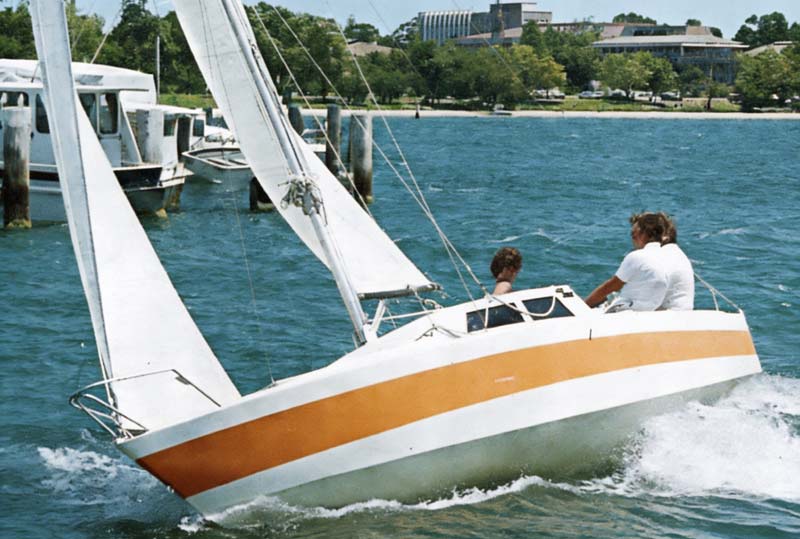
Australia’s first all-aluminium trailer sailer, the 6.5 metre Sprite Star gave the fourth division cruisers a thrashing at the 1975 Cockburn Sound Regatta — and she’s cheap at $4000.
A new star is rising on the Indian Ocean sailing scene and this one is made of aluminium.
Star Boating Centre, a marine business based in the Perth suburb of Kenwick, claims to have produced Australia’s first aluminium trailer-sailer. Perth-based designer Herman Boro developed four hull designs for the range: the Shooting Star, Morning Star, Cruising Star, and Sprite Star. Each hull is available in both a cruising and racing configuration.
One model, the Sprite, has already demonstrated its competitive credentials. At the New Year regatta on Cockburn Sound, near Fremantle, the Sprite took two first places, two thirds, and the fastest time in the fourth division.
Dick Eastaugh, the Sprite’s skipper and the company’s sailmaker, praised the boat’s ability to point high into the wind while also performing strongly downwind. A short test sail on the choppy Swan River bore out his assessment.
Arnold Rothwell, Star Boating’s managing director, noted that the hull’s light weight enhanced the effectiveness of the ballast, resulting in a favourable ballast ratio. The boat’s beam of 2.29 metres gives it an unexpectedly generous amount of space for sailing. The 6.5-metre hull features welded chain plates and 1/8-inch aluminium plating, combining lightness with durability.
Below decks, the Sprite offers more room than expected, with two full-length bunks on either side, provision for a toilet and a small galley, a forward chain locker, and storage space in the cockpit.
All four models are delivered ready to sail, though toilets, galleys, and bunk cushions are not included, which goes some way to explaining the price. The racing Sprite starts at $3,935 and the cruising version at $3,995, with both prices covering a basic sail package. The racing model features a taller mast and deeper keel. For anyone seeking comfortable cruising in a new yacht for around $4,000, it represents strong value (1975 prices).
Arnold Rothwell and his brother and co-director John are currently developing a centreboard version suited to shallow estuarine conditions. They have secured approval to operate a hire fleet on the Peel Inlet at Mandurah, roughly 80 kilometres south of Perth.
The Star range made its public debut at Perth’s August boat show, where the first order was placed. Seven boats have since been sold with minimal marketing effort, and the Rothwells anticipate stronger demand following the Sprite’s regatta performance. Arnold Rothwell admitted the result exceeded expectations, though he noted with some amusement that the handicapper has since taken notice (Schmitt 1975: 26-27).
Fact Box
Boat: Sprite Star, aluminium deep keel trailer sailer (drop centreboard version also available)
Builder: Star Boating Centre, Kenwick, Perth, WA
LOA: 6.5 m (21 ft 4 in.)
LWL: 5.4 m (17 ft 8 in.)
Beam: 2.29 m (7 ft 6 in.)
Draft: 0.685 m (2 ft 3 in.); 0.990 m (3 ft 3 in.) in racer
Displacement: 816.4 kg (1800 lb)
Mast: 6.98 m (22 ft 7 in.); 7.31 m (24 ft) in racer
Mainsail: 8.825 m² and 9.661 m² (95 and 104 sq ft)
Jib: 5.564 m² and 6.503 m² (60 and 70 sq ft)
Genoa: 11 m² (120 sq ft)
Spinnaker: 28.334 m² (325 sq ft)
Price: $3995 (racer), $3935 (cruiser)
Source: Schmitt, Hugh (1975), ‘Now: An Aluminium TS!’, Seacraft, April, p. 26-27. Historical photograph reproduced for identification and historical research purposes. Copyright remains with the original rights holder.
Quick tip: Keep in mind that trailer sailers can vary quite a bit, even within the same class. Take the RL28, for example: they might not all have outboard wells as designed. Some originally may have had inboard engines, and when those were removed, the owners swapped them for a standard outboard mounted on the stern.