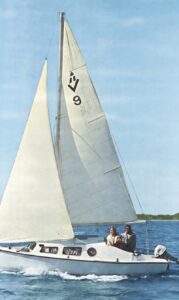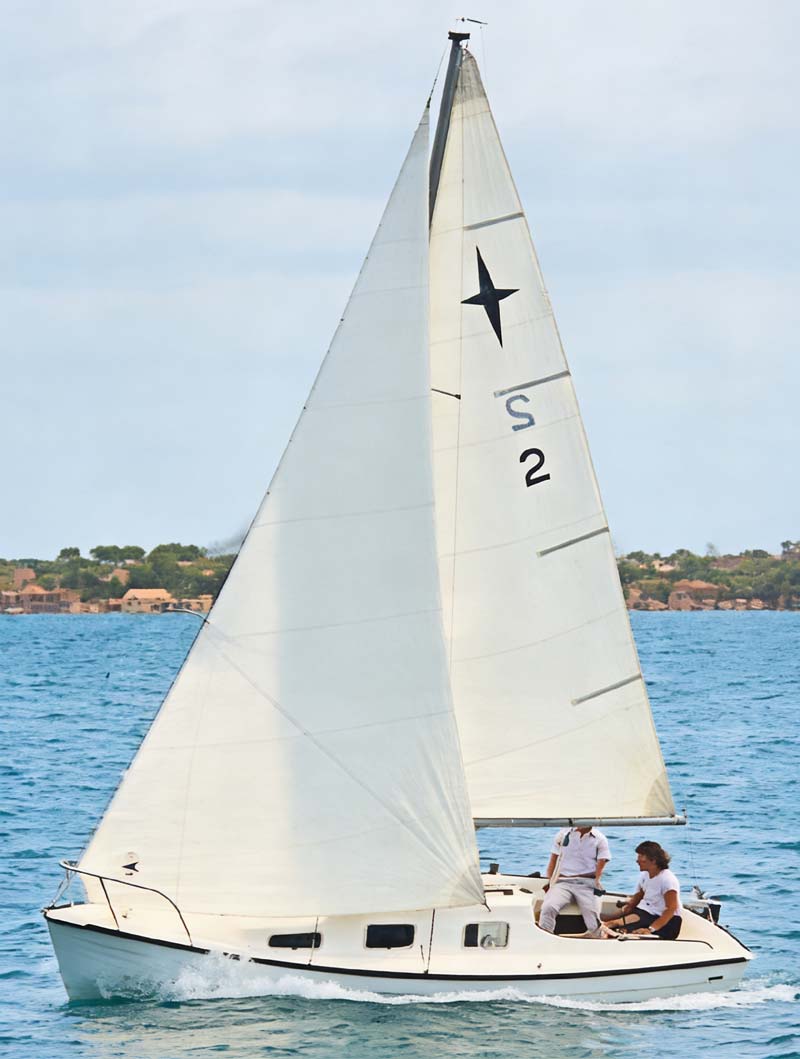
The Explorer 21 was tested at St Kilda Marina, although light and inconsistent winds prevented a full evaluation. The boat initially appeared to be stern-high, but this was largely an optical illusion created by the clinker-style hull and broad aft sections. The wide stern was designed to increase buoyancy and support the weight of crew gathered in the cockpit, reducing the tendency to squat under load.
The boat presented an attractive appearance, combining traditional styling with the low-maintenance advantages of fibreglass construction. Timber trim on the gunwales, handrails, transom and coamings added warmth and character.
Below deck, the cabin offered reasonable accommodation for a 21-footer. Headroom decreased toward the bow, but the layout made good use of available space. The centreplate case was unobtrusive, and sleeping accommodation consisted of two forward berths and two quarter berths.
Conditions during the test sail were frustratingly light. After leaving the marina under mainsail and genoa, the breeze faded completely, preventing the assessment of the boat in the stronger conditions where it was said to perform best. Nevertheless, the Explorer 21 appeared comfortable and practical, with a spacious cockpit, uncluttered side decks and clean cabin-top lines.
Later, the boat sailed alongside an Explorer 16. In approximately 10 knots of breeze, the larger Explorer 21 proved the faster boat, although the well-developed Explorer 16 remained competitive. During the sail, the Explorer 21 briefly grounded on a mudbank, providing an opportunity to demonstrate the effectiveness of the 500 lb (227 kg) swing keel. The keel was quickly raised, reducing draft to just 12 inches and allowing the boat to free itself and continue sailing.
The Explorer 21 was a handsome and strongly built trailer sailer with ample room for a family of four. Its clinker-fibreglass hull inspired confidence, the broad beam provided generous accommodation, and the large self-draining cockpit added to its cruising appeal. While not inexpensive by the standards of the day, it was considered a substantial trailer sailer capable of comfortable and safe cruising in a wide range of waters. Outboard is in a cutout on the transom.
FACT BOX
BOAT: Explorer, 21 ft swing keel trailer sailer.
DESIGNER AND BUILDER: J. Botterill and Sons, 6 Advantage Road, Highett, Victoria 3190.
LOA: 21 ft
LWL: 19 ft 9 in
BEAM: 8 ft
TRANSOM BEAM: 6 ft 6 in
DRAUGHT: 12 in (keel housed) and 4 ft 9 in (swing keel down).
BALLAST: 500 lb swing keel (gives self-righting).
HEADROOM: 4 ft 6 in.
ACCOMMODATION: four berths.
Sail Area
Main: 126 sq ft
Genoa: 149 sq ft
Jib: 68 sq ft
Standard Equipment
Upholstery, carpets, 15 gallon water tank, aluminium spars, roller reefing, SS rigging, Terylene sails, outboard well.
PRICE: At factory $4950 including tax (add outboard, 9.5 hp motor is ideal—and trailer).
Cockpit
5.7 ft long, self-draining and 4 ft 6 in. wide between seats. Air voids under floor for positive buoyancy.
Keel
Aerfoil. Masthead rig. Mast is 24 ft overall. Displacement 20 cwt all up. Winches can be reached from tiller if seated single handed.
Test Boat
Included toilet, stove, sink, laminated benches, pulpit and so on. $5100 including tax.
Source: Hopkins, Paul (1972), ‘Exploring Explorer’, Seacraft, August, pp. 24–25.


Historical photograph reproduced for identification and historical research purposes. Copyright remains with the original rights holder.
Quick tip: Keep in mind that trailer sailers can vary quite a bit, even within the same class. Take the RL28, for example: they might not all have outboard wells as designed. Some originally may have had inboard engines, and when those were removed, the owners swapped them for a standard outboard mounted on the stern.