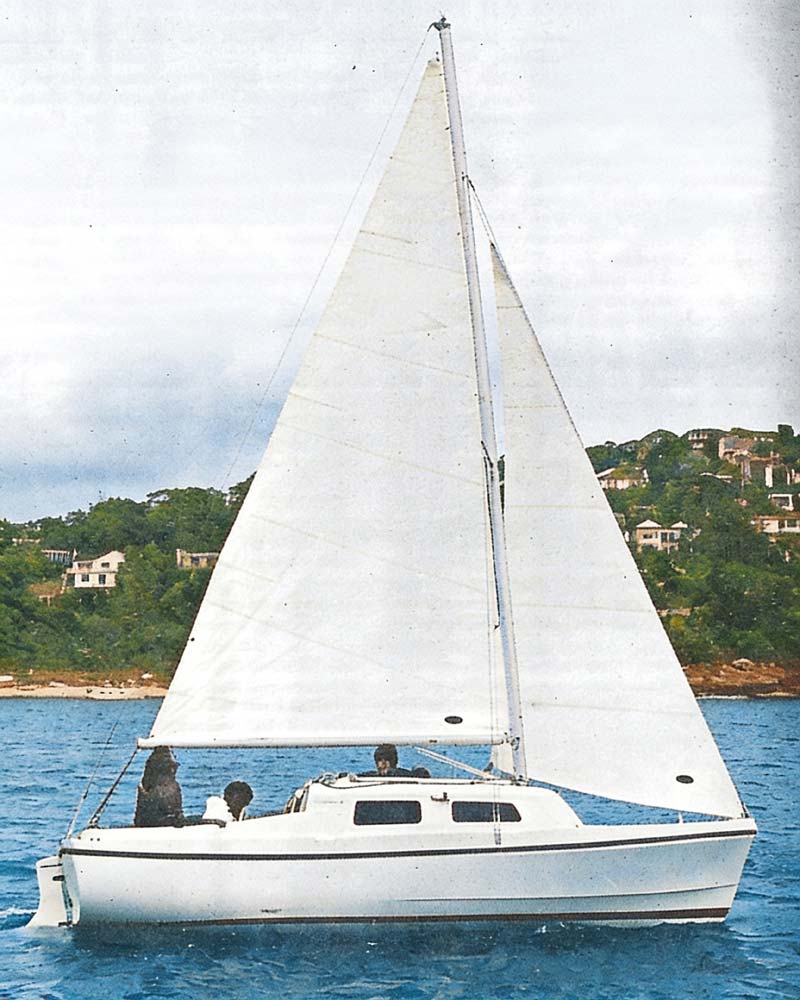
The Savage Nautilus motor sailer is built for durability rather than performance. Arguably the most robustly constructed trailer-sailer type vessel made in Australia, it’s actually better suited to a mooring or marina berth than regular trailering. Under power, it performs well; under sail, it falls well short of comparable boats like the Explorer, Matilda, RL24, Careel, and Timpenny. Its long, shallow keel keeps it tracking straight, but it struggles upwind.
The Yanmar diesel engine is a highlight – easy to start, powerful, and impressively fuel-efficient, though very loud down below.
Below deck, clever layout makes the most of the available space. The toilet and other fittings stow away to open up the cabin, creating a surprisingly liveable interior for a boat of this size. The finish is generally impressive, with non-skid surfaces running the full length of the deck and well-placed, solidly mounted hardware. One criticism is that certain fittings – companionway catches, hatch fasteners, and sharp cabinet corners – present injury risks that builders should address.
Sail handling is straightforward. Both the jib and mainsail halyards lead to the cockpit, so the crew can raise and trim sails without going forward. The foredeck is easily accessed through the fore hatch, and a well-designed bollard manages mooring and anchor lines, though its crosspiece has an annoying habit of snagging the jib sheets when hove-to.
The Nautilus won’t win any races, but it should handle most coastal bay conditions comfortably. The long keel promotes steady downwind progress and the hull is naturally stiff in a breeze. One concern is some of the internal lead ballast appeared to be loosely placed and could shift if the boat were inverted.
The cockpit suits two or three people comfortably; four is a squeeze. Similarly, the accommodation works best for a couple, though four can sleep aboard at a pinch. The one notable shortcoming below is headroom.
The boat proved surprisingly nimble under engine during photography at the Heron championships, weaving through the fleet without causing disruption. Its manoeuvrability was demonstrated dramatically on returning to the marina. With the Spit Bridge closed and an hour’s wait ahead, the crew heeled the Nautilus over and slipped her under the bridge’s northern span with room to spare.
Tacking is deliberate rather than quick, as expected from a long-keel hull. This is not a boat for thrill-seekers; it offers a steady, upright ride rather than an exciting one.
In summary, the Nautilus is a capable little motor-sailer, emphasis on motor. Windward performance is its weakness, but it tracks well, handles smoothly, and is very easy to sail short-handed. Its sturdy, displacement-style hull will appeal to those who value seaworthiness and longevity over speed. At $3,695 (1976 prices) fully equipped, it represents solid value as a coastal or estuary cruiser, and a capable fishing boat with accommodation to boot (Hopkins 1976: 26-28).
FACT BOX
-
Boat: Nautilus Motor Sailer. Strongly built fibreglass trailable fixed keeler.
-
Builder: Savage Fibreglass Boats, 100 Mason Street, Newport, Victoria 3015. Boat supplied by Spit Bridge Marina for test.
-
LOA: 5.84 m.
-
LWL: 5.33 m.
-
Beam: 2.34 m.
-
Draft: 0.68 m.
-
Displacement: 860 kg.
-
Sail area: Main 10.7 m2, jib 5.6m2.
-
Construction: Heavy glass hull and deck. Flared bow and moulded spray deflector forward. Fibreglass rudder with tiller steering. Moulded in propeller aperture. Self-draining cockpit with contoured seating and high coamings. Self-draining coamings. Self-draining recessed rope/anchor well forward. Foredeck hatch. Sliding main hatch to companionway. Fixed cabin windows. Cabin handrails. Wide side deck with toe rails. Moulded non-skid surface throughout.
-
Fittings: Bilge pump. Regulation navigation lights. Good deck hardware.
-
Accommodation: Four full length bunks with 76 mm foam mattresses and storage under. Galley with sink, water storage, pump, and provision for stove. Table and storage opposite. Interior lighting. Marine toilet. Sitting headroom is available aft of the underdeck mast support – no mast post.
-
Rigging: Deck stepped hinged alloy mast, alloy boom, stainless steel and synthetic wires and ropes. Mainsail sheet winches.
-
Engine: Under cockpit floor, below companionway. Yanmar 8 hp diesel with electric start and marine gearbox. Inbuilt 6.8 litre fuel tank on flexible mounts. Cockpit controls.
-
Price: As tested; as above, $3695.
-
Extras available: Spinnaker pole and fittings. Pulpit. Staunchions. Stern rail.
Source: Hopkins, Paul (1976) ‘Built to Last – Not to Win – Seacraft Action Test 28’, Seacraft, April, pp. 26-28. Historical photograph reproduced for identification and historical research purposes. Copyright remains with the original rights holder.
Quick tip: Keep in mind that trailer sailers can vary quite a bit, even within the same class. Take the RL28, for example: they might not all have outboard wells as designed. Some originally may have had inboard engines, and when those were removed, the owners swapped them for a standard outboard mounted on the stern.