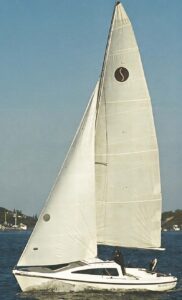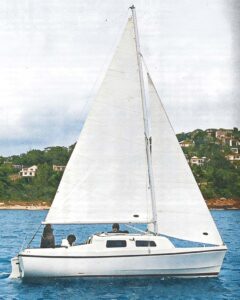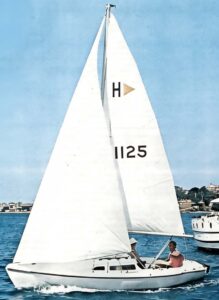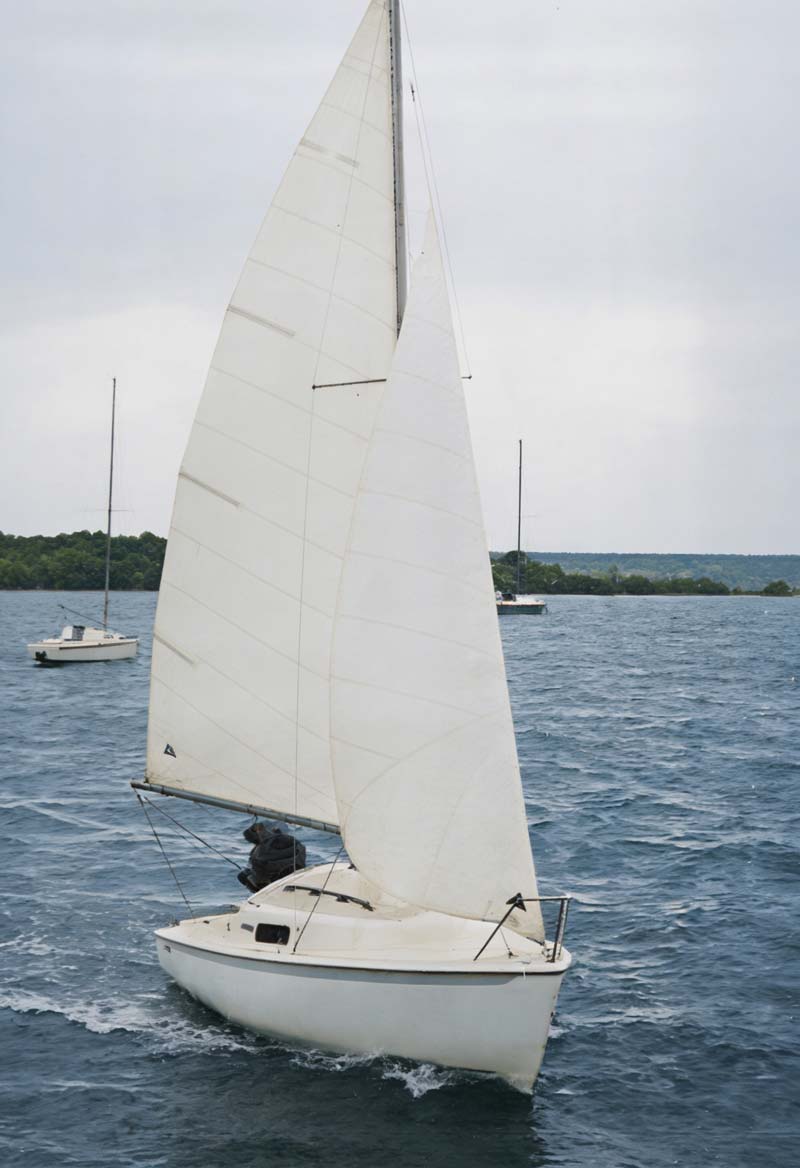
Most glamorous trailer sailer yet seen in Australia is the 19 ft 3 in. Nomad by Glascraft, of Brisbane. She sails well and has good accommodation for a family of four.
The trailer sailer is increasingly meeting the demands of buyers seeking comfort comparable to power cruisers, and many boat manufacturers are responding by adding wind-driven family cruisers to their ranges.
One such manufacturer is Glascraft of Queensland, whose Nomad, a 19-foot fibreglass trailer sailer, sits at the top end of the Australian market in terms of price. The case for value, however, is a strong one.
The test yacht was supplied by Glascraft’s Victorian distributor, Dandy Power Equipment of Dandenong. Unveiled at the 1968 Melbourne Boat Show, the Nomad has the appearance of a miniature ocean-going yacht, minus the deep keel. Its full-bodied sections and flowing lines suggest sea-kindly performance, though the substitution of a heavy keel with a swinging steel centreplate raises questions about whether the boat handles like a small deep-keel yacht or a large live-ballast dinghy.
Testing took place at Sandringham Yacht Club, with the clubhouse anemometer recording winds of 15 knots gusting to 22 knots.
Rigging took only a few minutes. The aluminium mast stows neatly for road travel in a crutch mounted on the rudder pintles, with the other end lashed to the stainless steel bow pulpit — nothing protrudes beyond the boat’s length on the road. Readying the mast for raising requires only sliding it back, pinning the heel in a well-designed hinge mast step, and shackling on the shrouds. A 9.8 hp Mercury auxiliary outboard mounts on an ingenious raisable transom bracket.
Once afloat, mast raising and rigging completion proceeded smoothly with no frustrating delays, confirming an initial impression of a practical, well-considered design. The mast is supported by a forestay, upper and lower shrouds on each side, and a bridle backstay leading to each quarter, all fitted with sensibly sized rigging screws. Jib halyard tension is applied via a highfield lever at the mast foot, and the jib rolls around the forestay using remote furling gear.
Conditions on the day were typically Melbourne: cool, moderate-to-fresh westerly winds, choppy seas, intermittent pale sunshine, and no rain. The Nomad proved a notably dry boat – a quality that adds considerably to sailing comfort in colder weather.
Steering with the outboard’s tiller proved somewhat awkward; locking the motor and using the ship’s rudder would likely be preferable. Once clear of the moorings with the mainsail, fitted with roller reefing gear, hoisted and the jib unrolled, the Nomad came alive. The jib furling system, operable entirely from the cockpit, is particularly well suited to family sailing.
With the centreboard fully lowered, the Nomad handled easily with just a touch of weather helm. Pointing ability was respectable, and even in an untuned state the boat was fast enough to provide genuine enjoyment. Downwind, there was no tendency to roll excessively.
All working controls are within cockpit reach – halyards, jib sheets, and the furling line all belay at the aft end of the cabin top. The jib sheets benefit from a 2-to-1 pulley system plus a snubbing winch, while the mainsheet operates on a 4-to-1 arrangement. One minor criticism: the mainsheet has a tendency to twist between the boom end and the swivelling quarter blocks, which might be resolved by substituting fixed blocks.
Steering from the weather cockpit seat proved comfortable in all conditions. Even in gusts above 20 knots, the boat required little corrective action and could be driven without easing the mainsheet or moving crew weight to windward. With a crew member sitting to leeward, stability remained impressive – none of the knife-edge sensation associated with light centreboarders. The lee rail did briefly go under, but the boat inspired sufficient confidence to keep driving. At a moderate 180 square feet of sail area, the rig should present no difficulty even to novice sailors.
Reefing is straightforward. The jib can be halved in size by rolling it partly around the forestay from the cockpit, and the mainsail is reduced by easing the halyard and rolling several turns around the boom. The mainsail reefing mechanism is particularly simple: the boom is pulled aft to disengage from the gooseneck, the sail is rolled, and a spring returns the boom to position.
Motoring back to the launching ramp, forward visibility from a seated position at the helm was limited, though standing for close-quarters manoeuvring is generally preferable anyway. Lowering the coachroof by a couple of inches could substantially improve the helmsman’s sightlines. Mast lowering with the boat still afloat proved as straightforward as raising it.
The Nomad’s design shows careful attention to both working gear and accommodation detail. The rig is robust and simple, with everything positioned for easy cockpit operation. Foredeck access is available via a translucent hatch in front of the coachroof, which admits diffused light into the forward cabin and avoids the gloomy forepeak effect common in small yachts. The bow pulpit proved adequate in use, and all fittings are of first quality, well secured above and below deck.
Below decks, the extra length and beam relative to smaller trailer sailers translate into genuine spaciousness. The full-length cockpit seats feature angled tops that remain level when heeled, and generous storage is provided under the seats and rear deck. An insulated icebox holds several days’ provisions, and a freshwater tank fitted under the cockpit floor fills from a pipe exiting under the starboard side deck.
In the cabin, the four-inch maple top of the centreplate case serves as a useful seat for the cook and could easily be extended into a table with fold-down sides. To port just inside the companionway is a laminate-topped galley with cupboards below; opposite is a hinged work surface concealing the marine toilet, alongside a small stainless sink with a hand-pump freshwater supply. Two wide bunks extend forward from the working area, fitted with four-inch foam mattresses upholstered in deerhide-type vinyl. Additional stowage is available under the bunks and on shelves beneath the side decks, which also serve as backrests – though extending them the full length of the bunks would improve sitting comfort. A buoyancy chamber forward of the bunks includes a small locker in the bow.
The cockpit seats are large enough to double as berths, and with a boom tent the Nomad could comfortably accommodate a family with two or three children on an extended cruise. The centreplate winch handle is the one cabin-layout criticism — it tends to intrude on the working space and would benefit from being made removable, or replaced with a different winch type.
The Nomad stands as the only trailable yacht genuinely practical for sleeping aboard in comfort comparable to a similarly sized power cruiser – a boat well worth stepping up to (Laird 1969: 42-45).
FACT BOX
-
MODEL: Nomad Fibreglass Trailer Sailer. MANUFACTURER — Glascraft Pty Ltd, Brisbane, Queensland.
-
LOA: 19 ft 3 in.
-
MAXIMUM BEAM: 7 ft 2 in. At water-line: 5 ft.
-
DRAFT: Plate up — 12 in. Plate down — 4 ft 10 in.
-
FREEBOARD (amidships): 24 in.
-
COCKPIT LENGTH: 6 ft.
-
CABIN HEADROOM: 4 ft 6 in.
-
ACCOMMODATION: Two bunks in cabin, two bunks in cockpit.
-
SAIL AREA: Main 108 sq ft, jib 72 sq ft, storm jib 42 sq ft, spinnaker, optional.
-
PRICE: Standard model — $3150. PLUS … Toilet, water tank, ice box, stove, cupboards, bunk cushions, fibreglass cockpit seats: $745.
-
TOTAL: $3895, plus suitable outboard motor. TRAILER — $385.
Source: Laird, Ray (1969) ‘One for the Road’ Seacraft, January, pp. 42-45. Historical photograph reproduced for identification and historical research purposes. Copyright remains with the original rights holder.
Quick tip: Keep in mind that trailer sailers can vary quite a bit, even within the same class. Take the RL28, for example: they might not all have outboard wells as designed. Some originally may have had inboard engines, and when those were removed, the owners swapped them for a standard outboard mounted on the stern.