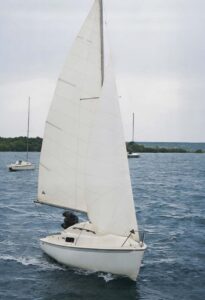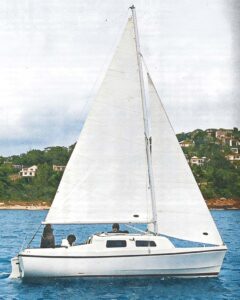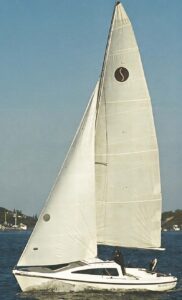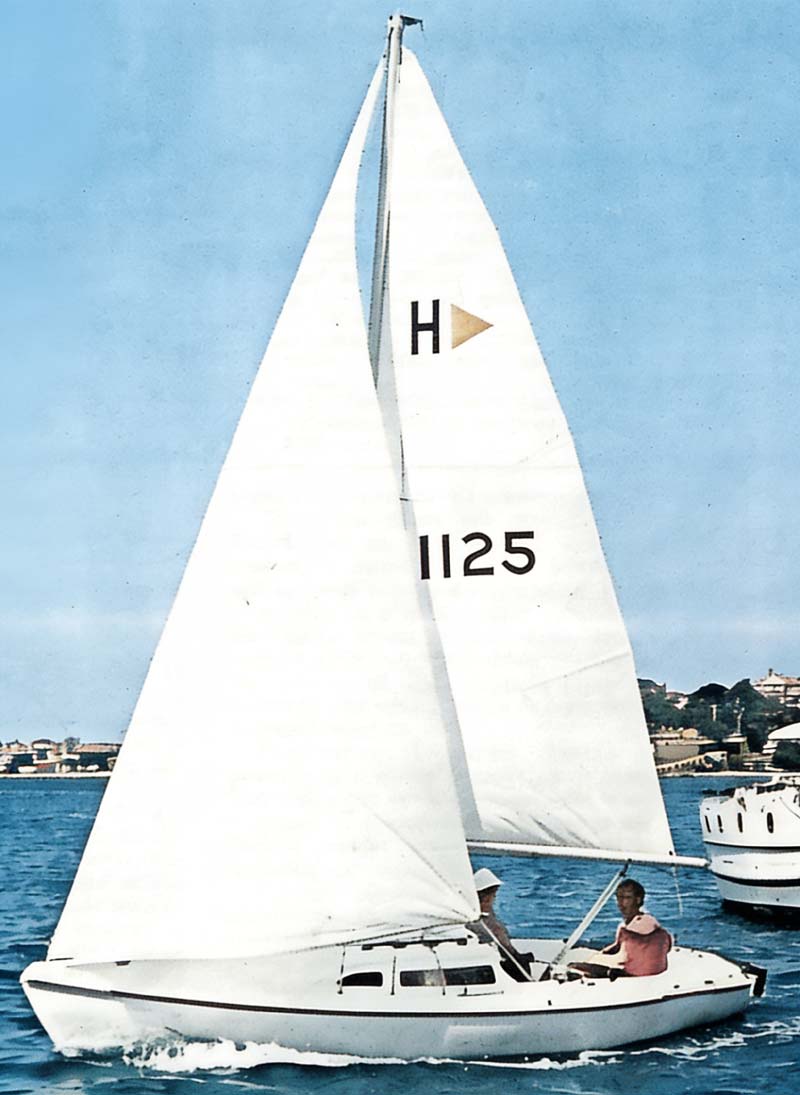
The Hunter 19 was designed by Oliver Lee in England, where it has been a remarkable success – around 500 boats have been built there. It has even proven itself offshore, with one example completing a solo transatlantic race and finishing tenth on handicap.
The design grew out of the well-regarded Squib 19 ft keelboat, and in 1969 it made a strong impression on the racing scene. That year it took first place in Class Five of the JOG Cowes to Poole race, first again in the Southsea to Cherbourg, and first overall in the RORC Southsea to Cherbourg. On top of that, during Burnham Week in 1969 it won six of its seven races and took a second in the other, along with a handful of other results.
The Hunter arrived in Australia around 1972, and within a year twenty had been built locally. The first eight came out of Triton’s workshop until their Triton 24 and 26 production got too busy, and Formfit Fibreglass took over and built the remaining twelve.
Out on the water, the Hunter 19 is a wonderfully light and responsive boat to sail. She carries just a touch of weather helm when the breeze pipes up, which gives her a lively feel and acts as a built-in safety check if the helm were ever left unattended.
The test boat, Kalina, was set up as a harbour racer and carried no guard rails. The JOG version has a different deck and cabin arrangement that meets all the required safety standards. It has a smaller cockpit and a more enclosed cabin. That was the configuration used by the boat that crossed the Atlantic. The hulls of both versions are identical; only the deck and cabin differ.
The rudder is mounted on the stern and is a little exposed – a half-submerged log could make short work of it, and there’s no skeg to offer any protection. That said, repairs at sea would be possible, and JOG crews might sensibly carry a spare.
The Hunter is a well-balanced and nimble yacht. She spins like a skiff, picks up speed smoothly, and can comfortably carry four people in the cockpit, which is well proportioned. The skipper has good foot support close to the leeward side. Down below, two adults can sleep in reasonable if snug comfort.
Weekend sailing with a close friend or two is certainly doable. There’s a small galley built into the port side just inside the companionway, and the forward bunks offer enough length for two people to stretch out. Just inside the hatch there’s sitting headroom, and it’s pleasant enough to stand in the companionway to catch the breeze – as long as you remember to duck when the boom comes across.
The basic sail-away package, similar to the test boat Kalina but without a spinnaker and other personal additions, comes in at $2,750 complete – genuinely good value.
For those who want to do some of the work themselves, an owner-competition kit is available at $1,375. This includes the hull and deck mouldings, timber forward bunks fitted, chainplate mounts, keel support floors, and a white-coated interior floor. Add the 730 lb (331kg) keel and the price rises to $1,695. A trailer-sailer version with a 600 lb (272kg) retractable keel and a mechanical jacking system is also on offer at $2,900 sail-away (1973 prices).
The extras list isn’t long but covers things like cabin windows, handrails on the cabin top, an outboard bracket, quarter berths, bunk cushions, cabin sole boards, roller reefing, additional genoa tracks, and a genoa. All up these come to around $517, though a handy owner could likely cut that figure in half by shopping carefully and doing the fitting themselves.
The sail-away price covers everything needed to get going: hull and deck mouldings, a 730 lb cast iron keel, rudder, antifouling, mast, boom, stainless steel fittings, winches, cleats, teak gunwale, fibreglass hatches, mainsail, and jib – all delivered, rigged, and launched in the Sydney area.
Kalina was carrying a clean, flat mainsail and a moderately cut genoa, both freshly recut by Jack Herrick to his own exacting standards. When the wind builds, skipper Randall drops the genoa in favour of a smaller high-cut jib. Under that reduced rig, with the mainsail traveller eased well out and the crew alert to ease the sheet skiff-style, she really moves.
The Hunter 19 is easy on the eye, handles beautifully, and is forgiving to sail, and the price is hard to fault. The drawbacks are simply what comes with a 19-footer – the cabin is tight and it wouldn’t suit a family of four or more. Realistically, two and a half people could sleep below, and another could manage a night or two in the cockpit under a boom cover. The solo sailor, though, will find this boat a genuine delight – easy to handle, and actually quite spacious when there’s only one person aboard (Hopkins 1973: 6-9).
FACT BOX
-
Yacht: Hunter 19, Kalina, owned by Phil Randall of the Parramatta River Yacht Club, Sydney.
-
Designer: Oliver J. Lee, Essex, England.
-
Builder: Yachting World Pty Ltd (Bill Norman), 70 Chisholm Ave, Avalon, NSW.
-
Moulders: Formfit Fibreglass, Sydney.
-
LOA: 19 ft (5.79 m)
-
LWL: 17 ft 3 in. (5.26 m)
-
Beam: 6 ft 2 in. (1.87 m)
-
Draft: 3 ft 3 in. (.91 m)
-
Displacement: 1500 lb (681 Kg)
-
Keel: 730 lb (331kg) cast iron
-
Ballast Ratio: 50 percent
-
Accommodation: Two/three berth with stowage in after hatch, in bins and throughout the cabin.
-
Mainsail Area: 84 sq ft (7.8 sq m)
-
Jib: 68 sq ft (6.3 sq m)
-
Genoa: 120 sq ft (11.15 sq m)
-
Basic Sail-Away Yacht: $2750 — white decks, colored hulls to owner’s choice.
-
Kit: $1375; $1595 with keel fitted.
-
Options: Retractable 600 lb (272kg) lead keel version $150 extra.
Quick tip: Keep in mind that trailer sailers can vary quite a bit, even within the same class. Take the RL28, for example: they might not all have outboard wells as designed. Some originally may have had inboard engines, and when those were removed, the owners swapped them for a standard outboard mounted on the stern.