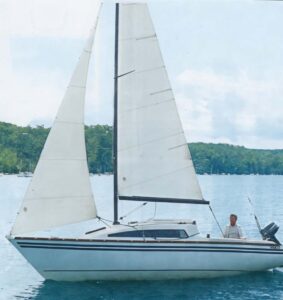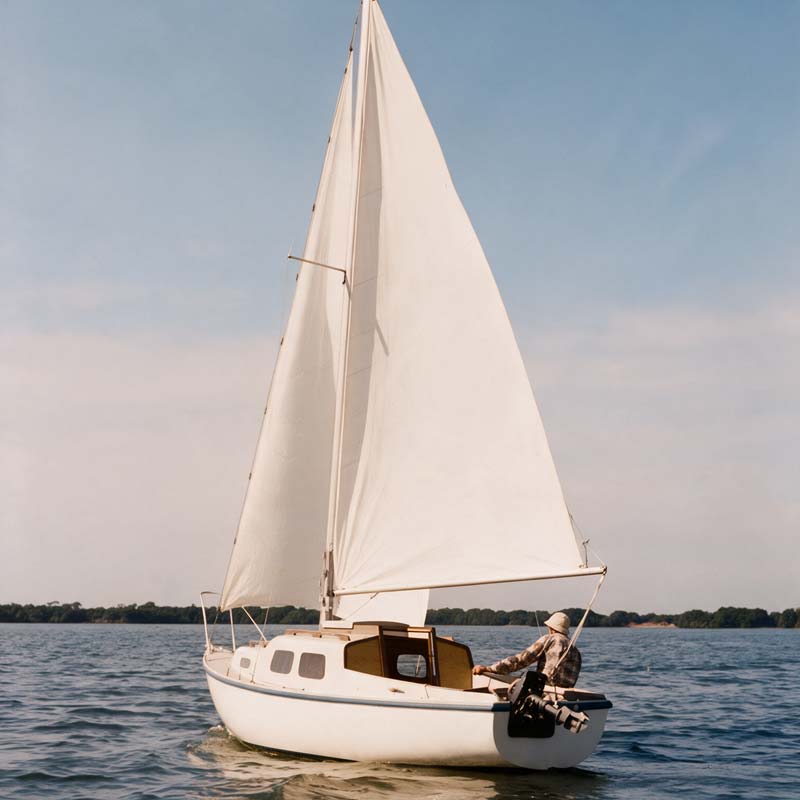
The Westwind 20, was an affordable and well-performing fiberglass sailing cruiser built in Adelaide, South Australia. Available in both deep fin keel and bilge keel versions, the boat handles exceptionally well, offering a smooth, well-balanced ride even when gusty winds pick up. The bilge keel model is particularly useful for tidal anchorages, as it stays upright when aground and can also be easily trailed behind a family car.
The boat’s construction features a quarter-inch fiberglass hull throughout, complemented by varnished timber trim and maple hatches that give it a classic nautical feel. Inside, the layout is surprisingly spacious for a 20-footer, accommodating up to four berths with plenty of locker space below them. It includes convenient features such as a stove alcove with a tray that can be stowed away, a sink, a boxed marine toilet positioned forward between bunks, and large windows that flood the cabin with sunlight. On deck, there is a roomy, deep, and self-draining cockpit with a companionway that can be securely sealed off with a door and a sliding hatch. Developed through the collaboration of builder Bill Porter, naval architect Neil Cormack, and sailmaker J. Robb, the Westwind 20 offers an impressive combination of simplicity, security, and family-friendly comfort at a competitive price (Branch 1968, pp. 54-59.)
Specifications:
Name & Builder: Westwind 20, built by W. G. Porter & Son, Birkenhead, SA.
Designer: Neil Cormack, AINA.
LOA (Length Overall): 20 ft.
LWL (Length on Waterline): 16 ft.
Beam: 6 ft 8 in.
Draft: 3 ft 6 in (fin keel); 2 ft (bilge keels).
Sail Area: 103 sq ft mainsail, 86 sq ft jib.
Ballast: 1100 lb, both models.
Accommodation: 4 berths: 2 for’ard, 2 aft.
Features: Stove alcove, sink, WC fitted for’ard, lockers, hatch on after deck for stowing outboard motor.
Price: $3700 (1968) (includes complete yacht, sails, mattresses, outboard motor and fittings, and sales tax).
Source: Branch, Charles A. (1968) ‘Ideal Sailing Cruiser’ Seacraft, September, pp. 54-59.
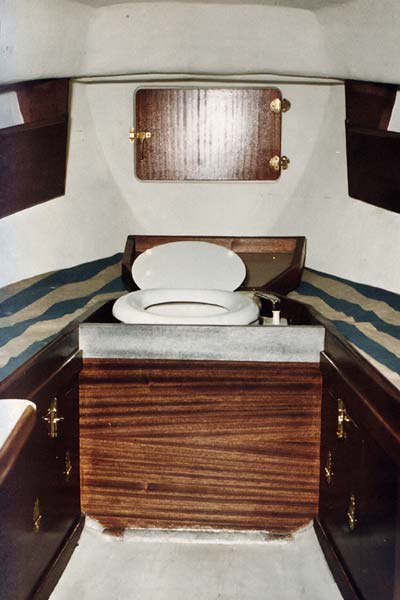
Historical photograph reproduced for identification and historical research purposes. Copyright remains with the original rights holder.
Quick tip: Keep in mind that trailer sailers can vary quite a bit, even within the same class. Take the RL28, for example: they might not all have outboard wells as designed. Some originally may have had inboard engines, and when those were removed, the owners swapped them for a standard outboard mounted on the stern.