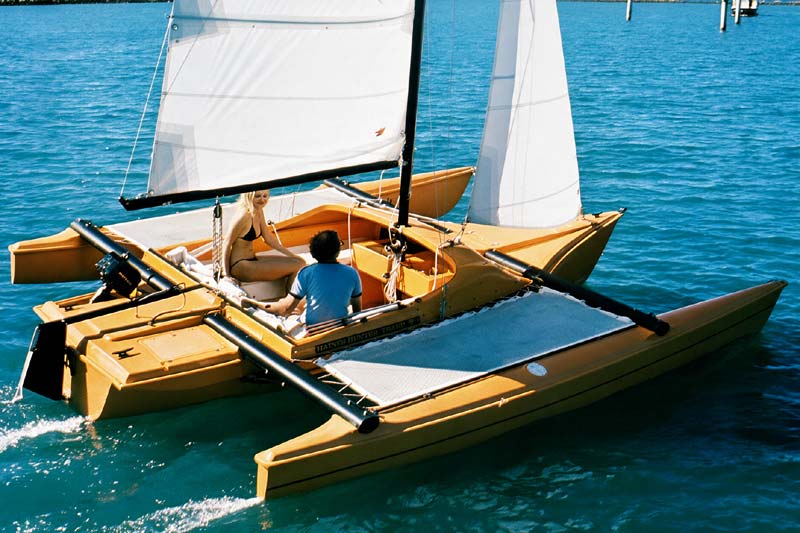
The Haines Hunter Tramp received high praise when it was named the 1981 Fibreglass Boat of the Year by the Australian Boating Industry Association and ACI Fibreglass. Initial test reports lauded its innovative concept, exceptional engineering, and overall quality, predicting that it would set a new standard for Australian boating, even if it was somewhat ahead of its time. Designed by New Zealander Ian Farrier, the trimaran represented a bold and controversial step for Haines Hunter, as many dealers were initially sceptical. However, more progressive dealers, the boating public, and industry judges ultimately recognized the craft’s revolutionary design and potential.
Space and comfort are standout features of the Tramp’s layout. The vessel offers ample room for relaxation, including two comfortable berths in the main cockpit, space for two adults to stretch out on the floor under a canopy, and plenty of area on the trampolines for children to play safely while sailing upright. While the cockpit can technically accommodate up to six adults, four or five people will find it most comfortable. The design features fixed seats and berths to port and starboard surrounding a spacious, level cockpit floor with minimal obstructions. A forward shelter cuddy offers protection for younger passengers, and although space near the mast is limited, an optional sink and galley unit can be added. This functional soft-top canopy arrangement converts the boat into a cozy four-berth cruiser for overnight trips or shelters the cockpit from harsh sun without interfering with sailing controls.
In terms of performance, the standard Tramp can achieve speeds in the range of 17 to 18 knots. Despite this impressive capability, most family owners choose to sail at more moderate speeds, favouring ease and comfort over pushing the boat to its maximum limits. Addressing concerns about safety in rough conditions, observers note that capsize or loss of control would require extreme negligence or extraordinarily severe weather. The Tramp avoids the dramatic heel-and-round-up tendencies common to light, heavily canvassed trailer yachts, making it arguably safer and far less intimidating for passengers and crew. Safety is further enhanced by internal bulkheads that provide buoyancy, ensuring the vessel remains afloat even if damaged by a submerged object.
Transporting and launching the Tramp is straightforward and compares favourably to handling standard monohull trailer yachts. Unfolding the vessel involves securing four folding arms with eight stainless steel bolts, though four are sufficient to keep it secure during normal operation. The craft operates remarkably well under power even with its two outriggers or floats folded inward, allowing the boat to be launched, retrieved, and navigated in and out of marinas or ramps before extending the floats for open water sailing. At the time of publication, the standard model was priced at $10,337 (1981) in Brisbane, fitted with a main sail and jib, with an optional Tinka 160B braked trailer available for $1,270.
Specifications:
-
Name / Type: The Tramp – a high performance, family day-sailing trimaran
-
Overall Length: 5.94 metres (19′ 5¾”)
-
LWL: 5.5 metres (18′)
-
Folded Beam: 2.45 metres (8′1″)
-
Unfolded Beam: 4.5 metres (14′9″)
-
Draft (up): 0.36 metres (1’2″)
-
Draft (Down): 1.22 metres (4′)
-
Displacement: 640kg (1411 lbs)
-
Weight on Trailer: 950kg (2094 lbs)
Source: ‘Haines Hunter Tramp’ Australian Boating, 1981, August, p. 88.
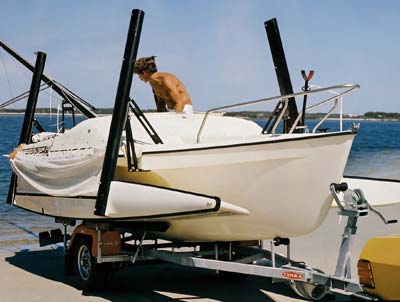
Historical photograph reproduced for identification and historical research purposes. Copyright remains with the original rights holder.
Quick tip: Keep in mind that trailer sailers can vary quite a bit, even within the same class. Take the RL28, for example: they might not all have outboard wells as designed. Some originally may have had inboard engines, and when those were removed, the owners swapped them for a standard outboard mounted on the stern.