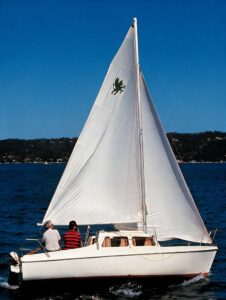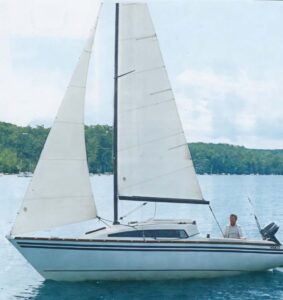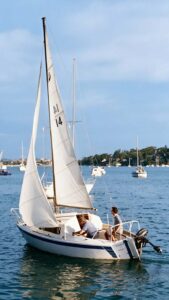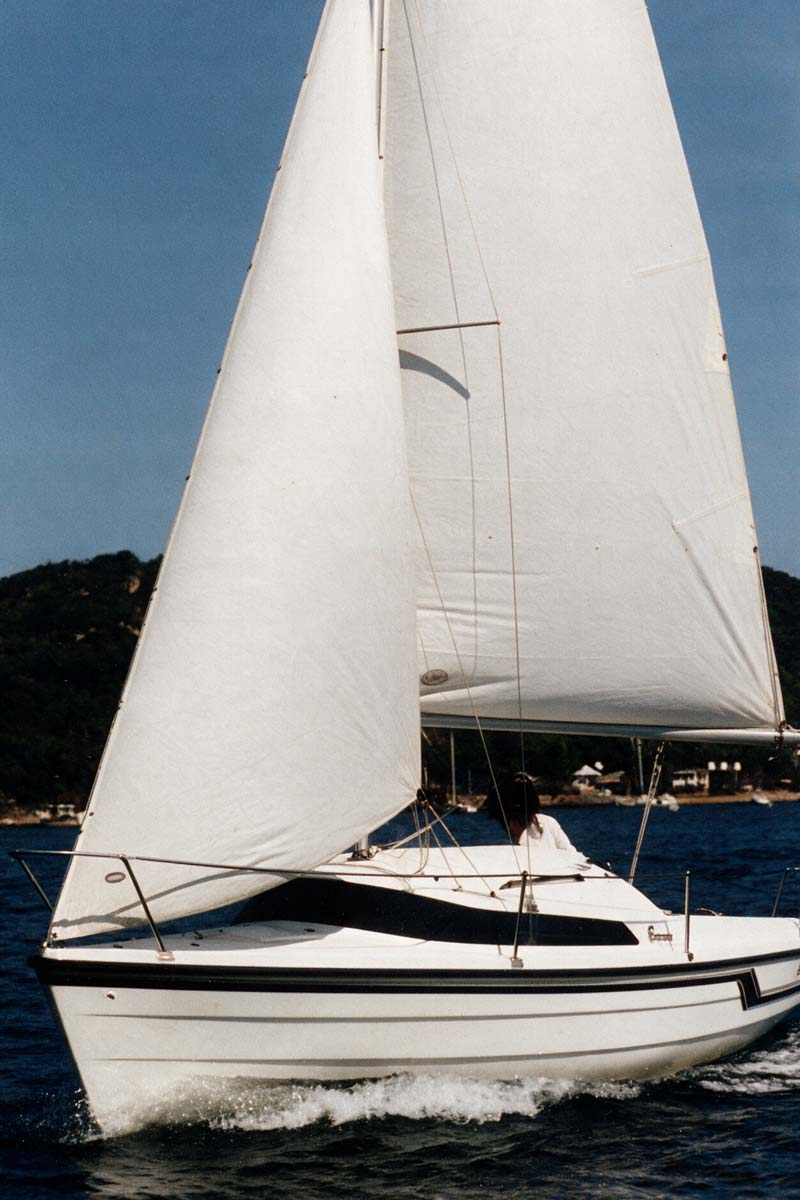
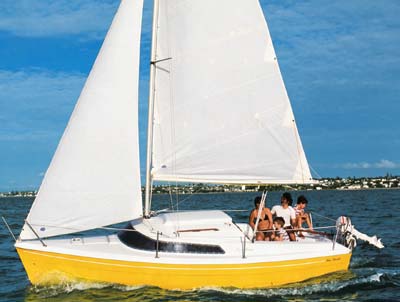
The Farr 6000 stands out as offering a distinctive option that combines the characteristics of a large sailing skiff with more generous freeboard and cabin space than typically anticipated. Hailing from the windy, cool climate of New Zealand, it feels well-suited as a fun day cruiser or for brief trips in good weather, making it particularly appealing to groups of young adult sailors rather than traditional families. The simple rigging setup lacks sheet winches entirely and handles easily, making a strong case for using small jib sails. While stability wasn’t precisely measured, it feels adequate for sailors experienced with open boats. Its racing-dinghy hull shape and fairly large stern contribute to a noticeable weather helm even at moderate heel angles, though this provides quick recovery from heavy heels, which many sailors may not mind.
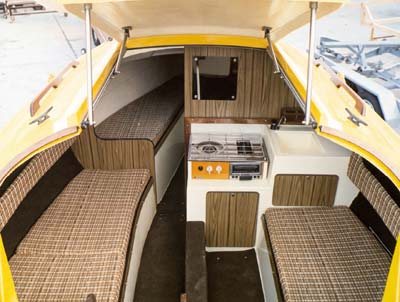
The yacht features an innovative design highlighted by an unusual rear bulkhead that folds completely down and away to connect the interior cabin and outer cockpit into one expansive area. This setup is brilliant for pleasant conditions, though it poses challenges during wet or rainy weather as the forward-sloping fiberglass moulding could channel rainwater into the cabin, forcing washboards to remain in place. Because there are no opening cabin windows or dedicated ventilation systems beyond a forward hatch, the interior can become overly warm and humid on rainy days. Inside, the layout works well as a day boat, featuring a semi-enclosed toilet tucked behind a bulkhead in the forepeak, a galley running crosswise against this bulkhead, two facing settee berths on opposite sides of the cabin, and a fold-away dining table designed to seat two.
On its trailer, the boat weighs roughly 1.24 tonnes, making it light enough to be legally towed by standard family vehicles. It launches easily off the trailer with a strong push, though setting up the uncomplicated rigging takes a few minutes longer at the ramp compared to some competing models. The transom design receives some criticism for its uninspired layout and awkwardly mounted outboard bracket, along with a lack of boarding access beyond a pelican clip on the lifeline above the tiller. On the water, headsail sheets are double-sided and operate through a two-to-one tackle system that eliminates winches while allowing the sail to be flattened when needed. The cockpit offers comfortable seating for hiking out, and the centreboard lowering system can be monitored directly through a clear Perspex window over the winch drum. Overall, the Farr 6000 delivers high-quality GRP construction and clever design innovations, making it an exciting choice for fast, exhilarating harbour day sailing.
Specifications
-
LOA: 6.07m / 20’0″
-
DWL: 5.60m / 18’4″
-
BEAM: 2.45m / 8’2″
-
DRAFT (Board up): 0.42m / 1’4″
-
DRAFT (Board down): 1.55m / 5’1″
-
WEIGHT: 884.5kg / 1950lb
-
BALLAST: 242.0kg / 535lb
Towing Weight: 1.24 tonnes (legally towable by a standard Holden Commodore)
– Rigging: Simple winchless rig with 2-to-1 purchase headsail sheets
– Steering & Controls: Tiller steering, cockpit-controlled centreboard with a clear Perspex inspection window
– Interior Features: Fold-down rear bulkhead, semi-enclosed forepeak toilet, athwartship galley, two settee berths, fold-away table for two
– Construction: High-standard GRP (Glass Reinforced Plastic) work, sold only as a completed boat
Source: Payne, Webster and Davidson (1981) ‘Farr 6000’ Australian Boating, January, p. 54.
Historical photograph reproduced for identification and historical research purposes. Copyright remains with the original rights holder.
Quick tip: Keep in mind that trailer sailers can vary quite a bit, even within the same class. Take the RL28, for example: they might not all have outboard wells as designed. Some originally may have had inboard engines, and when those were removed, the owners swapped them for a standard outboard mounted on the stern.