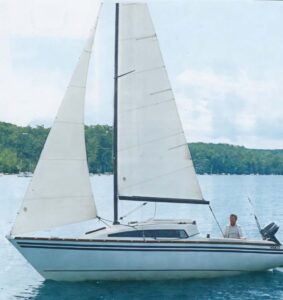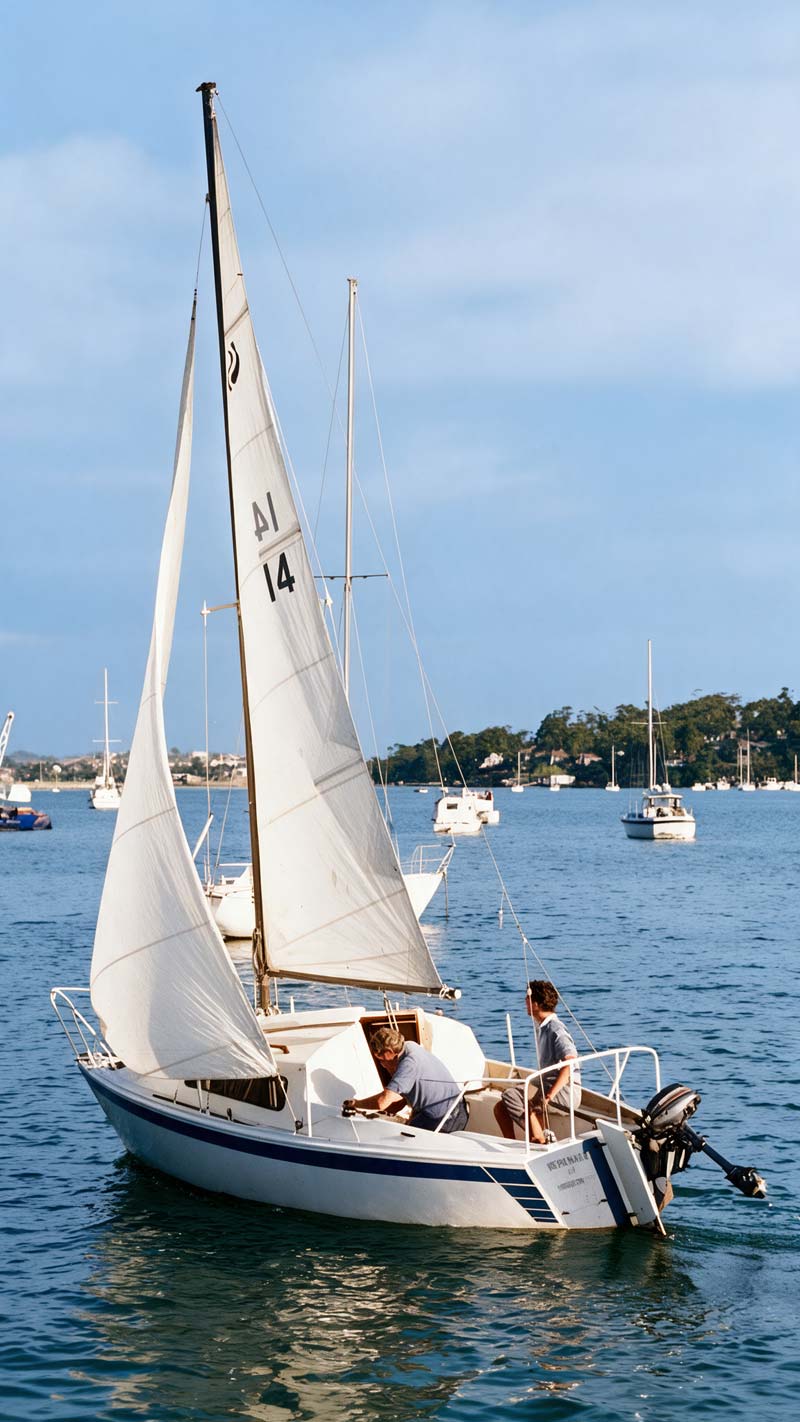
Although aluminium construction has long been proven in large ocean racers such as Bumblebee 4 and Siska, it has rarely seen widespread adoption in popular family trailer sailers. This is primarily because aluminium is relatively expensive and demands specialized technical skill to shape effectively compared to molded fibreglass. Nevertheless, shifting automotive trends toward smaller family cars with lower towing capacities make lightweight, sturdy alloy construction increasingly attractive. Designed by West Australian naval architect Herman Boro and built in Victoria by Kayfa Industries, the Siren 20 represents a sophisticated step forward for aluminium trailer yachts. From an aerial or dockside view, the craft features a teardrop profile accentuated by its short overall length of 6 metres and a generous maximum beam of 2.4 metres, utilizing nearly the entire legal towing width limit without pinching the ends. Combined with a sharply raked stem and reverse transom, the boat achieves a sleek, modern appearance reminiscent of contemporary racing yachts.
The interior arrangement provides adequate accommodation for up to four adults or a family with up to three children. The forepeak houses standard V-berths with provision for a marine head beneath. Rather than implementing a traditional dinette on the starboard side, which would intrude significantly into cabin space due to the centreboard case, the builders opted for continuous settee berths on both sides, with a quarter berth extending aft under the cockpit. Headroom ranges from 1.574 metres beneath the main cabin roof to 1.391 metres over the berths. Cooking amenities are compact, consisting of a two-burner stove with a sink situated directly beneath the companionway stairs, though there is no built-in icebox. On deck, the layout is practical and spacious, featuring wide side decks, a full-sized anchor well forward, and a roomy cockpit capable of seating up to six adults. Two dedicated storage lockers are built into the aft end of the cockpit seats, and the companionway is secured using a two-piece drop board and sliding hatch.
Constructed as an all-welded hull, the Siren 20 uses three-millimetre marine-grade aluminium plate for both the topsides and bottom. Its ballasting system features iron punchings encapsulated in epoxy set in concrete beneath the cabin sole, paired with an 8mm alloy swing keel operated via a 2:1 tackle system. All major fixtures, including the bow rail, mooring cleats, chain plates, pushpit, grab rails, winch pads, and mast tabernacle, are welded directly into place, creating a exceptionally solid structure. The deck-stepped mast relies on a strong vertical strut with fore-and-aft bracing. Overall, the alloy construction provides superior durability against road hazards, grounding, and beach landing wear compared to conventional fibreglass.
The boat utilizes a standard 7/8ths fractional rig featuring a single forestay, upper shrouds running through single spreaders, and an adjustable backstay. Main sheeting is positioned mid-boom with a traveller mounted on the bridge deck ahead of the companionway. While this placement keeps the boom controls clear of cockpit occupants, the mainsheet traveller line can obstruct companionway access while under sail. A boom vang is standard, though winches are optional. The demonstration model featured Dutch Meissner No. 10 winches for the jib sheets alongside a smaller cabin-top winch for halyards. Sail inventory for the test boat was produced by Hood’s Melbourne loft and included a 9.08 sq. m. mainsail with two rows of point reefing, a No. 1 jib, a No. 2 jib, and a large overlapping genoa measuring 12.16 sq. m.
Despite a total light-condition displacement of 950 kg and a working sail area of approximately 21 sq. m., the Siren 20 demonstrates impressive speed and agility, making it a strong contender for club racing. It exhibits extraordinary initial stiffness and high pointing ability. During testing in Pittwater, the yacht proved exceptionally well balanced on the helm, capable of tracking true “hands off” over long distances due to its hull form and built-in skeg. Off the wind, the vessel responds briskly and maintains straight directional stability. Safety is further supported by positive flotation, featuring 42 cubic feet of foam buoyancy beneath the berths and sole, and the vessel successfully passed the Victorian Yachting Council’s self-righting tests.
With a total towing weight of 965 kg, the Siren 20 is easily manageable behind most standard 6-cylinder automobiles and light 4-cylinder vehicles. Setup and launching take roughly 20 minutes for two people, while de-rigging requires only 10 to 15 minutes. At the time of testing, the complete retail package stood at $9,236.00 (1980), excluding the trailer ($1,285.00 for single axle, $1,775.00 for tandem) and outboard engine ($555.00 for a 5hp Mariner). Alternatively, Kayfa Industries offered a bare hull stage for $6,730.00, allowing owners to complete the painting, rigging, and internal fitting at their own pace (Coates 1980, pp. 82ff).
SPECIFICATIONS
-
Model: Siren 20
-
Length Overall (LOA): 6.0 m
-
Waterline Length (LWL): 5.0 m
-
Beam: 2.4 m
-
Draft (Minimum): 0.26 m
-
Draft (Maximum): 1.4 m
-
Displacement: 950 kg
-
Ballast: 350 kg
-
Mainsail Area: 9.08 sq. m.
-
Genoa Area: 12.16 sq. m.
-
No. 1 Jib Area: 6.70 sq. m.
-
No. 2 Jib Area: 3.15 sq. m.
-
Complete Sail-Away Price: $9,236.00 (1980) (as tested)
-
Bare Hull Stage Price: $6,730.00
-
Trailer Price: $1,285.00 (Single Axle) / $1,775.00 (Tandem)
-
Motor Price: $555.00 (5hp Mariner Outboard)
Source: Coates, Dick (1980) ‘We Test the Siren 20 – The Strongest T/S Yet?’ Australian Boating, June, pp. 82-89.
Historical photograph reproduced for identification and historical research purposes. Copyright remains with the original rights holder.
Quick tip: Keep in mind that trailer sailers can vary quite a bit, even within the same class. Take the RL28, for example: they might not all have outboard wells as designed. Some originally may have had inboard engines, and when those were removed, the owners swapped them for a standard outboard mounted on the stern.