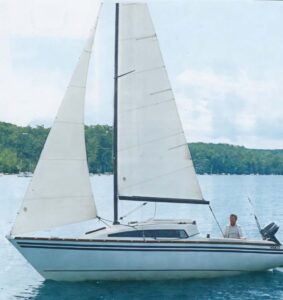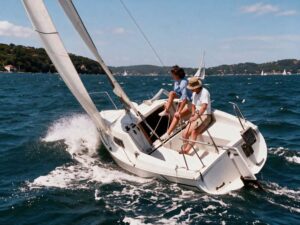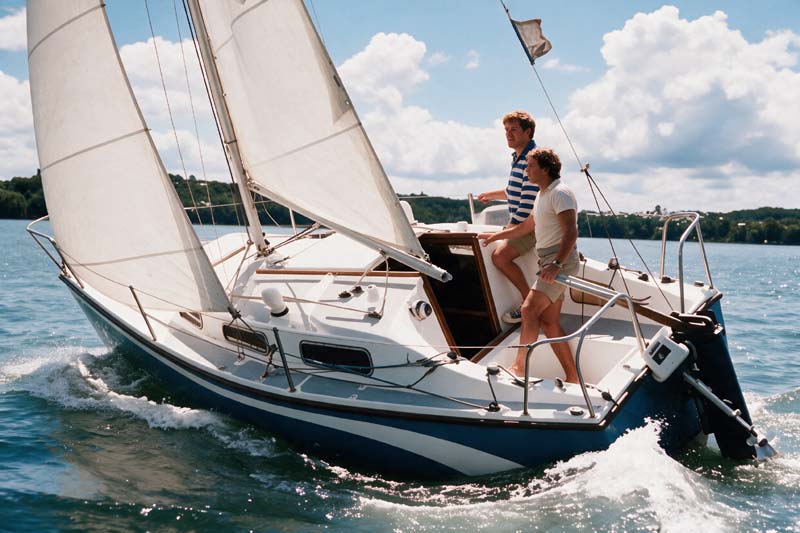
With designer Alan Scott, it is rare to find such real-world expertise applied to the creation of a trailerable boat, which explains why the Sabre 20 looks and handles like a dedicated small keeler. Its powerful, slab-sided hull design offers exceptional stability alongside remarkably generous accommodation space.
Scott accomplished this design feat by pairing naval architecture theory with practical experience, crafting a vessel with a very long waterline relative to its size and a broad beam. As a result, the Sabre 20 feels more like a compact cruising yacht than a conventional trailer sailer. Construction is exceptionally robust, utilizing traditional hand-laid glass fibre to meet high quality specifications. Its structural integrity and overall strength earned it formal approval as a trailer yacht from the New Zealand Trailer Yacht Association, as well as certification from the Marine Department for commercial charter operation.
Under sail, the Sabre 20 is remarkably stiff thanks to 272 kg of lead encapsulated within its full-length stub keel. Its upwind capabilities are superb due to a very fine entry forward that transitions into extremely beam-heavy aft sections. This design creates immense buoyancy toward the stern, easily compensating for the weight of four to five people seated in the cockpit. The vessel has comfortably managed 35-knot winds under a double-reefed main and working jib, proving to be fully self-righting. In a notable test of its stability, two strong men using a block and tackle were unable to heel the mast any further than a normal hard-heeled angle on the wind, even with the spreaders submerged, no water entered the vessel, and the cockpit remained completely dry.
Single-handed operation is effortless, making the boat manageable for one person alongside an inexperienced crew. All control lines lead back to the cockpit area, enabling a solo sailor to raise, lower, and adjust the centre-plate, drop the spinnaker quickly in emergencies, or reef the sails without leaving the cockpit. Below deck, the layout accommodates five roomy berths, featuring 1.9-meter quarter berths and a private forward cabin containing a double berth. The main cabin provides a comfortable space for adults or children, supplemented by an icebox, Dorade ventilators, and a table that comfortably seats five or six for dining. Thoughtful detailing throughout includes secure catchwords, specialized cockpit sides designed to support the lower back, and standard features such as a 25-litre fuel tank, a deep anchor locker, two-tone non-skid decks, and reinforced pads for winches and stanchions.
Rigging the Sabre is simple and can be completed by one person in just 15 minutes. Launching and retrieving are equally streamlined using a custom-designed float-on/off trailer that avoids typical launching hassles. High side bars keep the boat straight during crosswinds, while a 2.6-meter telescoping drawbar facilitates launching on shallow ramps without submerging the vehicle’s rear wheels. The Sabre could be purchased at any stage of construction, offering a highly competitive price point even when fully equipped with optional extras.
SPECIFICATIONS:
* Built By: Shorelink Yacht Sales Ltd
* Designed By: Alan Scott
* Length Overall: 6.2 m
* Length on Waterline: 5.6 m
* Beam: 2.4 m
* Beam on Waterline: 2.04 m
* Displacement: 907 kg
* Buoyancy: Optional
* Ballast: 272 kg
* Weight on Trailer: 1106 kg
* Main: 9.5 m²
* Genoa: 13.7 m²
* No. 1 Jib: 8.3 m²
* Storm Jib: 3.8 m²
* Spinnaker: 35.2 m²
* Mast Height: 8.1 m
* Length: 2.5 m
* Total Area (working): 18 m²
* Draught – Keel Up: 0.39 m
* Draught – Keel Down: 1.27 m
* Width on Trailer: 2.4 m
* Height on Trailer (mast down): 2.2 m
* Headroom from Sole: 1.52 m
* Number of Berths: Five
* Galley (equipment fitted): Moulded unit with cooker recess, sink, icebox
* Sitting Headroom: 1.06 m
* Placement of Head: Forward cabin
New Zealand Trailer Yacht Association. “Designs S–Z.” Accessed November 4, 2026.
https://www.nztya.nz/designs-s-z.
Photograph reproduced for identification and historical research purposes. Copyright remains with the original rights holder.
Quick tip: Keep in mind that trailer sailers can vary quite a bit, even within the same class. Take the RL28, for example: they might not all have outboard wells as designed. Some originally may have had inboard engines, and when those were removed, the owners swapped them for a standard outboard mounted on the stern.