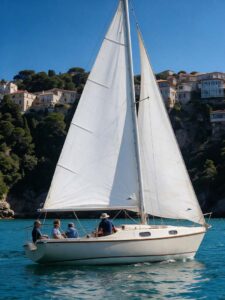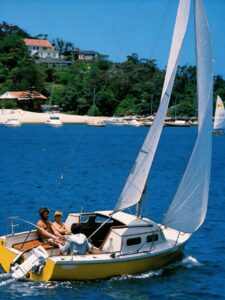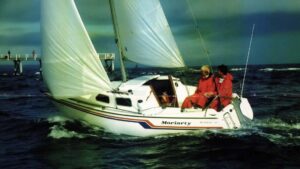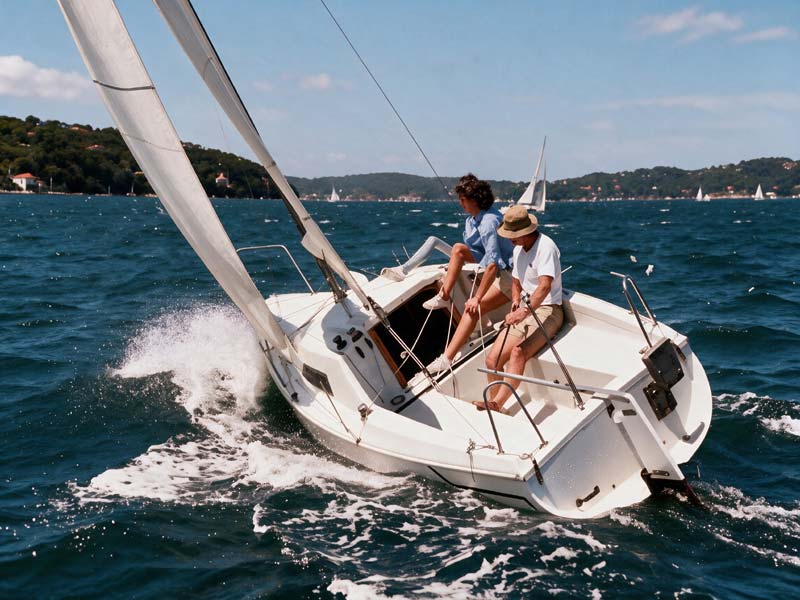
The Sonata 6 was designed by Sydney boat builder Jim Voysey, who previously built the Southern Cross 23 (a Scott Kaufman design). Realizing the limitations of larger, heavier trailer-sailers, Voysey sought to compress the best attributes of the 23-footer into a lighter, less expensive, and easier-to-tow 20-foot boat. The Sonata 6 features a modern style with a wedge-shaped cabin top, an arrow-straight bow, and clean lines. Its maximum beam is placed just above the waterline rather than using a topside tumblehome, maximizing width at heel height. Designed with a light-displacement hull form, it draws inspiration from eighth-tonner hull lines to offer efficient performance while keeping overall costs within an accessible range.
During sea trials on Pittwater in a fresh south-westerly breeze, the Sonata 6 demonstrated good speed and handling, tracking well through rough water without noticeable nose-diving. Downwind performance was lively, assisted by a deep rudder blade with a small skeg to prevent ventilation and maintain control during high-speed runs and broaches. The side decks measure 177.8 mm, requiring a high-clew headsail setup if closer sheeting angles are desired for racing. Early production issues, such as deck squeaking caused by internal egg-carton reinforcing, were resolved in standard models by transitioning to fibreglassed sheet plywood.
The interior offers a four-berth layout consisting of a double berth in the forward cabin and two single berths aft. Headroom ranges from 1.5 meters to 1.8 meters when utilizing the two-action pop-top companionway hatch. Facilities include a moulded starboard galley positioned near the main bulkhead, space for an optional two-burner alcohol stove, a sink, and an area offset to starboard for a chemical or pump-out toilet. Structural strength is provided by a main bulkhead tied to both hull and deck, with the hull built from multiple layers of chopped strand mat and woven rovings, extra reinforcement along the bottom and keel areas, and plywood reinforcement across flat deck sections.
The rig incorporates Sheerline silver-anodized spars with the shroud chainplates placed in the same athwartships plane as the mast step, enabling easy mast raising and lowering without adjusting turnbuckles. Sail handling features Barlow 12 sheet winches and 2:1 halyard purchases in lieu of halyard winches. Two underwater configurations are available: a fixed lead-filled fibreglass fin keel or a fully retractable cast iron/lead-antimony swing keel shaped like a hockey stick to concentrate weight lower down.
SPECIFICATIONS:
* Model: Sonata 6
* Builders: Sonata Yachts, Newport, NSW
* Length Overall (LOA): 6.1 m
* Length Waterline (LWL): 5.1 m
* Beam: 2.1 m
* Draft: 228 mm (keel up) / 1.35 m (keel down)
* Total Displacement: 580 kg
* Ballast (Swing Keel): 220 kg
* Ballast (Fixed Keel): 181 kg
* Auxiliary Power: Outboard engine up to 10 hp maximum
* Accommodations: 4 berths (1 double fore-cabin berth, 2 aft single berths measuring 1.9 m)
* Headroom: 1.5 m standard, expanding to 1.8 m with pop-top raised
* Construction Materials: Chop strand mat and 24-oz woven roving fibreglass; 5/8 inch sheet plywood reinforcement for flat deck areas
* Base Shell Price: $3,820 ex-Sydney
* Standard Sailaway Price: $5,505 ex-Sydney (Stage Two sailaway at $3,595 ex-Sydney)
* Fully Optioned Test Boat Price: Approximately $7,300 ex-Sydney (At time of test)
Source: John Crawford Marine. “Sonata 6” Trailer Sailer Library. Accessed November 6, 2026.
https://www.johncrawfordmarine.com.au/advice/trailer-sailer/sonata-6
Photograph reproduced for identification and historical research purposes. Copyright remains with the original rights holder.
Quick tip: Keep in mind that trailer sailers can vary quite a bit, even within the same class. Take the RL28, for example: they might not all have outboard wells as designed. Some originally may have had inboard engines, and when those were removed, the owners swapped them for a standard outboard mounted on the stern (Hill, James).