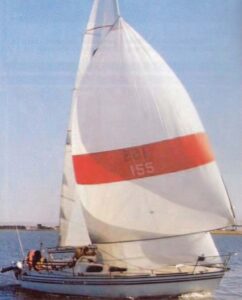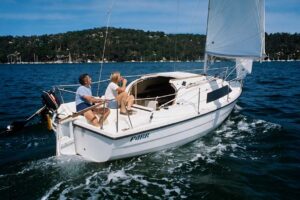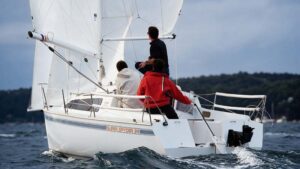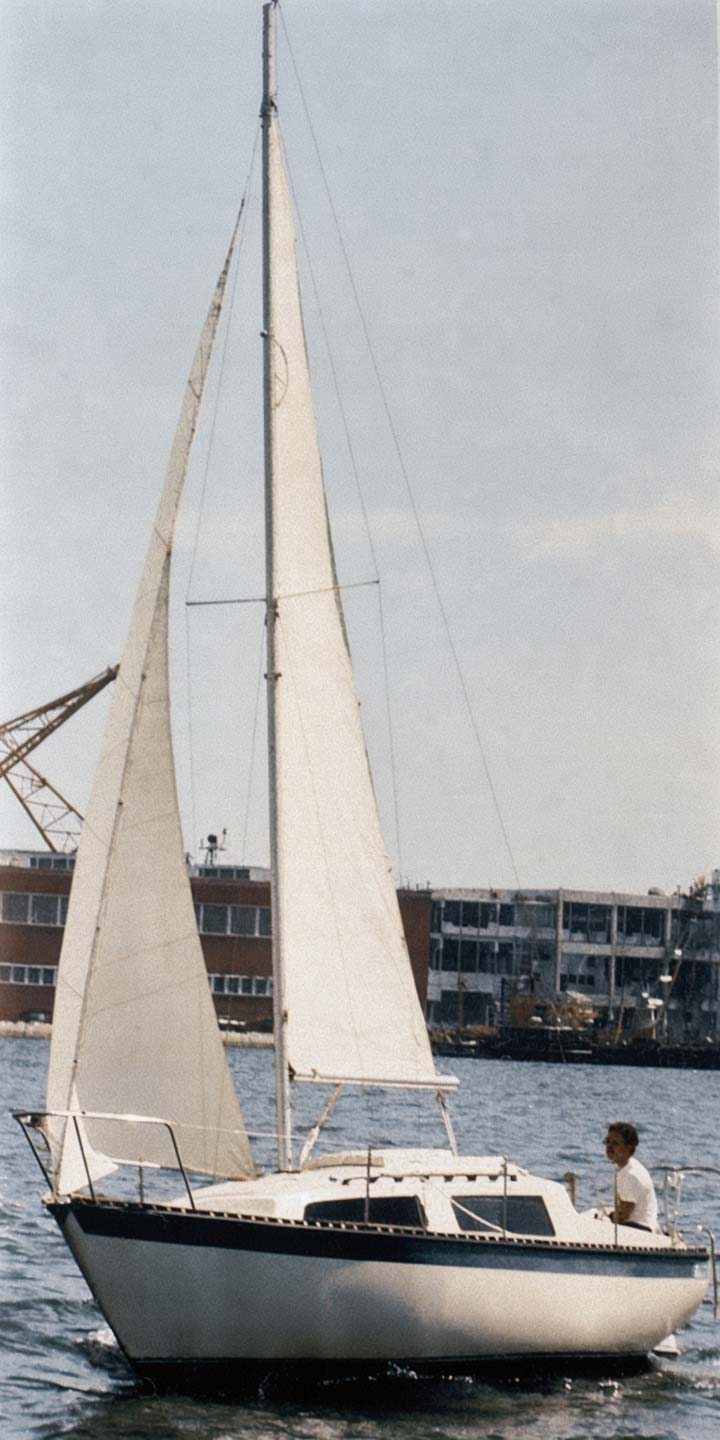
The Pacific 747 SD represents a distinct approach to the concept of a trailerable yacht. The “SD” designation stands for shoal draft, which is the primary feature that sets this vessel apart. Rather than being a typical light trailer sailer, it is built as a true miniature yacht featuring a fixed yet shallow keel, substantial stability derived from its hull design, and an exceptionally high ballast ratio of approximately 50 percent. Designed by Brian Cronshaw of Pacific Yachts, the boat is an evolution of the earlier Adventure 22, a design popular in Australian cruising articles by Hilda Van Beusichem. Cronshaw took the aspects he liked from the original vessel, raised the coach house by 150 mm, and made various other refinements. The resulting Pacific 747 has been available for roughly two years, with around 50 units sold.
In terms of design, the vessel is full-bodied with a full short keel, a rounded bow section, and a shallow v-shape toward the stern. It features a pleasing sheerline and a robust appearance that some might consider traditional or old-fashioned. The cockpit is roomy and well-designed, while the coach house has a moderate reverse sheer. The bow is chunky and incorporates a large anchor locker accessible directly from the deck.
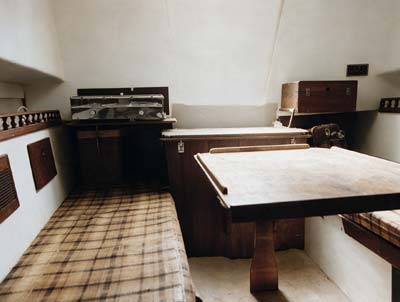
Considerable effort has gone into the interior arrangement below deck, resulting in several clever features. Most notable is a fully enclosed toilet, which is a rare inclusion for a boat of this type. This layout is achieved using two partial bulkheads with a hinged door, preserving an open and spacious feel throughout the cabin. Another innovative solution is the saloon table mounted to a bulkhead; it sits flush against the bulkhead when stowed and folds down when needed. The stove and sink setup is equally resourceful, sliding out on runners from a locker above the starboard quarter berth when required. The sink itself is moulded directly into the companionway steps with a faucet accessible on the right side, and its covering board acts as the first step down into the cabin without blocking access to the sink when in use. Additional sleeping arrangements include a large vee berth forward, two settee berths, and two quarter berths, making the cabin capable of accommodating four adults and two children. There is provision for an inboard diesel engine under the companionway or a long-shaft outboard on the transom, alongside an 85-liter water tank built into the bow, ample stowage options, and a fully insulated ice box under the port settee berth.
The rig is configured as a 7/8 rigged sloop with conventional rigging, featuring the mainsheet traveller located in the forward section of the cockpit to ensure easy access through the hatchway. All control lines are led aft, supported by two Arco halyard winches mounted on the cabin roof as well as sheet winches on the cockpit coamings. A substantial alloy toe rail runs along the gunwales, acting as an attachment point for sheet blocks, providing exceptional deck strength compared to standard balsa core construction.
Performance testing was conducted with Terry Wise of the Pacific Sailing School at Rushcutters Bay in Sydney on a day featuring a building north-easterly breeze. Having used 747s in a sailing school environment for two years, Wise noted that they are ideal training boats due to their stiffness, lack of tricky quirks, and ability to handle constant heavy use without issues. On the water, the boat proved remarkably solid and offered a reassuring sense of security. While making some leeway when beating into the wind, a standard trade-off for a shoal draft design, it tracked smoothly without sudden jerking or rolling. Downwind, the sail plan carried the boat easily without needing a spinnaker pole, holding a large sail area comfortably without excessive pressure on the helm.
At a price point of $16,800 (1981), the Pacific 747 SD comes remarkably complete. Standard equipment includes a stainless steel boarding ladder, interior and navigation lights, sink, stove, plumbing, toilet, cushions, bilge pump, and three sails, offering strong value given the vessel’s build quality and comprehensive inventory. Overall, the boat stands out as a solid, well-designed family cruiser that delivers safety and comfort on the water.
SPECIFICATIONS
* LOA: 7.47m
* LWL: 5.70m
* Beam: 2.40m
* Draft: 0.66m
* Ballast: 890kg
* Displacement: 1790kg
* Sail Area – Main Sail: 9.57 sq.m.
* Sail Area – No 1 Genoa: 15.79 sq.m.
* Sail Area – No 2 Genoa: 13.47 sq.m.
* Sail Area – No 3 Genoa: 9.38 sq.m.
* Sail Area – Storm Jib: 5.48 sq.m.
Source: ‘Pacific 747 SD’ Australian Boating, 1981, May, pp. 70-71.
Historical photograph reproduced for identification and historical research purposes. Copyright remains with the original rights holder.
Quick tip: Keep in mind that trailer sailers can vary quite a bit, even within the same class. Take the RL28, for example: they might not all have outboard wells as designed. Some originally may have had inboard engines, and when those were removed, the owners swapped them for a standard outboard mounted on the stern.