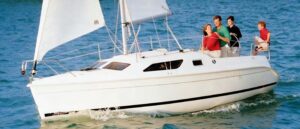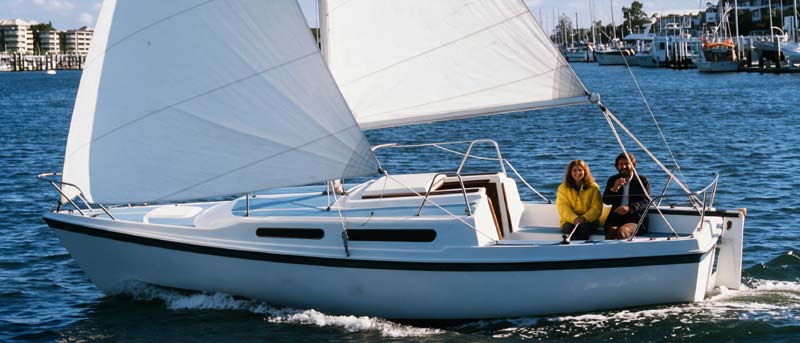
The MacGregor 25 is designed to deliver a high standard of comfort, convenience, safety, and performance compared to other sailboats in its category, all while maintaining an exceptionally affordable price point regardless of chosen options. Built with practical transportation in mind, the vessel rests low on its trailer and is lightweight enough to be towed easily. Ramp launching is as straightforward as it is for a small powerboat, allowing a single person to launch and rig the entire vessel in under fifteen minutes. By storing the boat on its trailer, owners can completely eliminate the ongoing expenses associated with marina moorings. Inside, the cabin is well-equipped for extended trips, featuring a fully enclosed head compartment, a slide-away galley, a large built-in ice chest, an eight-foot five-inch long settee, and a dinette that transforms into a double berth. Overall, the boat comfortably accommodates up to five people with sleeping berths, while a pop-top roof provides six feet of headroom inside the main cabin area.
Safety is a primary design focus of the MacGregor 25. To demonstrate its solid foam flotation system, manufacturer testing included drilling a large hole in the hull to flood the boat; even when filled with water, the vessel remained afloat rather than sinking to the bottom, a crucial safety advantage over many competitors whose keels could otherwise drag a damaged or swamped boat down. Furthermore, the sailboat incorporates a self-bailing cockpit, effective non-skid deck surfaces, and meets MORC self-righting standards. Passengers are protected by a comprehensive set of safety rails, including a bow pulpit, stern pulpit, and side lifelines. Construction involves hand-laid fiberglass hulls, decks, and liners reinforced with a high proportion of durable woven fiberglass roving.
In terms of sailing performance, the MacGregor 25 ranks among the fastest vessels of its size. Its long, flat underbody enables high-speed surfing and planing, while a deep, efficient keel offers the stability and lift necessary for excellent upwind performance. Despite these high-performance traits, the vessel remains easy to maneuverer, making it stable and spacious enough for comfort yet light and simple enough for one person to handle or for a family to master in a single afternoon. Crucial to its versatility is the 625-pound retracting keel, which provides self-righting stability during operation while swinging back and up via a small cabin winch to allow shallow draft for ramp launching, beaching, and trailering. The spacious six-foot seven-inch cockpit accommodates six adults comfortably, supplemented by ample internal storage for all necessary cruising gear. Mast stepping is equally streamlined: the mast slides back and pins to a hinged step before being raised, a task easily performed by one person or assisted by a second person pulling the headstay, while side shrouds and the backstay remain connected at all times. Launching involves simply backing the trailer until the boat floats free, pushing it off gently with a bow line attached, and guiding it back to the ramp to load crew.
Specifications:
* Model: MacGregor 25
* Length: 24′ 11″
* Beam: 7′ 11″
* Weight: 2,100 lbs
* Draft (Keel Down): 5′ 8″
* Draft (Keel Up): 1′ 10″
* Keel Weight: 625 lbs
* Sail Area (Main & Jib): 236 sq. ft.
* Sail Area (Genoa Jib): 176 sq. ft.
* Number of Berths: 5
* Maximum Outboard Power: 10 HP
* Cockpit Length: 6′ 7″ (79″)
* Mast Length: 28′
* Headroom: 6′ (with pop-top raised)
* Settee Length: 8′ 5″
* Rigging Time: Under 15 minutes (one person)
* Cockpit Seating Capacity: 6 to 8 adults
Source: John Crawford Marine. “Macgregor 25” Trailer Sailer Library. Accessed October 30, 2026.
https://www.johncrawfordmarine.com.au/advice/trailer-sailer/macgregor-25
Photograph reproduced for identification and historical research purposes. Copyright remains with the original rights holder.
Quick tip: Keep in mind that trailer sailers can vary quite a bit, even within the same class. Take the RL28, for example: they might not all have outboard wells as designed. Some originally may have had inboard engines, and when those were removed, the owners swapped them for a standard outboard mounted on the stern.