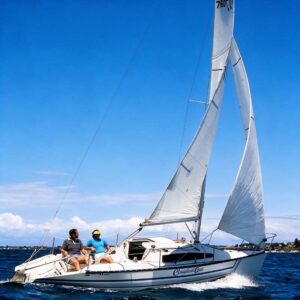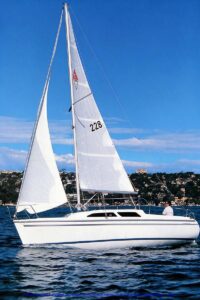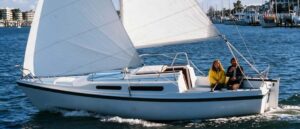
In response to the scarcity of official facilities like marinas and moorings around the Port Adelaide area in South Australia, boat designer Clive Ragless created the Flinders 7.8. Ragless recognized that many existing maxi-trailer yachts were too race-focused. He aimed to build a trailerable vessel around the 25-foot mark that offered easy and safe sailing, comfortable standing headroom below decks, a deep dry cockpit, and internal diesel power. Named after explorer Matthew Flinders, the 7.8-metre shoal-draft trailer yacht was first showcased in late summer 1978 before being transported to Sydney for the on-water sailboat show.
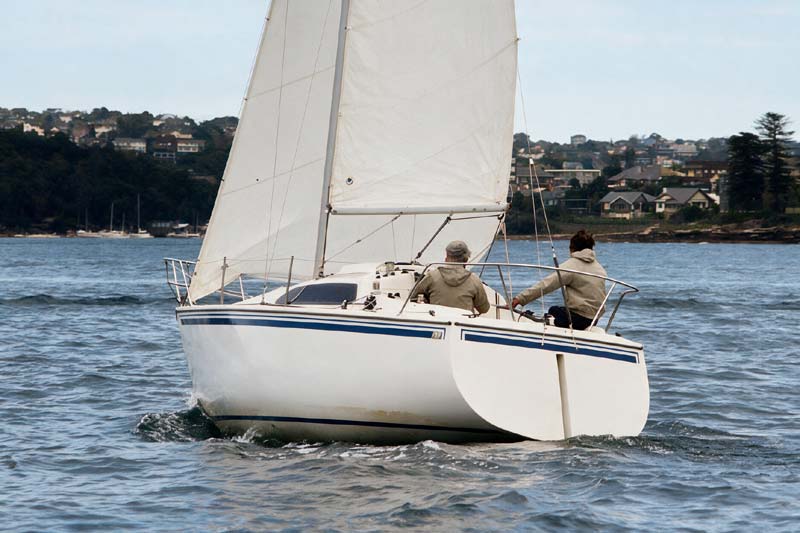
The vessel features a distinctive wedge-shaped cabin top, a high profile forward of the cockpit, and a reverse transom without a traditional rudder gudgeon, giving it a big-yacht appearance. Placing the engine well forward allows space for a deep, self-draining, and comfortable cockpit. An inboard 8 hp Yanmar diesel engine fits under the cockpit floor, providing low fuel consumption, safety, and a quieter ride compared to an outboard motor. The boat achieves stability through a broad 8 ft 2 in beam paired with a ballasted lifting keel, drawing between 0.38 metres (1 ft 3 in) with the centreboard raised and 1.52 metres (5 ft) when lowered. The lead-moulded ballast within the bottom two feet of the keel weighs 362.9 kg (800 lb).
Under sail test conditions, the Flinders 7.8 performed reliably, proving to be dry and responsive on both reaches and runs. It features a conventional masthead rig with a large Number One genoa and full-sized mainsail. While its ballast-to-displacement ratio is lower than the typical 30 percent centreboarder standard, causing it to lean in strong breezes if sail area is not reduced, its broad aft beam provides ample buoyancy to comfortably accommodate passengers in the cockpit. On deck, it is equipped with long genoa tracks, cabin top winches, a five-to-one mainsheet system, an X-section traveller, and a deep self-draining anchor well on the foredeck.
The interior is built around complete sets of interior mouldings, featuring an Airex core in the layup up to the waterline for added hull strength and insulation. The cabin provides reasonable standing headroom in the main saloon, tapering to roughly five feet forward of the mast, and accommodates up to five people across two quarter berths, two settee berths, and a fore-berth. The galley area includes a two-burner stove, a sink with running water, a double icebox with a drain, and teak trim around lockers and mouldings. The centreboard mechanism is located well forward and operated via a chain hoist with a hand-operated cabin clamp, leaving the interior space uncluttered. The transom-mounted rudder system includes a protective skeg forward of the propeller to prevent damage during beaching or grounding (Hill 1979, pp. 76-78).
SPECIFICATIONS
* Built by: Explorer Yachts Constructions, Richmond S.A.
* Designed by: Clive Ragless
* LOA: 7.8m (25ft 8in)
* LWL: 6.6m (21ft 8in)
* Beam: 3.04m (8ft 2in)
* Draft, min: 0.38m (1ft 3in)
* Draft, max: 1.52m (5ft)
* Displacement: 1.36 tonnes (3,000lb)
* Ballast: 362.9kg (800lb)
* Mast height: 8.84m (29ft)
* Auxiliary: 8hp Yanmar diesel, range 240 miles at 6 knots
* Price, basic assembly: $8872
* Price, sail away with 8hp Yanmar: $17,765 (1979)
Source: Hill, James (1979) ‘Sail Report – Flinders 7.8: Maxi for Modern Explorers’ Seacraft, March, pp. 76-78.
Historical photograph reproduced for identification and historical research purposes. Copyright remains with the original rights holder.
Quick tip: Keep in mind that trailer sailers can vary quite a bit, even within the same class. Take the RL28, for example: they might not all have outboard wells as designed. Some originally may have had inboard engines, and when those were removed, the owners swapped them for a standard outboard mounted on the stern.