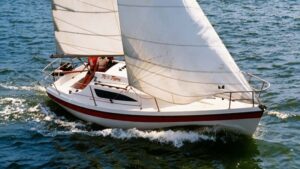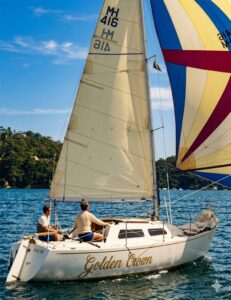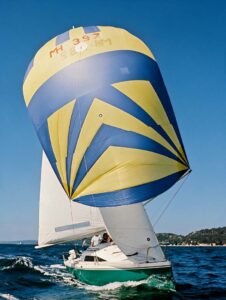
Sailing tests with Sailing Scene owner Kerli Corlett are always full of high spirits, as he confidently sets spinnakers even in harsh weather conditions that would force other boat dealers to reef or cancel entirely. This immense trust stems from his long experience with Greg Elliott-designed trailer sailers. During a previous test sail in 1991 aboard an Elliott 5.9 day racer, a 40-knot westerly squall knocked the vessel completely flat, leaving the mast tip inches from the water and seawater pouring into the cockpit. Boarding the new Elliott 770 on a rough Pittwater brought back a sense of familiar anticipation with its larger hull, taller rig, and bigger spinnaker. Sure enough, during a black nor-easter, the helm lost steering control, the boat careened onto its gunwale with the boom skimming the water, and the vessel settled temporarily at an 80-degree heel while the crew held on for safety.
Despite the severe knockdown, the boat’s structural design proved remarkably resilient. Trapped under the squall, the hull shuddered as the tall rig fought the heavily ballasted bulb centreboard until the vessel began to right itself. At a 45-degree angle of heel, the rudder regained control, allowing the skipper to bear away, trim the sails, and resume high-speed sailing completely undamaged. The wipeout was the result of crew error rather than a design flaw. When the crew properly anticipated incoming gusts, the trailer sailer planed smoothly over the waves like a skiff, spraying thick sheets of water from the bow and hitting speeds in the low teens with ease.
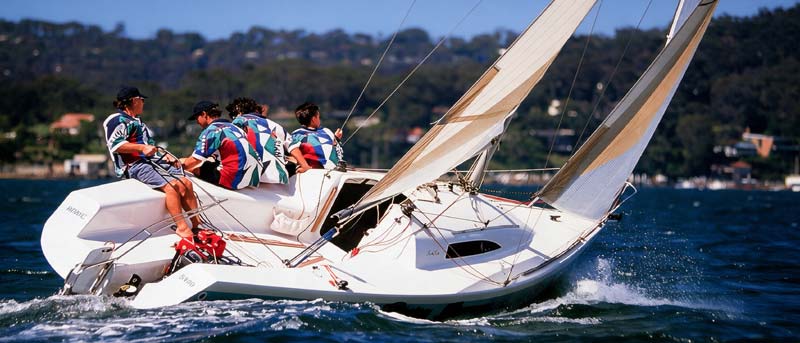
The boat’s upwind performance was equally strong, reaching speeds of around six knots while pointing high into the wind. Managing the main sail and tiller required weight positioned out wide on the gunwale, and the small, easily managed headsail made tacking swift and efficient. During a twilight race on Pittwater against a diverse fleet, the Elliott 770 started near the back but quickly worked its way through the fleet to reach third place at the windward mark, ahead of a rival Elliott 780 built by Darren and Nicky Schofield. After a fierce, 50-minute back-and-forth race where the two boats repeatedly traded the lead during wind gusts, the 780 edged out the 770 at the finish line by half a boat length, equal to just two seconds.
Commissioned by Corlett, the Elliott 770 was designed to offer competitive one-design racing alongside live-aboard facilities for occasional weekend cruising. It bridges the gap between the daysailer-focused Elliott 7 and the more expensive, complex development class of the Elliott 780. Visually, the 770 shares the hull shape of the Elliott 7, utilizing the same deck layout but extending the bow and stern to add 70 centimetres to the cockpit length. The hull features a narrower waterline, increased rocker, 110 kilograms more ballast, and roughly 30 percent more sail area. These changes give it the stable, powerful feel of a small yacht rather than a dinghy, while remaining easier to operate than the 780 by specifying a smaller racing crew of four people instead of six or seven.
The rig setup, designed by Steve Kiely, consists of a single set of swept-back spreaders on a spun-tapered Goldspar mast without a backstay or running backstays. An asymmetric spinnaker is launched via a retractable bow pole system, which feeds into a carbon fibre sprit to route water through the anchor locker where it drains away safely. Below deck, the interior is minimal but provides enough space for weekend family trips. It includes a floor-to-ceiling centreboard trunk, a single-burner stove to port, a plastic sink to starboard, a cooler under the companionway steps, a portable toilet between the forward berths, and space to sleep up to six people, though four adults fit most comfortably.
Deck hardware features a tailored blend of Ronstan and Lewmar fittings. Improvements over early prototypes include a shortened, covered outboard well that prevents steering interference and a dedicated cockpit locker for the fuel tank. Built using E-glass and Klegecell foam with reinforced bottom glass for trailering, the hull integrates a structural internal liner and an epoxy-bonded hull-to-deck joint. It can easily be towed behind standard family cars. Positioned performance-wise and price-wise between the Elliott 7 and 780, the Elliott 770 offers an ideal balance of fast class racing and lightweight cruising capability (Rothfield).
SPECIFICATIONS:
* Model: Elliott 770
* Designer: Greg Elliott
* Rig Designer: Steve Kiely
* Sailmaker: David Eichmeyer (Performance Sails)
* Builder: New Yachts (Melbourne, Australia)
* Dealer: Sailing Scene
* Length Overall (LOA): 7.70 m
* Beam: 2.50 m
* Draft: 0.55 m / 1.60 m
* Displacement: 820 kg
* Ballast: 350 kg
* Total Dry Towing Weight: 1,400 kg
* Main Sail Area: 27.3 sq m
* Genoa Sail Area: 14.2 sq m
* #2 Jib Sail Area: 11.15 sq m
* Spinnaker Sail Area: 65 sq m
Source: John Crawford Marine. “Elliott 700” Trailer Sailer Library. Accessed October 29, 2026.
https://www.johncrawfordmarine.com.au/advice/trailer-sailer/elliott-770
Photograph reproduced for identification and historical research purposes. Copyright remains with the original rights holder.
Quick tip: Keep in mind that trailer sailers can vary quite a bit, even within the same class. Take the RL28, for example: they might not all have outboard wells as designed. Some originally may have had inboard engines, and when those were removed, the owners swapped them for a standard outboard mounted on the stern.