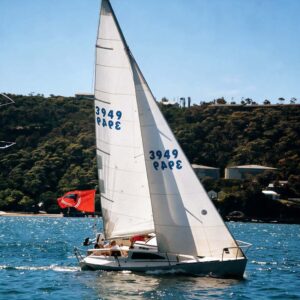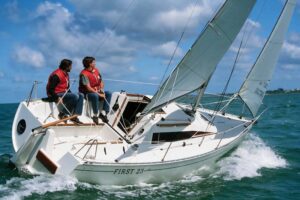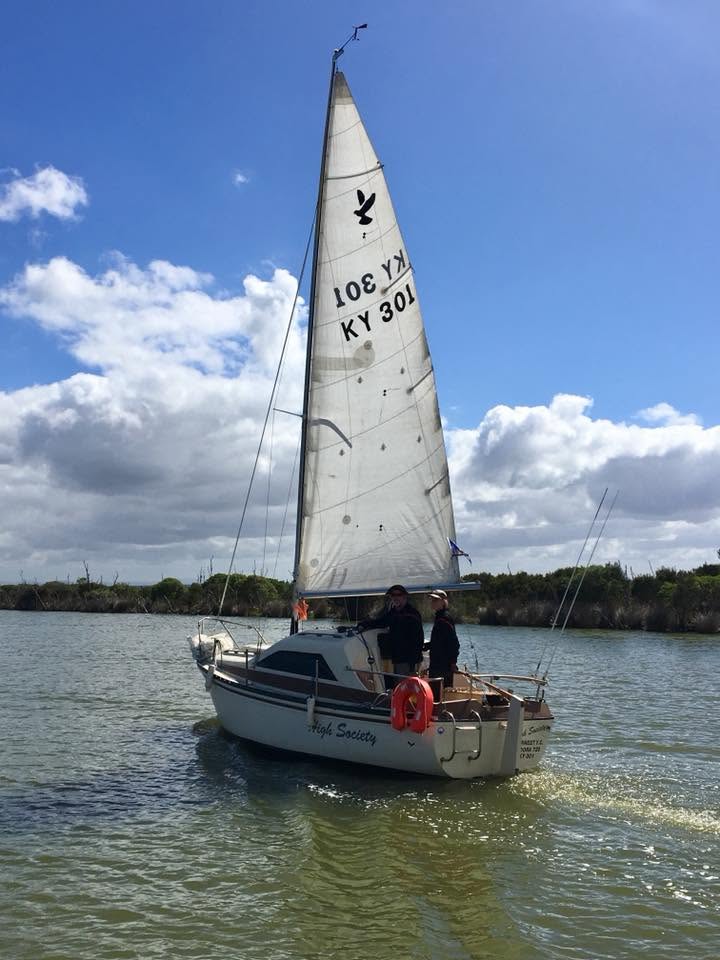
The Aloora 720 trailer sailer originated from a challenging design brief presented to Victorian yacht designer Ossie Whittley by a group of six sailors looking to purchase their ideal vessel. They requested features typically found on much larger 30-foot boats, such as standing headroom, six berths, a spacious galley, a dedicated shower compartment, seaworthiness, and good performance in light winds, all built into a compact 23-foot hull that would be easy to tow and handle.
Despite the traditional tradeoff between speed and interior space, Whittley came out of semi-retirement to draft a successful compromise. Aloora Marine was involved in the first six units built. The boat was initially built on demand via word-of-mouth recommendations in Melbourne, where it sold steadily for five years before expanding into northern states. Whittley owned the moulds and built the majority to order.
Visually, the Aloora 720 gives the impression of being exceptionally spacious for its size, heavily prioritizing cruising comfort. To maximize interior headroom and volume, the cabin trunk is built notably high above the gunwale, extending into the cockpit space and leaving the cockpit under two meters long. A full-length dark accent stripe is used visually to soften the high cabin profile. While the initial MkI cockpit was somewhat tight and required the skipper to sit on a stainless steel coaming rail to see over the cabin roof, subsequent updates redesigned the space to accommodate six people more comfortably with a standard coaming and pushpit arrangement.
The cockpit includes several functional features designed for ease of use. Its floor is contoured so crew members can easily maintain foot support, and an integrated central outboard well houses a Honda 9.9hp motor that can be raised and lowered via a tackle system. This motor position keeps the propeller deep in the water to prevent cavitation while pitching, and ventilation through the transom allows for a sound-dampening hatch cover. There was also a Lug sail version with mainly inboard Drofin Diesels and this accounted for nearly half the boats built.
Storage is catered for with a large locker that keeps sails and gear out of the main cabin. Additionally, the mainsheet is mounted above the curved companionway, and all halyards and control lines are led back from the mast for easy access.
The boat’s twin bilge keels are operated by a stern-mounted hand crank requiring 20 turns to fully raise or lower. A patented rod and pulley linkage system runs through the settee berths, integrating the keel cases into the seating to strengthen the hull while keeping the main floor layout open and uncluttered. To stabilize the high-cabin design, 350kg of ballast is housed within the keels, with an additional 140kg of internal ballast added to MkII models to trim the bow down and reduce leeway drift. On the water, the boat demonstrates pleasant, manageable handling and decent light-wind capability, enhanced by an owner-installed racing setup that included a twin-foil headstay, racing mainsail, three headsails, and a spinnaker.
There are two models, the Mk1 which has lighter keels and the Mk2, the Mk2 was a better sailer than the Mk1 by all accounts.
* Designer: Ossie Whittley.
* Headroom: Full standing headroom
* Interior Accommodations: 6 berths, large galley, separate head/shower compartment, open floorplan
* Cockpit Capacity: Redesigned to seat 6 people; cockpit length under 2 m
* Auxiliary Power: Honda 9.9 hp outboard engine mounted in a centerline well with tackle lift system and sound-dampening hatch cover
* Ballast & Keel System: Dual retractable bilge keels operated by a stern crank handle (20 turns); 350 kg keel ballast; 140 kg internal ballast added in MkII models
* Rigging & Sail Controls: Mainsheet attached above companionway; control lines and halyards led aft to cockpit; optional setup included twin-foil headstay, spinnaker, racing mainsail, and three headsails
* Reporting Journalist: Mark Rothfield
Source: John Crawford Marine. “Aloora 720” Trailer Sailer Library. Accessed October 19, 2026. https://www.johncrawfordmarine.com.au/advice/trailer-sailer/aloora.
Specifications:
• Manufacturer: Aloora Marine Somerville, VIC
• Model: Aloora 720 Mk1
• Hull Material: Glass Reinforced Plastic (GRP)
• Length Overall (LOA): 7,020 mm
• Waterline Length (LWL): 6,126 mm
• Maximum Beam (BM MAX): 2,458 mm
• Rated Beam (BM RATED): 2,396 mm
• Standard Hull Mass: 1,330 kg (Note: Most owners add ~150 kg of ballast to match Mk II specifications, bringing total mass to around 1,500 kg)
• Draft: 300 mm (keels up)
• Ballast: 350 kg (housed within keels; total mechanism weight is 350 kg)
• Main Sail Area: 13.9 square meters
• Genoa Sail Area: 13.6 square meters
• Spinnaker Sail Area: 36.0 square meters
• Mast: 8.9 m LOA, 7/8 rig, single-spreader Yachtmast 4C tapered section
• Keel Type: Twin aerofoil retractable bilge keels (23 turns to lift)
• Engine/Auxiliary Power: Steerable Honda 4-stroke in well with custom lift system and external exhaust (or optional diesel)
• Accommodation: 2 double berths, 2 single berths (~6 ft headroom)
• Galley: 2-burner spirit stove, stainless steel sink, electric water pump, workspace, 2 cupboards
• Head: Marine head with holding tank, hand basin, shelves
• Storage: Under-cockpit roll-out icebox, under-bunk storage, port sail locker, 2 fuel/fender lockers
• Trailer: Custom-built tandem galvanized steel trailer (Approx. 540 kg)
Specifications:
• Manufacturer / Distributor: Aloora Marine (Somerville, Victoria)
• Model: Aloora 720 Mk II
• Hull Material: Glass Reinforced Plastic (GRP)
• Length Overall (LOA): 7,020 mm
• Waterline Length (LWL): 6,050 mm
• Maximum Beam (BM MAX): 2,458 mm
• Rated Beam (BM RATED): 2,396 mm
• Total Mass: 1,520 kg
• Draft (Keels Up): 300 mm
• Draft (Keels Down): 1,130 mm
• Internal Ballast: 150 kg (lead shot)
• Total Ballast: 500 kg (including keels)
• Keel Specifications: Twin aerofoil retractable bilge keels (23 turns to lift; total weight with mechanism is 350 kg)
• Main Sail Area: 13.9 square meters
• Genoa Sail Area: 13.6 square meters
• Spinnaker Sail Area: 36.0 square meters
• Mast: 8.9 m LOA, 3/4 rig, Goldspar spun-tapered single-spreader section, elevated tabernacle with Highfield lever system
• Auxiliary Power: Honda 9.9 HP 4-stroke engine in well, steerable, tackle lifting system, external exhaust, motor cover usable as cockpit table
• Accommodation: 2 double berths, 2 single berths, ~1.8 m (6 ft) headroom, seating for 8+ in cabin, swing-away table seating 7
• Galley: 2-burner spirit stove, stainless steel sink, electric water pump, ample working area, 2 spacious cupboards below
• Head / Ensuite: Starboard forward ensuite, marine head, large forepeak holding tank, hand basin, shelving, anchor locker bilge pump for waste transfer
• Storage: Under-cockpit roll-out icebox, under-bunk storage, main cabin side pockets, forward berth shelf, ensuite shelves, port sail locker, 2 fuel/warp/fender cockpit lockers, large anchor well
• Trailer: Custom-built tandem steel galvanized trailer (Approximate weight: 480 kg)
Aloora Marine. (n.d.). Aloora 720 Mk I and Mk II specifications [Brochure]. Aloora Marine, Somerville, VIC.
Historical photograph reproduced for identification and historical research purposes. Copyright remains with the original rights holder.
Quick tip: Keep in mind that trailer sailers can vary quite a bit, even within the same class. Take the RL28, for example: they might not all have outboard wells as designed. Some originally may have had inboard engines, and when those were removed, the owners swapped them for a standard outboard mounted on the stern.