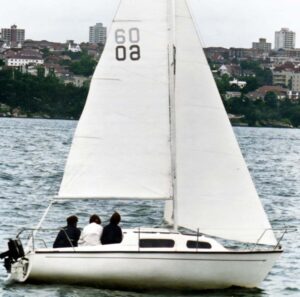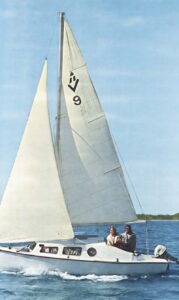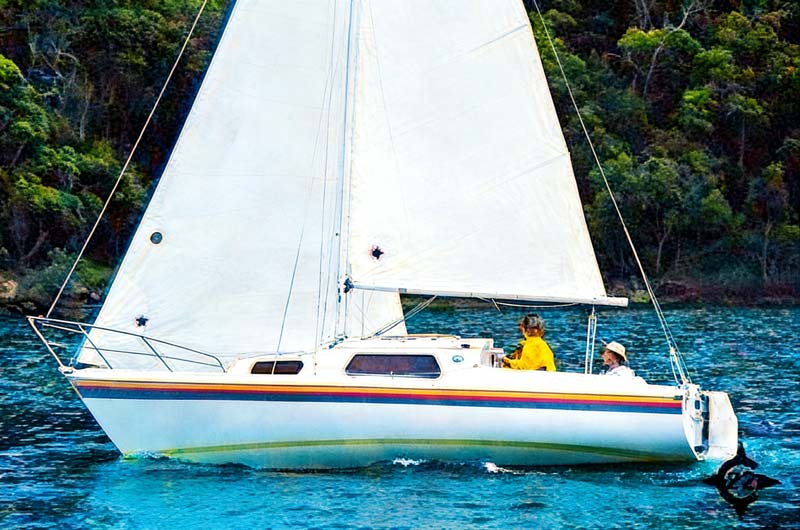
The Compass Careel is a redesigned Duncanson 18 with everything that opens and shuts.
According to Compass Careel retailer David Rose, the most significant changes to the yacht resulted from both the passage of time and a change in manufacturing. The revised production methods ensured a more consistent standard of construction, with each boat leaving the mould to the same quality as the one before it.
Construction techniques were also refined. The centreboard case became an integral part of the hull moulding, reinforced with marine plywood and fibreglass for added strength. A redesigned hull incorporated a gently curved transom, eliminating the need for screws where the hull and deck mouldings joined.
Numerous practical improvements were introduced. The original teak coamings were replaced by moulded coamings with integrated winch pads, reducing maintenance while improving comfort. Other additions included a foam-insulated icebox draining into the self-draining cockpit, a stronger and more attractive pushpit, a dedicated fuel locker for a five-gallon tank, and a block-and-tackle centreboard system that replaced corrosion-prone winches. A centreboard locking mechanism was also fitted, preventing the board from retracting into the case if the yacht was knocked down.
Further refinements included an efficient roller-reefing system proven in offshore racing, an insulated cabin roof, improved interior finishes with no exposed fibreglass, a teak mast support replacing galvanised pipe, and a completely redesigned interior moulding with provision for a marine toilet. Larger cabin windows improved visibility, while additional timber and plywood reinforcement in key structural areas enhanced both strength and seaworthiness.
Rose also highlighted a specially designed self-draining cockpit, upgraded teak interior panelling featuring cup racks and a fold-down stove arrangement, removable flotation that allowed easier access to deck fastenings, and a noticeable reduction in weather helm.
Non-skid surfaces were positioned where they were most needed. The Interior work was considered exceptional, with cabin joinery and finishing setting the Careel apart from many competitors.
The centreboard case had been made wide enough to accommodate a heavier board if required. As a result, the standard centreboard had excessive clearance and tended to move about in light winds, creating noise and reducing efficiency.
Aside from this minor issue, the Careel as close to ideal. Compared with many trailer sailers of the period, it offered an unusually high level of comfort and equipment, justifying its price of around $4,500 [1971 prices] complete with trailer, outboard motor on transom, toilet, and a range of extras.
For buyers seeking a more economical option, a basic sailing version without interior fit-out was available for just under $3,000, while a hull-and-deck package costing approximately $1,730 allowed owners to complete much of the finishing work themselves.
While Australia offered many excellent trailer sailers, the Compass Careel 18 stands alone as a genuinely luxurious example. With comfortable accommodation, tasteful furnishings, and high-quality craftsmanship, it provided a level of refinement rarely found in a trailerable yacht. Although some sailors might choose a similarly priced deep-keel yacht, the Careel offered one major advantage: when the weekend was over, it could be taken home on its trailer (Hopkins 1971: 39).
Specifications:
-
MODEL: Compass Careel, luxury trailer sailer
-
BUILT FOR AND SOLD BY: David Rose Yachts Pty Ltd, 11 Currawong Ave, Palm Beach, NSW, 2108.
-
LOA: 18 ft 5 in.
-
BEAM: 7 ft 5 in.
-
DRAFT: board up, 1 ft; board down, 4 ft
-
DISPLACEMENT: 1200 lb
-
MAST HEIGHT: 23 ft
-
CENTREBOARD WEIGHT (standard): 140 lb (Deep keel also available.)
-
SAIL AREA: Main 134 sq ft; genoa 112 sq ft; jib 61 sq ft; storm jib 28 sq ft.
-
FIBREGLASS construction throughout. TEAK TRIM down below.
-
DECK AND CABIN INSULATED with foam between glass.
-
BASIC ASSEMBLY (with interior moulding): $1730
-
BASIC SAILING (main and jib included): $2895
-
DE LUXE MODEL: $3095 (with some accommodation work)
-
OPTIONAL EXTRAS: $1038 (anchors/toilet/stove/trailer/etc)
-
SIX HP Outboard Motor: $360
-
AS TESTED: $4500 (1971)
Source: Hopkins, Paul (1971) Seacraft, June, p. 39.
See also: Duncanson 18


Careel 18 Mk II
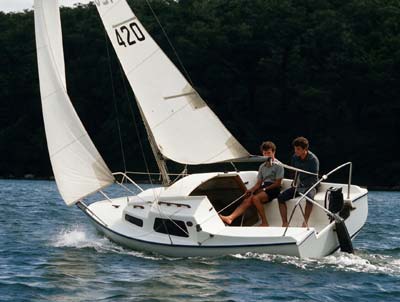
The Careel 18 stands as one of Australia’s most enduring and highly successful small trailer-sailers, achieving sales of well over 400 units in the eleven years following its initial release. Originally designed by John Duncanson of Adelaide, the vessel underwent extensive modifications and refinements over time by its builder, David Rose, who also produced the popular Careel 22. The Mark II version represents the first major facelift in the model’s production history, featuring entirely new moulds, expanded interior volume, ballast positioned lower in the hull, and an updated rudder system.
The hull exhibits a distinct wedge shape that carries its full beam clear to the stern, paired with rounded underwater sections and a small skeg to assist with tracking. Below deck, the cabin top was raised by 50mm to provide comfortable sitting headroom. The interior layout substitutes the traditional forward V-berth for back-to-back settees that provide more than five meters of total sleeping length along each side. This arrangement can accommodate four adults overnight or give a family of two adults and two children ample room to maneuver. The centreboard case extends from the cockpit to the mast step and features folding teak drop-leaves that serve as a dining table. Positioned in the bow, the toilet compartment can be curtained off for privacy; when not in use, a timber cover converts it into a sturdy foothold to access the spacious forward hatch. Domestic amenities include a portable stove stowed within the cabin liner for cockpit use, a sliding sink designed to tuck away beneath the cockpit, a bulkhead-mounted water pump, forward water storage tanks, and a fully insulated, self-draining icebox located in the cockpit.
On deck, the Careel 18 MK II offers a remarkably spacious cockpit featuring 1.8 meters of floor space, enabling two people to sleep on the sole beneath a boom tarp. The cockpit area remains clean and uncluttered, equipped with toe-rails for support while under sail and extra-long seats suitable for hosting larger groups. Non-skid surfaces cover most of the foredeck, cabin top, and cockpit area, while the sliding companionway hatch is reinforced with timber to allow crew members to stand safely upon it.
The boat utilizes a fractional rig featuring two forestays and two shrouds, dispensing with both a backstay and mast spreaders. The outer forestay typically accommodates a headsail furling system, while the inner baby stay prevents the mast from bending backward. To keep the cockpit space unobstructed, the mainsheet attaches to a sliding block mounted directly on the stern pushpit. Depth control relies on a solid daggerplate housed inside a fixed case, operated via a horizontal trailer-type winch in the cockpit. By leading the winch wire directly to the top of the board, the system avoids wire exposure underneath the boat, eliminating vibration hum while allowing a locking rope to hold the board down securely. Finally, the updated rudder features a stainless steel fabrication with a fully adjustable tiller that can be tied off vertically against the pushpit when anchored or moored to maximize usable cockpit space.
Specifications & Key Details:
– Length Overall (LOA): 5.6 m
– Beam: 2.26 m
– Draft: 0.3 m (board up) / 1.2 m (board down)
– Displacement Weight: 607 kg
– Ballast: 186 kg (centreboard daggerplate, approx. 32% ballast ratio)
– Hull Type: Wedge-shaped hull carrying full beam to stern, rounded underwater sections, small skeg
– Rudder: Transom-hung, stainless steel fabrication, tilts for trailering, vertical tiller tie-off capability
– Rigging: Fractional rig, 2 forestays (outer furling, inner baby stay), 2 shrouds, no backstay or spreaders, pushpit mainsheet traveler
– Centreboard Mechanism: Winch-operated solid daggerplate, top-mounted wire feed with board-locking rope feature
Source: ‘Careel 18 MKII’ Australian Boating, December, 1981, p. 81.
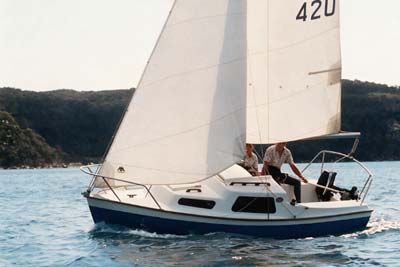
Historical photographs reproduced for identification and historical research purposes. Copyright remains with the original rights holder.