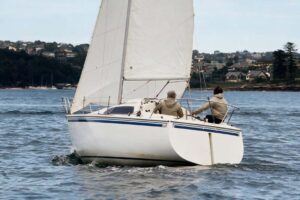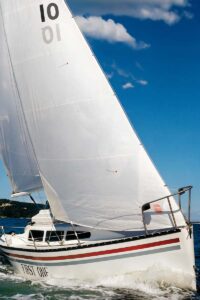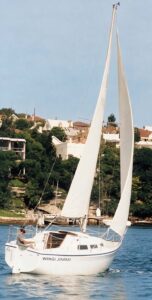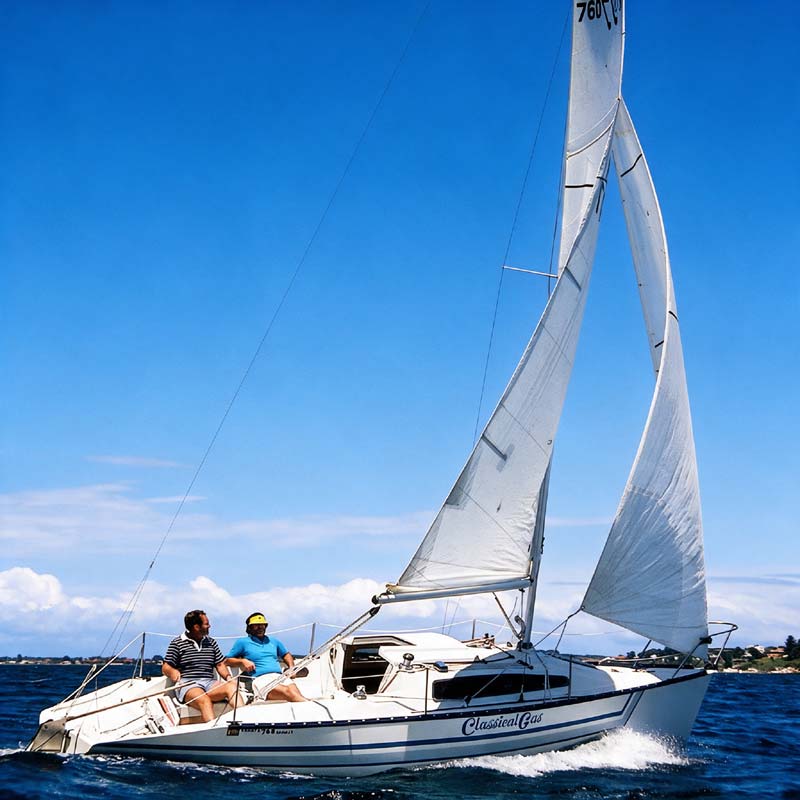
The Sonata 760 Sport represents an upgraded evolution of its predecessor, the Sonata 6.7. Introduced to the market in early 1987, the vessel has demonstrated exceptional performance capabilities, frequently outracing trailer sailers under ten meters in length when traveling downwind and surpassing larger keelboats during upwind legs. Built by Glass Tech Industries in Newcastle, the hull extension of ninety centimetres is integrated so seamlessly into the original design that the manufacturing quality conceals the boat’s origins. While the interior arrangement from the companionway forward remains very similar to the 6.7, the redesign fully utilizes the added length in the cockpit area and sail rig.
A significant improvement in the 760 Sport’s engineering stems from its construction materials and ballast distribution. Utilizing a Divinycell high-density foam sandwich construction for both the hull and deck lay-up, with the bottom hull section reinforced to a fifteen to sixteen millimetre sandwich layer, the manufacturer achieved a lighter, significantly stiffer structure. Combined with relocating all ballast into the vertical drop keel and increasing the working sail area by twenty-five percent, the three-quarter rig takes full advantage of the extended waterline, delivering impressive speed across all points of wind. Practical additions include an inboard motor well featuring a bottom plug to eliminate drag when the outboard is not in use, alongside a venturi system that quickly clears any accumulated water.
During performance testing in a Lake Macquarie Yacht Club non-spinnaker race, the vessel showcased its design strengths under tight wind conditions of twenty to twenty-five knots. Carrying a No. 1 genoa and operating short-handed with a three-person crew, the boat demonstrated remarkable responsiveness. On broad reaches, proper fore-and-aft weight distribution allowed near-instant acceleration to seven knots. Downwind legs yielded average speeds of seven and a half knots, touching eight and a half knots at peaks while maintaining light, positive steering. The flat-bottom hull profile with firm bilges prevented rolling, while upwind legs proved the boat’s stability despite being over canvassed, dipping its gunwales only occasionally without severe weather helm or rounding up.
The deck hardware and control systems offer strong functionality, though a few minor area improvements exist. The wide traveller, boom vang, and backstay provide extensive control over sail shape, while translucent Mylar on the genoa improves visibility in forward blind spots. The drop keel system utilizes a folding tackle cradle to prevent interference with the vang, supported by a locking pin to secure the keel when fully lowered. Side decks are wide enough for easy movement, complemented by a sturdy mooring cleat, bow roller, side-hinged anchor locker, and an aft-hinged forehatch fitted with security bars. Suggested modifications include re-angling sheet winches for easier handle insertion during heavy heel, applying non-skid paint over the moulded deck surface, choosing off-white deck colours to minimize solar glare, strengthening pop-top support struts, and capping the forward edge of the narrow bridge deck to limit line chafe. Inside, the cabin retains the functionality of the 6.7, adding a low-profile sub-bulkhead for chainplate support, a pop-top with a Perspex hatch for standing headroom, and a detachable galley table (Norton, Andrew).
Specifications:
* Length Overall (LOA): 7.6 m
* Length at Waterline (LWL): 6.2 m
* Beam: 2.5 m
* Draft: 1.55 m / 0.2 m
* Displacement: 900 kg
* Ballast: 290 kg (vertical drop keel)
* Working Sail Area: 28.5 m²
* Construction: Divinycell high-density foam sandwich hull and deck
* Distributor: Pacific Sailboat Centre, Newcastle
Source: John Crawford Marine. “Sonata 760” Trailer Sailer Library. Accessed November 6, 2026.
https://www.johncrawfordmarine.com.au/advice/trailer-sailer/sonata-760
Photograph reproduced for identification and historical research purposes. Copyright remains with the original rights holder.
Quick tip: Keep in mind that trailer sailers can vary quite a bit, even within the same class. Take the RL28, for example: they might not all have outboard wells as designed. Some originally may have had inboard engines, and when those were removed, the owners swapped them for a standard outboard mounted on the stern (Hill, James).