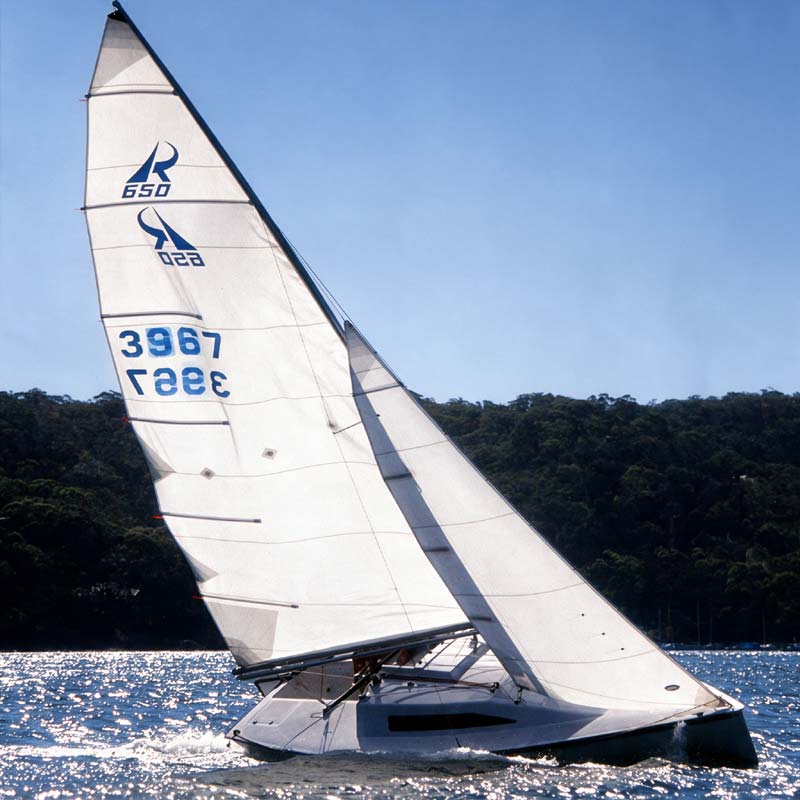
The Ross 650 represents an ultra-dinghy style trailer sailer designed for speed enthusiasts seeking an all-out racing experience. Functioning as a smaller sibling to the highly successful Ross 780, the 650 offers similar high performance in a more affordable package that is easier to tow with a standard motor vehicle. Its design maximizes waterline length and eliminates unnecessary cosmetic weight by utilizing a square bow, a wide rounded stern, and a wide, powerful hull. Built with a Divinycell foam sandwich core in both the hull and deck, the vessel achieves a light dry weight of 670 kg. Its ballast is split between a modest 91 kg in the lifting daggerboard and approximately 132 kg glassed into the hull floor near the centrecase and mast base. To perform effectively in strong winds, the powerful rig relies heavily on crew weight as dynamic human ballast positioned on the weather rail.
On-water testing of the Ross 650 demonstrates its exceptional speed, particularly on reaching and running legs, where it transitions smoothly from a displacement hull to a fast planing state. Downwind under spinnaker, speeds exceeding 14 knots have been achieved in New Zealand. The boat features a rounded underbody with fore-and-aft rocker and a flat section along the bottom that fades near the transom, making it well-suited for both light and heavy air. Its fractional sloop rig features a simple setup without lower stays, backstays, or runners, using a tapered Hutchinson spar, a large boom section, and a full-width mainsheet traveller. Standard deck features include headsail sheet winches, a sliding companionway hatch, a forward anchor locker, a glass-topped Passport hatch forward of the mast, and halyards led aft to jammers. Standard safety lifelines provide security when hiking out on the wide side decks.
Below deck, the Ross 650 offers a surprisingly open and spacious cabin for an overnight-capable racer. The interior avoids bulky fiberglass interior liners to save weight, instead utilizing a flow-coated finish. Accommodation consists of structural stainless-steel pipe-cot berths with dusty pink fabric covers and integrated zippered storage pockets. A central plywood bulkhead integrates the centrecase and mast step, dividing the main cabin from the forepeak. The port side houses a compact galley with a sink and stove, while the starboard side leads to a forepeak used for sail storage and a portable chemical toilet. Marketed as a strict one-design class similar to the J/24, the Ross 650 package includes a fully rigged boat, sails, lifelines, an outboard bracket, and a custom trailer. The design particularly appeals to former dinghy and catamaran racers stepping into high-performance trailer sailer racing (Hill, James).
Specifications:
* Overall Length: 6.5 m
* Length Waterline (LWL): 6.02 m
* Beam: 2.48 m
* Draft: 0.22 m to 1.67 m
* Dry Weight: 670 kg
* Total Ballast: 223 kg (91 kg in daggerboard + ~132 kg in hull floor)
* Hull Construction: Divinycell foam sandwich cored hull and deck
* Price (as tested/package): $22,500 ex-Sydney (approx. $23,500 fully ready for racing with trailer and basic gear)
Source: John Crawford Marine. “Ross 650” Trailer Sailer Library. Accessed November 2, 2026.
https://www.johncrawfordmarine.com.au/advice/trailer-sailer/ross-650
Photograph reproduced for identification and historical research purposes. Copyright remains with the original rights holder.
Quick tip: Keep in mind that trailer sailers can vary quite a bit, even within the same class. Take the RL28, for example: they might not all have outboard wells as designed. Some originally may have had inboard engines, and when those were removed, the owners swapped them for a standard outboard mounted on the stern.