Setting up a trailer sailer of this magnitude in just over an hour is an impressive feat. The vessel was transported from the parking area at Middle Harbour Yacht Club to the launch ramp at Roseville Bridge, located just up the harbour from Sydney’s Spit Bridge. The package comes standard with a robust, substantial trailer, though caution is required when manoeuvring because the boat’s width exceeds eight feet, pushing close to legal towing limits. Despite its size, with a dry weight on the trailer hovering just over a single ton, it remains light enough to be towed.
Rigging and launching the yacht is streamlined and remarkably user-friendly. The mast utilizes a specialized lift pole to simplify stepping the rig, and all deck hardware is organized intuitively so that assembly is straightforward. With a practiced crew of just two people, the setup process can be completed in as little as forty minutes. Marketed as a ideal hybrid offering the spaciousness of a larger vessel alongside the convenience of trailerability, the Catalina 250 retailed for around $50,000 including the trailer.
Once floating in the water, the water ballast system is engaged by opening a seacock located beneath the lowest companionway step, allowing up to 500 kilograms of water to fill the hull. Operators must also remember to open the air pressure release valve situated inside the forward anchor locker. After the air escapes and the hull fills, the pulley-assisted centreboard can be lowered manually via a control line beneath the mainsheet block in the cockpit, reaching a full depth of 1.75 meters and cleating off cleanly. This setup illustrates how racing technologies like water ballast have been successfully adapted for cruising convenience.
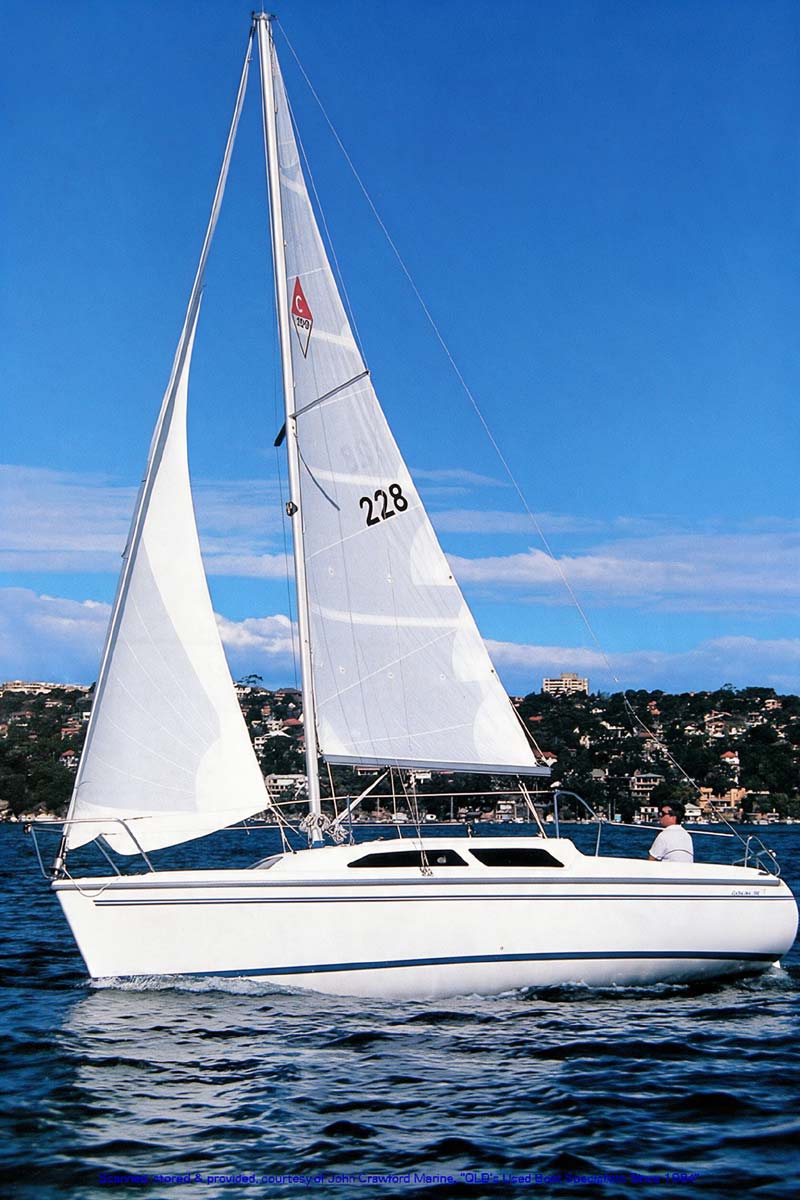
The cockpit design is exceptionally spacious for a 25-foot trailerable boat and features convenient access through the transom, complete with a ladder that is helpful when the boat is on land. Features include a Honduras mahogany tiller, cockpit storage shelves, two large lockers beneath the port and starboard seating, a manual bilge pump to port, and depth and speed instruments on the starboard coach roof. The saloon table can also be moved and mounted in the cockpit when desired, and a dedicated outboard fuel box is positioned in the aft centre. Up forward, the deck stays uncluttered with an anchor locker, a forward hatch, and two tracks along the coach roof. The short, high-set boom remains safely clear of the cockpit, while the headsail is operated via a forward furler and two Lewmar 6 winches.
Below decks, the interior maintains a big-boat feel with generous lighting provided by two spotlights and four main overhead lights. The forward open V-berth accommodates two sleepers and stows the primary saloon table underneath, while a smaller swap-in coffee table offers flexibility to seat up to six people for entertaining. To port, the head area houses a portable toilet and a spacious hanging locker, provided with cold water service. Opposite the head, the galley features a single gas burner, dual drawers, a cool box, a sink, and storage compartments below.
During a test sail from Roseville to the Spit Bridge under variable wind conditions, the Catalina 250 proved light to handle, responsive, and forgiving. Designed with simplicity and safety in mind rather than aggressive performance, it offers clear forward visibility and minimal deck clutter, making it effortless to sail short-handed or even single-handed. The mainsheet can be easily managed by the helmsman while a single crew member handles the jib. Following its international debut at the Miami Boat Show, the model achieved immediate success with 250 units sold in its first year, benefiting greatly from being half the weight of its predecessor. Overall, the Catalina 250 serves as a versatile, accessible choice for families, beginners, or experienced sailors seeking hassle-free cruising, with a fixed-keel version also available. Motor is usually on the transom.
Specifications:
* Overall Length: 25 ft 0 in (7.62 m)
* Waterline Length: 21 ft 3 in (6.48 m)
* Beam: 8 ft 6 in (2.59 m)
* Displacement (Dry): 2,400 lbs (1,089 kg)
* Water Ballast: 1,102 lbs (500 kg)
* Draft (Board Up): 1.67 ft (0.51 m)
* Draft (Board Down): 5 ft 9 in (1.75 m)
Source: John Crawford Marine. “Catalina 250” Trailer Sailer Library. Accessed October 23, 2026. https://www.johncrawfordmarine.com.au/advice/trailer-sailer/catalina-250